A harsh metallic scrape rings out against the pan – the nails-on-a-chalkboard sound that makes everybody at the table glance over. Your friend simply laughs and carries on stirring the tomato sauce with a stainless-steel spoon. Red bubbles burst over what used to be a flawless non-stick finish, now criss-crossed with pale silver marks. The meal smells wonderful, conversation continues, and the pan appears… all right. More or less.
Later, after it has been rinsed and left beside the sink to dry, the light exposes the damage mercilessly. Fine scratches. A faded ring. A darker area where the coating seems thinner, almost worn out. You shrug, put it back in the cupboard and give it no further thought.
What remains unseen is what may have made its way into your meal.
What really happens when you scratch a non-stick pan
On the surface, a non-stick pan seems almost miraculous: food does not stick, less oil is needed, washing up is simple, and eggs glide around rather than fusing to the metal. But that convenience depends on a thin, vulnerable coating bonded to the pan. Sharp metal utensils and that coating are never going to be a happy match.
Whenever a fork, knife or metal spatula is pulled across the surface, it weakens that bond. The coating may not dramatically peel away the first time. More often, tiny scratches appear: initially invisible, then barely noticeable, and eventually plain to see. Each one creates a small route through which particles may come loose and enter your food.
A single loud scrape from a fork will not immediately ruin your cookware. The issue is the supposedly one-off moment that becomes a weekly habit.
Picture a hectic weekday evening. Children are asking when dinner will be ready, your phone is vibrating on the worktop and pasta water is boiling over. You take the nearest utensil from the drawer: a metal spoon. The sauce is thick and catching at the base, so you scrape without thinking. There is slight resistance, followed by that gritty sensation of metal rubbing over the coating. You wince briefly, then carry on. Dinner matters more than the pan – it always does.
Then take a wider view. If this happens three times each week for six months, that adds up to roughly 70–80 cooking sessions in which metal has rubbed, scraped, tapped and dragged across the same delicate layer. Gradually, the glossy surface becomes dull, then uneven, and finally begins to flake at the edges.
A 2022 Australian study examined scratched non-stick pans under a microscope and found that a single damaged surface could release tens of thousands of particles. They are far too small to notice. That does not mean they are absent from the food you have just served.
The chemistry behind many traditional non-stick pans has long involved a group of substances called PFAS. They are frequently called “forever chemicals” because they break down very slowly in the environment and in the body. Older pans and lower-cost models are more likely to use these formulations, including ones related to PTFE, the well-known Teflon coating.
When the finish remains whole, the chance of exposure is much lower. The coating functions as a sealed protective layer. However, once it is scratched, chipped or overheated, that protective seal can begin to break down. High temperatures can accelerate deterioration, produce fumes and increase the release of fragments. Scratches simply make the problem easier to start.
Researchers have associated PFAS exposure generally with concerns including hormone disruption, certain cancers and effects on the immune system. A frying pan is not the only potential source, but it is one of the few that you can directly manage, right in the centre of family life: the dining table.
How to cook safely without giving up your favourite non-stick pan
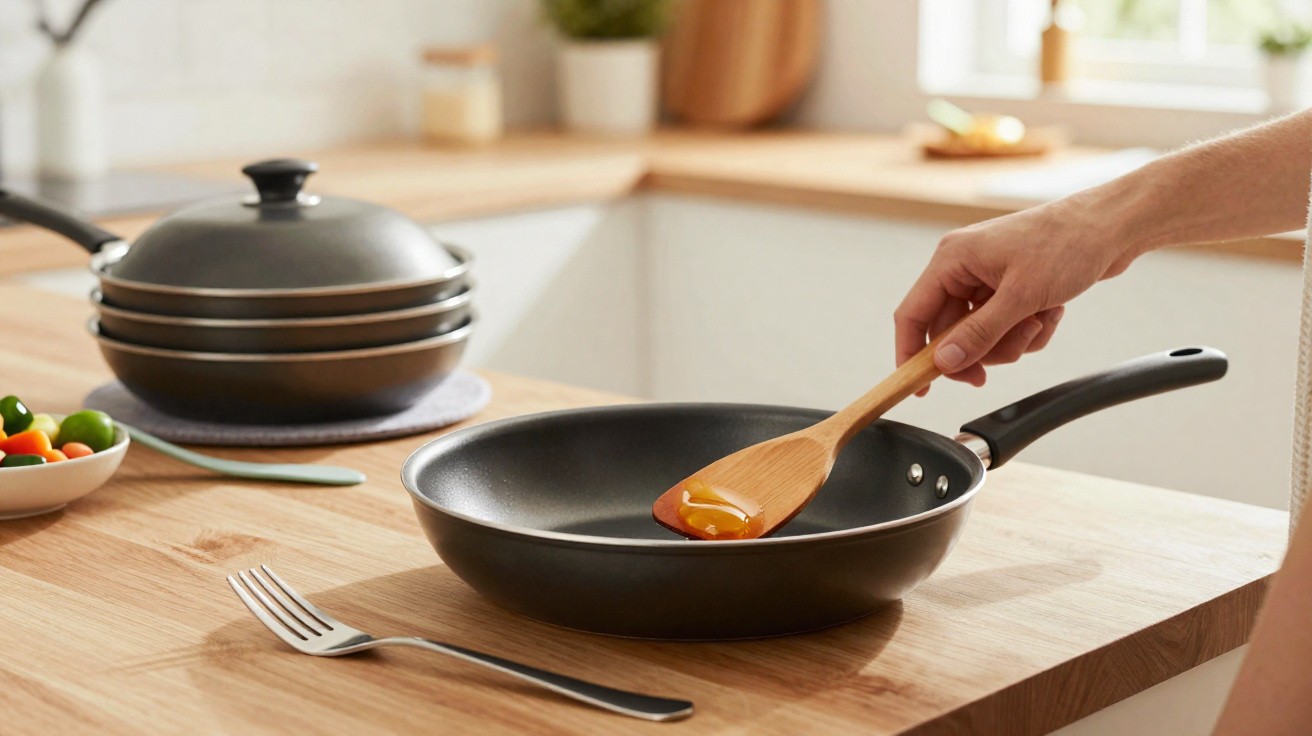
The first measure is almost remarkably simple: change the utensils you use. Create a small soft-utensil area by the hob, with a silicone spatula, wooden spoon and perhaps a nylon turner. When you are in a hurry, the safer choice will already be within reach.
Treat a non-stick pan as you would a quality phone screen. You would not deliberately run a key across it. Stir with a light touch, slide food rather than chopping at it, and allow the pan to do its job. Non-stick finishes are made to release food easily; if you feel compelled to scrape hard, turn down the heat or pour in a small splash of liquid instead.
Cleaning can also cause subtle damage. Replace steel wool and scouring powders with soft sponges, warm water and mild washing-up liquid. Soak stubborn residue instead of scrubbing at it aggressively. The aim is not to “polish” the coating – it is to preserve it for as long as you can.
Let’s be honest: nobody handles every pan like a museum piece every day. You may be balancing time, money, children and work, perhaps all at once. That is precisely why manageable everyday habits are more useful than grand promises that you will never scratch a pan again.
A straightforward visual rule helps: when the metal beneath the coating is clearly visible, the pan has served its purpose and deserves to be retired. Flaking, bubbling, or a particular area where food suddenly starts sticking are further warning signs. You would not drink from a chipped glass with sharp edges, and your cookware warrants the same natural caution.
Many people feel a quiet sense of guilt about throwing away pans, particularly costly ones. Yet holding on to a damaged non-stick surface because it “still sort of works” means accepting a gradual release of synthetic particles into meals that matter to you.
There is a mental burden too. That persistent question – “Is this pan safe?” – can creep in just when you are trying to enjoy cooking for somebody you care about. On its own, that is reason enough to improve both your habits and the utensils you use.
“Non-stick cookware was designed to make life easier in the kitchen,” says one toxicology researcher I spoke with. “The trouble starts when we treat it like cast iron. A non-stick pan can be a great servant, but it’s a terrible long-term companion once the surface is compromised.”
Keep this short mental checklist close to the cooker:
- Use wooden, silicone or nylon utensils only with non-stick cookware.
- Use low to medium heat for most dishes.
- Replace pans with visible scratches, chips or peeling.
Those three actions alone greatly reduce the risk. There are no complex routines or specialist tools required – only a modest change in how you look after the kitchen item that comes into contact with your food more often than almost anything else you own.
Rethinking non-stick pans in your kitchen
Once you view a non-stick pan as a coated utensil rather than a magical object that lasts forever, the way your kitchen works can change entirely. You can begin assigning specific jobs: stainless-steel pans for searing, cast iron for steaks, and non-stick for omelettes and pancakes, where its effortless release is genuinely useful.
This rotation shares out the work. Your non-stick pan handles fewer demanding meals, so it lasts longer and releases fewer particles. You gain better texture, improved browning and greater peace of mind. Almost without realising, you move from thinking, “I hope this is safe”, to knowing why and how you use each pan.
One small question may now remain each time a metal ladle hovers over a glossy black surface: is this stir worth the scratch? For many people, this is the point at which an ordinary kitchen action begins to look different.
| Key point | Detail | Why it matters to the reader |
|---|---|---|
| Avoid metal utensils | Rigid edges scratch the non-stick coating and release particles | Reduces exposure to chemical residues in everyday meals |
| Check the condition of the surface | Replace the pan as soon as metal shows through, or the coating peels or bubbles | Maintains an intact protective barrier between heat and food |
| Adjust heat and cleaning methods | Cook over medium heat, use a soft sponge, and avoid steel wool and abrasive products | Extends the coating’s lifespan and limits particle emissions |






Comments
No comments yet. Be the first to comment!
Leave a Comment