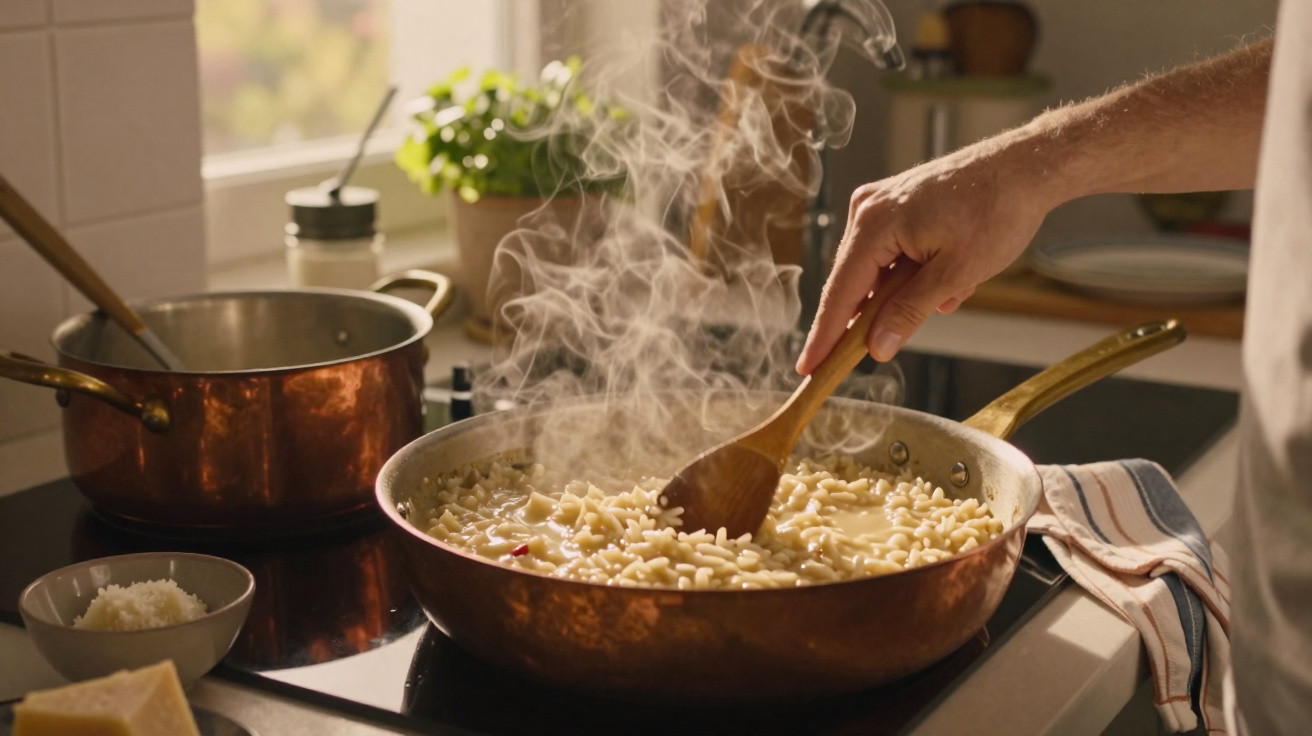
The first time you properly watch somebody make risotto, it can feel as though the entire kitchen slows to a halt. There is no haste or frantic banging of utensils, only the quiet drag of a wooden spoon moving around a weighty pan. The cook is not consulting a recipe. Instead, they watch the grains: how they expand and stick together, and how the liquid vanishes before being replenished with measured ladlefuls.
Steam mists up the window. Beneath the unbroken stirring, the rice shifts like a slow tide, drawing back before rolling forwards once more.
Nothing dramatic appears to be taking place. Yet something remarkable is.
Why slow stirring turns rice and broth into silk
Look closely at the pan and the difference is clear: the rice does not bubble away like soup; it glides. As the spoon guides it round, every grain softly nudges the next. There is no vigorous whisking or hurried beating, only a relaxed wrist and an even tempo.
By ten minutes, the rice no longer resembles a collection of distinct little pearls. At fifteen minutes, it begins to become a single, soft, living mass.
This is when risotto subtly moves beyond “rice in a pot” and becomes that iconic creamy wave.
Imagine a hectic Tuesday evening in a tiny Milan trattoria. In the kitchen, a cook stays at one broad pan without moving away. Tickets arrive, dishes leave, yet their right hand repeats the same sequence: stir, stir, pause, add stock, stir.
They might speak to the server, take a brief drink of water or laugh at a joke, but the spoon continues to circle through the rice. Diners at the front see only the finished dish: a shiny, saffron-yellow risotto that gently ripples as the waiter tips the plate.
That mesmerising creaminess does not come from loads of cheese. It largely comes from the thousands of small, unhurried movements made in the pan.
The science behind that composed wrist is remarkably straightforward. Arborio and Carnaroli rice contain plenty of starch, particularly around the surface of every grain. With slow stirring, the grains brush against one another and against the pan’s sides. This friction carefully removes a microscopic coating of starch.
That starch melts into the hot stock, turning it into a fluid, silky sauce that binds the rice together. If it remained trapped inside the grains, you would simply have swollen rice sitting in thin liquid.
Slow stirring connects these two outcomes: it frees enough starch to cover everything without crushing the grains into mush.
The right way to stir risotto (and how not to lose your mind doing it)
Rather than thinking of risotto stirring as “mixing”, treat it as steering. Take a wooden spoon or silicone spatula and make broad, unhurried circles, sweeping across the base so that nothing catches. It should feel more like folding dense cake batter than whisking an egg.
Maintain a light simmer rather than a vigorous boil. Add hot stock gradually by the ladleful, then stir gently until it has nearly been absorbed before pouring in more.
You want an easy, steady rhythm: add, stir, observe, repeat. It is almost like rocking a baby to sleep.
There is a common belief that you have to stir without interruption for 20 minutes or the whole dish will fail. That notion has put off more home cooks than undercooked rice ever has. Honestly, no one truly cooks this way every day.
What the rice actually requires is frequent, easy-going care. Stir for a minute, step aside to grate some cheese, then return and stir again. Taking a brief pause is not the problem; turning up the heat and disappearing for five minutes is.
We have all had that experience: the pan begins to smell slightly too toasted and you discover that your “resting” risotto has stuck fast to the base. Scorched starch will not become creamy. It will only taste burnt.
Risotto chef Andrea, who has stirred more pans than most of us will in a lifetime, once shrugged and told me: “People think it’s magic. It’s not. It’s just rice, heat, and respect. The spoon is how you show respect.”
- Use a wide, heavy pan
Keeping the rice in a shallow layer promotes even cooking and means you can stir without having to dig down. - Keep your stock hot
Cold broth shocks the rice and delays the release of starch. - Stir from the edges to the centre
Rice around the outside cooks sooner and helps emulsify the sauce. - Add butter and cheese off the heat
This careful stage, known as mantecatura, creates the final glossy creaminess. - Stop just before “perfect”
The middle of the rice should remain al dente. It will continue to soften while resting.
The quiet pleasure of giving a dish your full attention
There is something almost traditional about food that asks you to stand still and perform one straightforward task properly. There is no air fryer, no preset programme and no app alert announcing that the timer has ended. It is simply you, a pan and a spoon tracing patient circles.
Risotto is sometimes described as “meditative cooking”, and that is not far from the truth. Its continuous, gentle stirring makes you stay in the moment. You hear the bubbles, see the grains grow and sense the mixture thicken beneath your hand. You can’t rush it, and you can’t really multitask it.
Oddly, this “slow” approach can feel quicker than recipes packed with stages and gadgets. You are not stopping to time every last second. You cook until the rice looks right, moves right and tastes right. That is the quiet rebellion at the centre of risotto: relying on your senses rather than the packet.
When the pan finally reaches the table and the rice settles into a soft spread, almost like a puddle, you know the effort has been worthwhile. Not because it is elaborate, but because that modest bowl of rice and broth contains twenty minutes of your complete attention.
That is the real ingredient beneath the celebrated creaminess. It is not starch alone. It is attention.
| Key point | Detail | Value for the reader |
|---|---|---|
| Slow, regular stirring releases starch | Soft friction between the grains transforms broth into a silky sauce | Helps you achieve restaurant-level creaminess at home |
| Right heat and pan matter | A gentle simmer in a wide, heavy pan avoids sticking and uneven cooking | Keeps the process more relaxed, with fewer mishaps or burnt areas |
| Stop at al dente and rest | The rice continues cooking off the heat as butter and cheese emulsify | Produces a risotto that flows across the plate rather than sitting in a firm heap |








Comments
No comments yet. Be the first to comment!
Leave a Comment