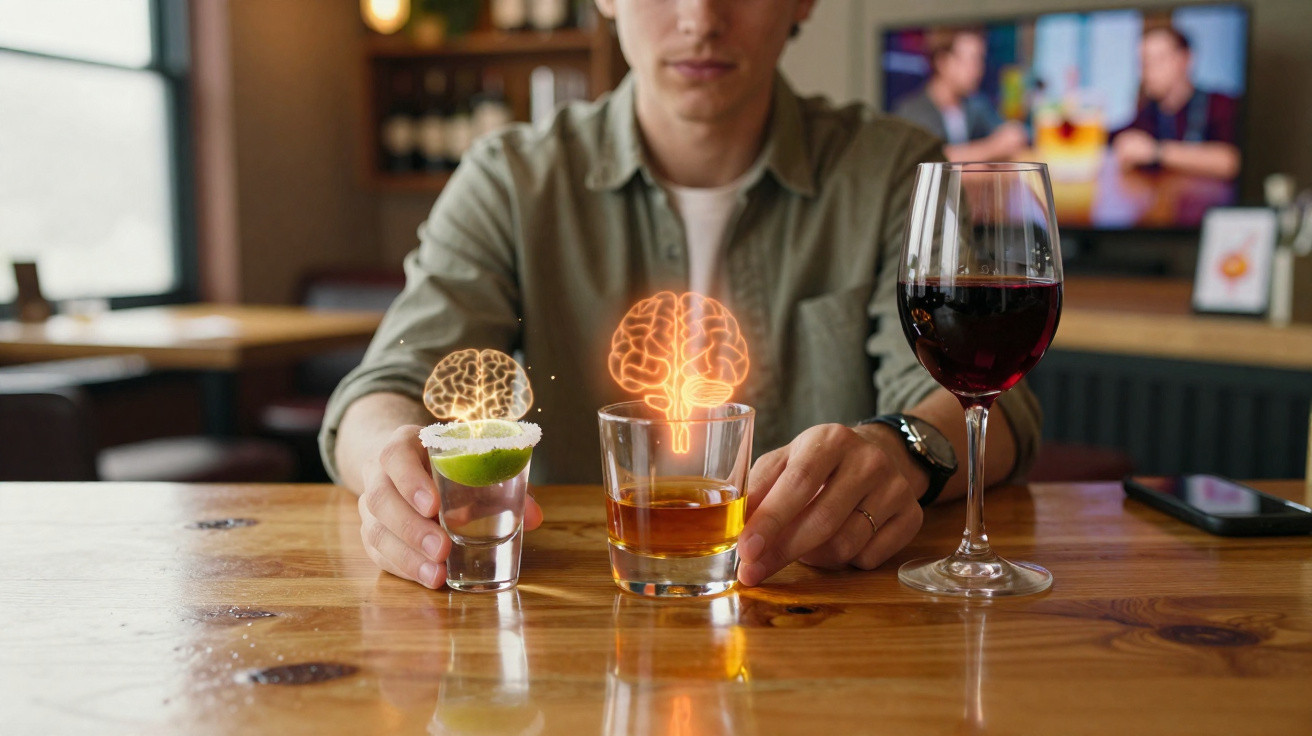
Many people recognise the feeling: simply imagining tequila with friends, whisky in an armchair or a glass of wine on a date can change the mood. A new study now shows that the brain shifts into a particular mode within seconds, before a single drop of alcohol has entered the bloodstream.
Study shows alcohol affects the mind before we drink
A US research team followed 429 young adults through several experiments. Participants were asked to think about three typical evening drinks: tequila, whisky and wine. Nobody drank during the test phase; the exercise was entirely about mental imagery.
The researchers wanted to find out which emotions, social roles and scenarios emerge as soon as a particular spirit enters the picture. To investigate this, they first asked participants to freely associate and collect words for the three drinks.
Their responses revealed three broad mental “categories” into which the brain often places alcohol:
- a distinct party mode;
- an overtly masculine, “tough” mode;
- a stylish, generally calmer mode.
In the following experiments, participants were randomly given the name of one of the three drinks and then asked how energetic, strong or elegant they felt. This was all based on imagination alone, without an actual drink.
The name of a drink alone is enough to activate a complete script for the evening in the brain – including mood, role and expected scenes.
Tequila, whisky, wine: three drinks, three inner roles
The findings appeared remarkably clear-cut. Each type of alcohol triggered distinctly different mental states – almost like three masks people put on internally.
Tequila: an energy mode with a risk of losing control
When thinking about tequila, many participants used terms such as “crazy”, “loud”, “party” and “going wild”. Common images included noisy groups, shots at the bar, spontaneous dancing and short nights.
- high energy, loud music and plenty of action;
- spontaneity and impulsiveness;
- little emphasis on limits and self-control.
This “party mindset” can be enjoyable, but it also carries an obvious risk: those who have already mentally prepared to be “completely uninhibited” may be quicker to drink more than intended. The study suggests that it is not alcohol alone that lowers inhibitions here; expectations can do so beforehand.
Whisky: toughness, maturity and playing with image
Whisky brought up very different images. Many people thought of strength, self-confidence and “masculinity”, as well as the classic film cliché of a person holding a glass who has everything under control.
Typical associations included:
- robust, strong and assured;
- somewhat rough and “grown-up”;
- courage, risk and sometimes performative coolness.
Choosing whisky can often mean unconsciously taking on a role: more mature, tougher and more worldly. The study indicates that this mental pose can influence behaviour – people speak and carry themselves differently, and may be more likely to make remarks they would never make sober with a glass of water in hand.
Wine: style, closeness and a selective calm
Wine mostly prompted calmer, though no less powerful, images. It was associated with elegance, style and a more restrained, often more intimate setting: dinner, a restaurant, slow music and deeper conversation.
A typical “wine mindset” involves:
- sophistication, style and perceived maturity;
- a calm, controlled atmosphere;
- attention to ambience, outfit and details.
Interestingly, according to the researchers, people thinking of a glass of wine are more likely to picture a well-kept setting, good food or a date – and adjust both their behaviour and appearance accordingly. Even without taking a sip, there can be an urge to make “a little more” of themselves and the evening.
Symbolic signals: what your drink reveals about your plans
The study’s central idea is that alcohol often works as a symbol. Tequila represents one kind of night, whisky another and wine yet another. Before blood alcohol levels rise, the scene people will play out is already set internally.
Alcohol acts as a symbolic cue: the drink signals to the brain which social role and type of evening seem appropriate at that moment.
Younger adults, including Generation Z, are continually surrounded by such images: clips from clubs, television characters with their “signature drink”, and adverts featuring perfectly staged scenes. These create established expectations:
- tequila supposedly fits better with certain people;
- whisky can seem ideal for making a “strong impression”;
- wine is treated as the standard choice for romantic or quiet evenings.
These expectations steer an evening in a particular direction, including the amount that eventually ends up in the glass.
How thoughts about alcohol can shape how much you drink
The researchers also examined whether these mental scripts affect specific decisions. The data suggests they do: imagination alone can change how much someone is willing to drink, who they choose to go out with and how risky they allow the evening to become.
Someone mentally preparing for a “party to the limit” is more likely to expect numerous rounds. Someone viewing themselves through a “serious” whisky image may permit themselves more, because the evening seems like “controlled enjoyment” in their mind – even if a second or third round follows later.
This makes one point clear: responsible drinking starts well before the first sip. It begins when a person decides, “Tonight it will be tequila, tonight whisky, tonight wine”, and accepts the accompanying mental film.
Three simple ways to approach alcohol more consciously
The findings offer practical starting points for everyday life. Small mental techniques can help prevent an automatic pattern of “drink = role = loss of control”.
- Check your mindset: Before the first glass, briefly ask yourself: “What am I expecting from this evening?” Anyone who notices they are looking for “escape” or “switching off at any cost” should slow down.
- Mix up drinks – disrupt expectations: Rather than always choosing the same “party drink”, making a deliberate change can break rigid patterns and loosen automatically adopted roles.
- Build in routines: Have a glass of water between drinks, set a limit in advance, or decide on a fixed time to leave. Such routines take some power away from the internal script.
Health authorities in many countries recommend clearly limiting weekly consumption, planning alcohol-free days and regularly reviewing personal drinking habits. The health effects of sustained heavy consumption range from liver damage to a higher risk of cancer.
How advertising and television shape our view of drinking
The symbolic effect does not arise in a vacuum. Television series, films, social media and advertising reinforce particular images: the cool television hero with whisky, the carefree group with shots, the elegant date with wine. All of this becomes embedded in memory.
People who regularly consume these scenes unconsciously adopt the scripts that go with them. For example, someone who sees almost exclusively wild party nights with tequila shots in short-form videos is more likely to link that spirit with “finally free and wild” – and behave accordingly as soon as the word tequila is mentioned.
Friendship groups reinforce these norms too. In some groups, drinking wine at every gathering is considered “normal”; in others, shots simply come with the territory. Becoming more aware of this can help people push back and develop their own rules, rather than relying solely on group pressure.
Why the brain responds so strongly to symbols
From a neuroscience perspective, this phenomenon is no surprise. The human brain likes shortcuts. It stores experiences as patterns: certain music plus certain people plus a particular drink create a mood. When only one piece of that puzzle appears later, the brain activates the entire pattern, including its emotions and expectations.
Alcohol brands have deliberately used this for decades. A logo, a colour or a distinctive bottle shape can be enough to evoke images of an “ideal night”. The fact that science now also demonstrates how powerful imagination alone can be brings personal responsibility into sharper focus: people who know their mental triggers are better able to manage them themselves.
Practical implications: what to consider before your next drink
Before the next party or date, a quick check can help:
- What image do I currently associate with this drink – party, strength or style?
- Does this mode genuinely suit my mood and tomorrow morning?
- What specific limit will I set myself: number of drinks, finishing time or alcohol-free alternatives?
This turns an automatic sequence into a conscious decision. Alcohol remains something to enjoy – not a remotely controlled script that writes the evening as soon as it enters your thoughts.



Comments
No comments yet. Be the first to comment!
Leave a Comment