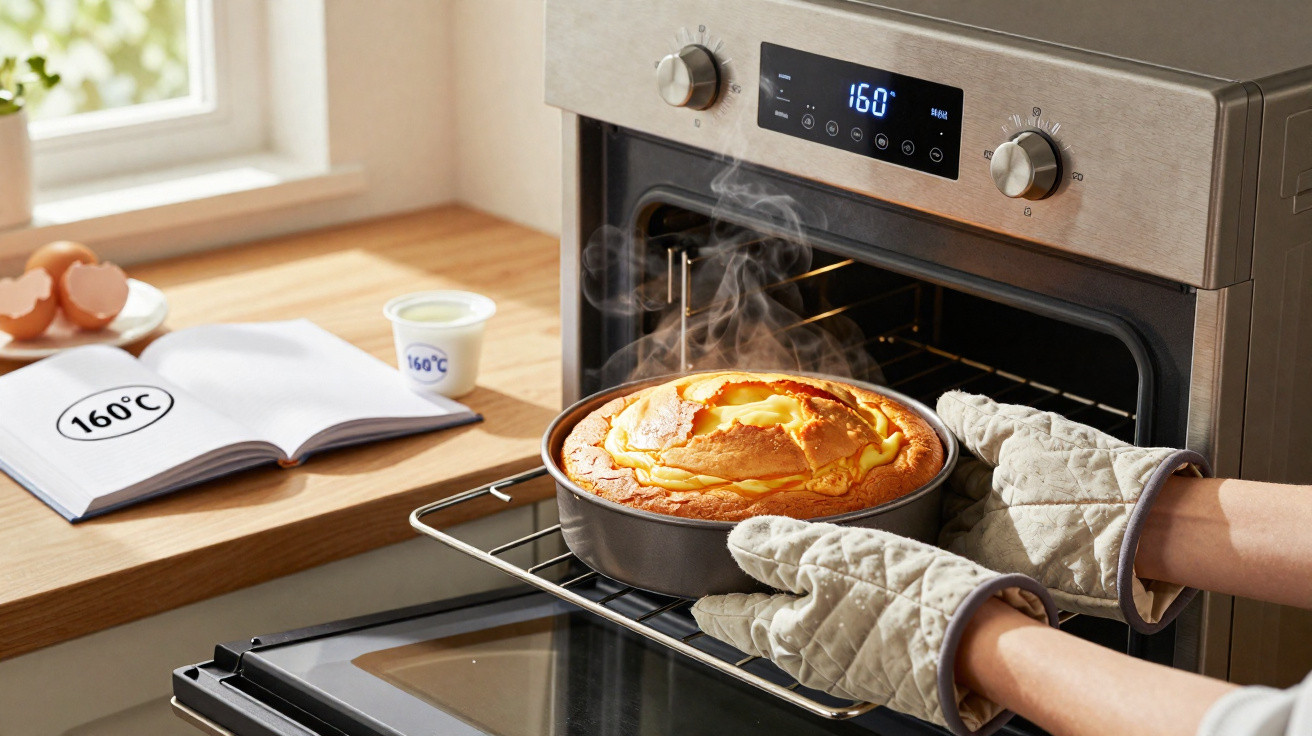
The batter is straightforward, the ingredients are inexpensive, yet an apparently easy yoghurt cake often ends up with a cracked surface, a dense crumb or a sticky centre. The recipe is rarely to blame; in most cases, the oven is - more specifically, the wrong temperature. Adjusting it by just a few degrees can turn a half-baked crater landscape into an evenly light, moist cake.
Why 180 °C ruins yoghurt cake
Many home bakers set their oven to 180 °C out of habit. It appears in countless recipes, it is how Grandma did it, and it is considered “standard”. That heat may work for a relatively airy sponge mixture, but it is often too aggressive for classic yoghurt cake batter.
The mixture contains eggs, yoghurt, oil, sugar and raising agent. This combination is comparatively heavy and moist. When it meets excessive heat, the surface sets and browns far too quickly while the centre lags well behind. The cake looks baked on the outside, but the inside still clings to the knife.
Excessive heat at the start creates a hard outer crust, traps moisture and leaves the middle behind.
The raising agent adds another factor. At 180 °C, the gas bubbles in the batter rise almost explosively. The cake domes up and briefly looks impressive in the oven - only to collapse later because its internal structure is not yet firm enough. The result is a tall, cracked “volcano” that sinks as it cools.
What goes wrong in the oven at 180 °C
In detail, an entire series of physical and chemical reactions works against a yoghurt cake:
- Rapid raising-agent reaction: The raising agents act too abruptly, leaving the crumb unable to develop gradually.
- Crust forms too early: The surface dries out and hardens, restricting heat from reaching the inside.
- Trapped water vapour: Moisture enclosed within the cake looks for an escape route and splits open the surface.
- Excessive browning: Sugar and protein react strongly, making the crust dark before the centre is baked through.
The reaction between sugar and protein does create flavour and browning, but combined with high heat it also produces a hard, almost “sealed” surface. The cake seems ready on the outside while the middle is still raw. This is exactly where the correct temperature determines whether baking is a success or a frustration.
The much better choice: 160 °C as a reference point
The key adjustment is simple: turn the heat down. For an evenly moist yoghurt cake, around 160 °C works considerably better - ideally using a fan oven.
For a light yoghurt cake with a fully baked centre, approximately 160 °C in a fan oven is the most reliable guideline.
At this temperature, the raising agents still work sufficiently well, but not explosively. The crumb gradually gains structure while the heat has time to reach the core. The surface browns gently instead of immediately forming a crust.
A practical baking guideline is this: if you have previously baked at just under 180 °C, set the oven to around 160 °C and extend the baking time by roughly 10 to 15 minutes. The result is usually a flatter, more evenly risen cake with a fine, springy crumb.
What if the oven does not have a fan setting?
Many older ovens only offer conventional top and bottom heat. In that case, the temperature can be slightly higher, but the underlying principle remains the same: bake gently and steadily rather than forcing the process with intense heat.
The following figures offer a broad guide:
| Oven setting | Recommended temperature | Typical baking time |
|---|---|---|
| Fan oven | approx. 160 °C | 45–50 minutes |
| Conventional top and bottom heat | approx. 170 °C | a similar or slightly longer time |
If you do not know your oven well, take a gradual approach: it is better to bake slightly longer at a moderate temperature and check towards the end than to start too hot and risk burnt edges.
Step by step: how to bake yoghurt cake at 160 °C
Besides temperature, using the oven correctly also affects the outcome. A simple basic routine is enough to achieve consistently good results.
- Preheat the oven in good time: Heat it to around 160 °C on the fan setting for at least 15 minutes so that the temperature is genuinely stable.
- Choose the correct shelf position: Place the tin in the lower third of the oven. This keeps the cake slightly farther from the upper heating element, so the top will not burn as quickly.
- Keep the oven door shut: Do not check out of curiosity during the first roughly 35 minutes. Each opening causes the temperature to drop sharply and may make the batter collapse.
- Time the skewer test properly: After around 45 to 50 minutes, test with a wooden skewer or thin knife. If batter still sticks to it, the cake needs a few more minutes.
- Cool it gently: Once the baking time has ended, switch off the oven, leave the door slightly ajar and let the cake stand inside for about 10 minutes. This prevents it from collapsing when removed.
This slow cooling stage avoids drastic changes in temperature. The cake remains stable and the crumb settles without becoming rubbery.
Common mistakes - and how to avoid them
Once the temperature is under control, a few further adjustments can improve your chances of success:
- Tin is too small: A very deep layer of batter takes longer for heat to reach the centre. When in doubt, use a slightly larger tin.
- Mixing too much: Once the flour and raising agent have been added, fold them in only briefly. Overmixing makes the batter tough.
- Cutting too soon: Ideally, the cake should cool completely after baking. It may taste good while still warm, but it is harder to slice neatly.
- Overenthusiastic extra heat: If the surface seems too pale, do not simply turn the temperature up drastically. Instead, allow a few more minutes and remain patient.
If you notice that the top is browning too fast, place the tin one shelf lower or cover it loosely with aluminium foil. The temperature stays unchanged, while the direct heat from above is reduced slightly.
What else affects the “perfect” temperature
A setting of around 160 °C is an excellent guideline, but it does not replace knowing your own oven. Every appliance heats differently. Some run too hot, while others are actually well below the temperature shown on the dial.
An inexpensive oven thermometer can prevent plenty of frustration. If you find that an oven set to 160 °C is in reality running substantially hotter, reduce the setting accordingly. Conversely, a weak oven can tolerate a few extra degrees as long as the baking time is adjusted.
The amount of batter matters as well: a thick, tall cake takes longer to cook through at its centre than a shallower-filled tin. The core strategy stays the same: moderate heat, sufficient time and a calm baking period without repeatedly opening the door.
Benefits in practice far beyond yoghurt cake
Anyone who understands the logic behind this adjusted temperature will also benefit with other baking projects. Dense sponge mixtures, loaf cakes with plenty of fruit and heavy nut cakes behave much like yoghurt cake. Here too, a slightly lower temperature prevents the dreaded “dark outside, raw inside” scenario.
Switching to moderate heat also benefits flavour: the batter dries out less, stays moist for longer and keeps better. Anyone reconsidering their usual 180 °C setting and more often baking at 160 to 170 °C will frequently notice after just a few attempts how much cake quality improves - without needing a single additional kitchen appliance.

















Comments
No comments yet. Be the first to comment!
Leave a Comment