The first time I watched this, I genuinely assumed the man was having me on.
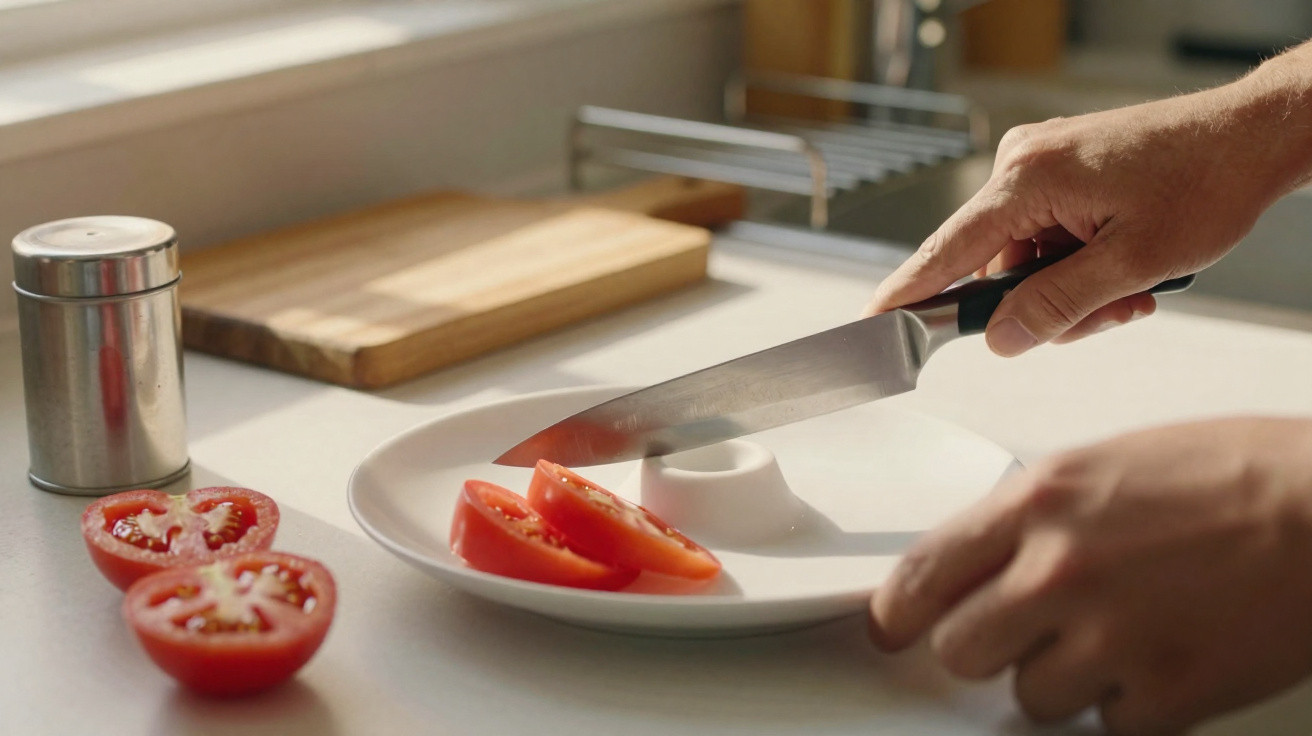
In a tiny Jaipur kitchen, beneath a squeaking ceiling fan and beside a hissing pressure cooker, an elderly man picked up a blunt knife, squatted by the door and began rubbing its blade against an ordinary ceramic floor tile.
Half a minute later, he cut through a tomato as though it were jelly. There was no crushing or sawing – only a smooth, pleasing slice.
He shrugged, wiped the blade on his shirt and said, “Why pay someone, beta, when you have this?”
When I got home, I tested it on my own lifeless, butter-knife-sharp blades.
That day changed something for me.
Why your “dead” knives aren’t really dead
Most people cooking at home decide a knife is finished once it no longer glides through an onion and begins to squash it instead.
Then we apply more force, press down, mutter to ourselves, blame cheap supermarket knives and start wishing for expensive Japanese steel.
Usually, though, the explanation is far less dramatic. The cutting edge has not disappeared; it has simply rolled slightly or developed tiny dents.
That dull and unsafe sensation often means the edge needs a quick correction rather than a complete revival.
This is precisely where the straightforward Indian trick quietly enters the picture, as if it has been there waiting all along.
Spend any time in Indian households and you may notice an unusual thing.
Most families have no costly sharpening sets, diamond stones or electric grinders.
Yet they prepare food every day: kilos of vegetables, along with meat, fish, herbs, endless onions and tomatoes.
Knives that might be thrown away in some Western kitchens remain in use, still cutting effectively into food.
Ask how they keep their blades going and the same relaxed response often follows, usually with a shrug: “Arre, we just use the plate, yaar.”
They mean exactly that.
Steel is more forgiving than many of us assume, which is why this works.
At a microscopic level, a knife edge is merely an exceptionally thin strip of metal that bends, folds and chips.
Passing it lightly over something harder than the steel, but not overly aggressive – such as unglazed ceramic – helps realign that edge.
Rather than removing half the blade, you are guiding that thin metal line back into position.
It seems almost absurdly easy, which is probably why so many people overlook it.
But the principle is basic physics, not magic.
The one-minute Indian method with a plate or tile
This is the technique exactly as I saw it, without the squealing fan or chai simmering on the stove.
Take a normal ceramic plate or mug, turn it upside down and find the rough, unglazed ring underneath.
That matte, dull circle becomes your “stone”.
Hold the knife at a low angle – about 15–20 degrees – then gently move the edge across the ring from heel to tip, as though shaving a thin layer from the ceramic.
Make 8–10 passes on one side before turning the knife over and repeating the process on the other.
To finish, wipe the blade and gently pull it through a folded tea towel or along a wooden board to remove any tiny burrs.
That is all: around a minute, perhaps even less.
This is the point at which many people become nervous.
They use far too much pressure, hurry the movement or keep altering the angle as if sketching with a pencil.
Indian home cooks who use this method regularly remain calm.
They apply light, almost lazy pressure and allow the ceramic to do the job.
Nor do they fixate on achieving “perfect” angles.
They simply keep the blade in the same position throughout every stroke.
In truth, almost nobody does this every day.
Most people reach for it once the knife becomes irritating, then forget about it until another stubborn tomato puts up a fight.
There is a quiet wisdom in this habit, handed down between kitchens without a grand explanation or YouTube tutorial.
It is not about having ideal equipment; it is about refusing to let your tools intimidate you.
“People think you need a machine,” an Indian street food vendor in Delhi told me, flicking his knife on the edge of a broken cup.
“I just need my chai glass and two minutes. After that, the knife respects me again.”
- What you need
A ceramic plate, mug or tile with an unglazed ring, a clean towel and a little worktop space. - How often to do it
Do it whenever your knife can no longer cut cleanly through tomato or onion skin without force. - What to avoid
Do not slam the blade, use the glossy glazed surface or attempt it on extremely brittle, high-end blades without first testing very gently. - Hidden bonus
You become less afraid of your tools and begin to see them as partners rather than mysterious, demanding divas.
From “throw it out” culture to “keep it sharp” culture
After watching a flea-market knife become razor-sharp on the underside of a plate, modern kitchen culture can begin to feel slightly wrong.
Many of us quietly accept that knives are disposable: “sharp” belongs to the day they leave the box, while “dull” is simply inevitable.
The old Indian approach makes a small tear in that idea.
It suggests that your tools can grow old alongside you if you give them a minute of attention now and then. Usually, a plate, a steady hand and a little curiosity will do the job.
You start seeing everyday objects differently.
The chipped mug, cracked tile and scratched plate take on a different character.
Perhaps you also begin to reassess your own routines.
If a one-minute action can bring a dead knife back to life, what else in your kitchen – or your day-to-day habits – might be waiting for one small, simple adjustment?
| Key point | Detail | Value for the reader |
|---|---|---|
| Use unglazed ceramic | Turn over a plate, mug or tile and use the rough ring | An instant “sharpening stone” without purchasing another tool |
| Light, consistent strokes | Keep the same shallow angle, making 8–10 passes on each side | A safer, sharper edge with a lower chance of damaging the knife |
| Sharpen when food resists | Test tomato or onion skin rather than leaving it too long | Less effort while cutting, fewer slips and greater enjoyment when cooking |





Comments
No comments yet. Be the first to comment!
Leave a Comment