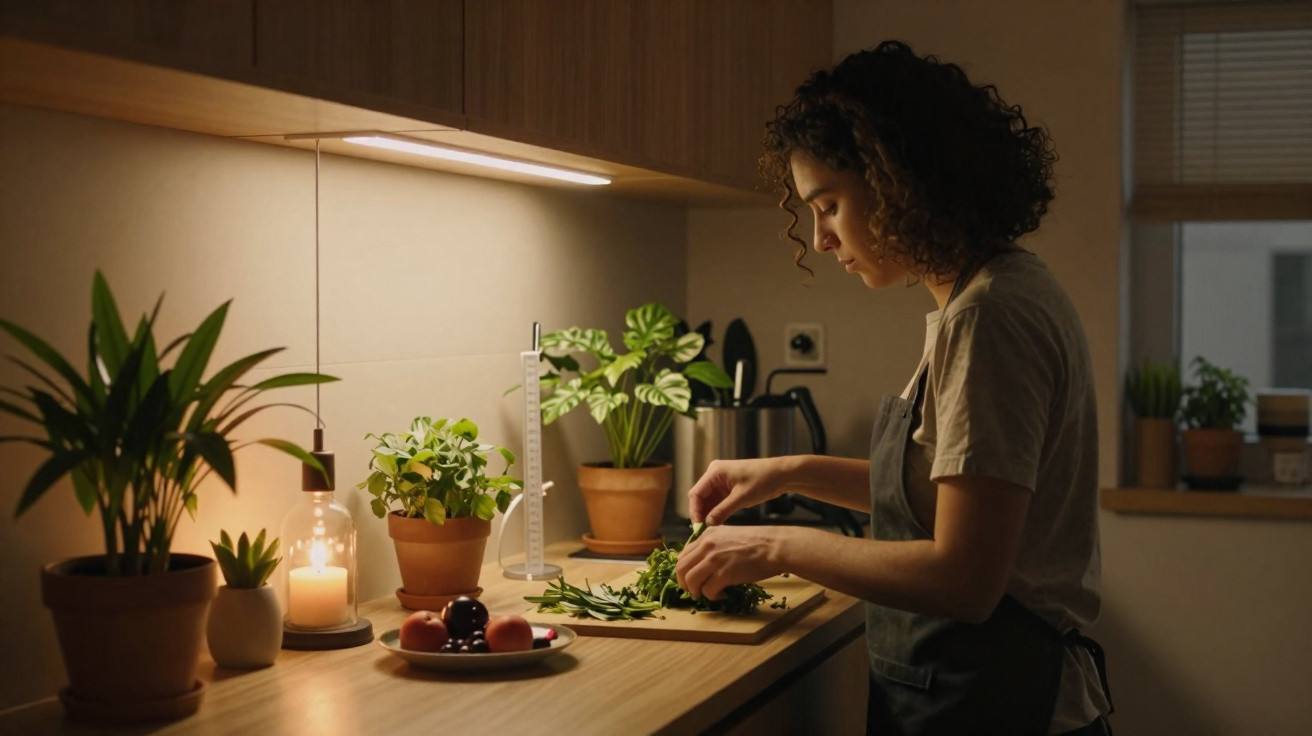
The homeowners point everywhere but upwards: across the island, beneath the cupboards and along the open shelving. “So… no main light at all?” he says, partly amused and partly appalled. They grin. Not any longer.
The previous approach was straightforward: fit one large ceiling light, flick the switch and call it finished. It delivered a harsh white glare that flattened every surface and made 9 p.m. feel like a visit to the dentist. That convention is now fading. Kitchens are becoming miniature stage sets, with lighting planned for chopping, scrolling, drinking and conversation.
Farewell, central lighting fixtures. The layered lighting trend is subtly transforming the idea of a properly “lit” kitchen. Once you notice it, the traditional method starts to seem almost primitive.
The quiet decline of the single ceiling light
Step into a newly refurbished kitchen and glance at the ceiling. The familiar central “UFO” fitting has often disappeared. You may find tiny recessed spotlights, an understated track, a slim strip above the cupboards and a soft glow beneath the island instead. Rather than a room illuminated by a single command, it feels like a space having a conversation with itself.
Central lighting once imposed a stark choice: full brightness or gloomy dimness. Layered lighting allows different moments to take shape. The morning breakfast rush can feel clear and fresh, while the late-night snack area remains gentle and soft. It is the same kitchen with the same people, but an entirely different atmosphere.
In theory, this may sound decorative. In practice, it alters how people use the room.
One lighting designer in London told me that half of her kitchen clients now arrive with screenshots of lighting rather than cupboards or appliances. They show glowing lines beneath floating shelves, small ceiling spotlights washing over textured splashbacks, and warm pendant lights hanging low above an island like those in a boutique-hotel bar.
Searches for “layered lighting kitchen” on Pinterest and Instagram have risen sharply over the past few years, while brands compete to relabel longstanding products as “task”, “ambient” or “accent” lighting. A recent US renovation survey found that more than 60% of new kitchens now combine three or more light sources, as conventional single-fixture schemes continue to decline.
People may not know the terminology, but they recognise that a kitchen feels calmer, more luxurious and more “finished” when light is not shouting from one overhead point.
Beneath the aesthetic buzzword is a simple principle. Daylight does not originate from one isolated bulb in the sky: it reflects from walls, passes through windows and changes as the day progresses. Layered lighting takes its cue from that. Task lighting targets the places where your hands work, including worktops, the hob and the sink. Ambient lighting provides a soft foundational glow throughout the centre of the room. Accent lighting draws attention to the details you want noticed, such as a niche, shelf, plant or textured wall.
Rather than a simple “on/off” choice, each layer can have its own slider. Cooking? Switch on the task lighting. Having friends over for wine? Reduce the task layer and rely on warm ambient and accent lighting. Eating with children at 6 p.m.? Make everything bright without making it punishing. In practical terms, this requires more wiring and preparation. Visually, however, it feels surprisingly natural.
There is a psychological element too: as the lighting changes, your brain grasps the mood of the moment before you have consciously considered it.
How to build layered lighting in a real kitchen
Begin with the work you do, rather than the fittings you want to buy. Stand in the kitchen and map out your usual movements: the chopping area, coffee station, sink, hob and island seating. Each needs its own modest pool of focused light. That forms the task layer. Consider slim LED strips beneath wall cupboards, compact recessed spots above the island and perhaps a directed downlight over the sink.
Next, consider the room in its entirety. Where do evening conversations take place? Where does the cat settle down? Those areas call for ambient lighting: perhaps a soft track around the room, several dimmable downlights or a low-glare surface-mounted fitting instead of an enormous chandelier. Add accent lighting last, with a strip above the cupboards grazing the ceiling, a small spotlight on a picture or a glow behind open shelves.
Plan in zones rather than relying on “one big light and hope for the best”.
On a grey Tuesday at 7 a.m., when you wander in for coffee, you may use only the under-cupboard strips and one warm pendant. The kitchen feels only half-awake, just like you. At 11 a.m. during the weekend, brighter ceiling spots can come on for food preparation and cleaning. It is one kitchen, following a different script.
A couple in Manchester told me they once had one large light that they scarcely used in the evening. Their options were either “interrogation mode” or watching television in the dark. Following their renovation, they use four switches: island pendants, under-cupboard task strips, ceiling ambient lighting and shelf accents. The unexpected outcome? They sit at the island more often, stay there longer and talk more. The lighting makes the kitchen somewhere they want to spend time, even when no one is cooking.
We have all experienced an old rental kitchen where one flick of the switch makes you feel immediately exposed. Cold, flat, bluish light lands on everything: your face, the unwashed dishes and the fridge door. Layered lighting reduces that emotional jolt, allowing certain corners to recede while others come forward.
There is a less glamorous reality behind the Pinterest finish, too. Layers often expose poor layouts. If the only location for task strips is behind your head, your body will throw shadows across the chopping board. If island pendants hang too high, they will shine into your eyes instead of illuminating the worktop. Let’s be honest: nobody measures lighting angles every day after work. But getting the essentials right once can turn everyday irritation into understated comfort.
One expert expressed it simply:
“Every light should have a job, a mood, or both. If it does nothing for how you live in the space, it doesn’t belong there.”
Even so, the same mistakes keep happening. People purchase beautiful pendants that look excellent when switched off but dazzle everyone once lit. They avoid dimmers to save money, only to dislike the harshness of the lighting at night. They install exclusively cool-white LEDs because they have heard they are “brighter”, then question why the room feels like an office. In a kitchen where you also live, scroll and talk, warm, dimmable layers nearly always come out on top.
- Start with tasks rather than trends.
- Fit separate dimmers for every lighting group.
- Combine warm and neutral whites, and avoid entirely cool schemes.
- Check for glare by sitting, standing and leaning as you genuinely will.
- Retain at least one very soft, low-level light for late nights.
A kitchen that adapts to you, not against you
At its core, this trend is not really about “design”. It is about adaptability. Kitchens now serve so many purposes that one blunt overhead fitting cannot meet them all. They function as offices, homework spaces, cocktail bars, playrooms, therapy booths and quiet midnight scrolling areas. One ceiling fixture expects every one of these settings to wear the same outfit.
Layered lighting lets you change that outfit in seconds. Bring up bright, shadow-free worktops for chopping. Lower the room to a gentle glow above the table when somebody finally says what they have been holding in all day. Switch on only the plinth strip at 2 a.m. to raid the fridge without waking yourself fully. That goes beyond convenience; it is a discreet form of care for your energy and attention.
There is a subtle social benefit as well. Harsh central lighting puts every imperfection on display: crumbs, clutter and tired eyes. Softer layers are more forgiving. You are more likely to invite a friend in for a drink when you know the dimmer can restore the atmosphere. In this way, lighting can become a confidence aid for imperfect, real-world kitchens.
Once you’ve lived with layers, going back to one central bulb feels like downgrading from a playlist to a single looping track.
The trend will continue to develop. Fittings will become slimmer, smarter and less visible. Control systems will work increasingly with your phone, voice and the time of day. But the essential change has already arrived: kitchens are no longer illuminated as static boxes, but as living settings that adjust to what you need, hour by hour.
So, if you are looking at that sad, solitary ceiling fitting and considering your options, you are not merely refreshing a style. You are deciding how the room will welcome you on hurried mornings, support you on difficult nights and frame the ordinary minutes that nobody posts online. The layered lighting trend simply offers more ways to say yes to all of it.
| Key point | Detail | Benefit for the reader |
|---|---|---|
| Replace the single central fitting | Use several task, ambient and accent sources instead of one main light | Makes the kitchen feel calmer, richer and more practical throughout the day |
| Think in zones and layers | Plan lighting around real activities: cooking, eating, working and relaxing | Reduces glare, shadows and frustration during everyday routines |
| Add dimmable, warm lighting | Use independent dimmers and warm LEDs for evenings and social time | Creates flattering, flexible moods without a full renovation |

















Comments
No comments yet. Be the first to comment!
Leave a Comment