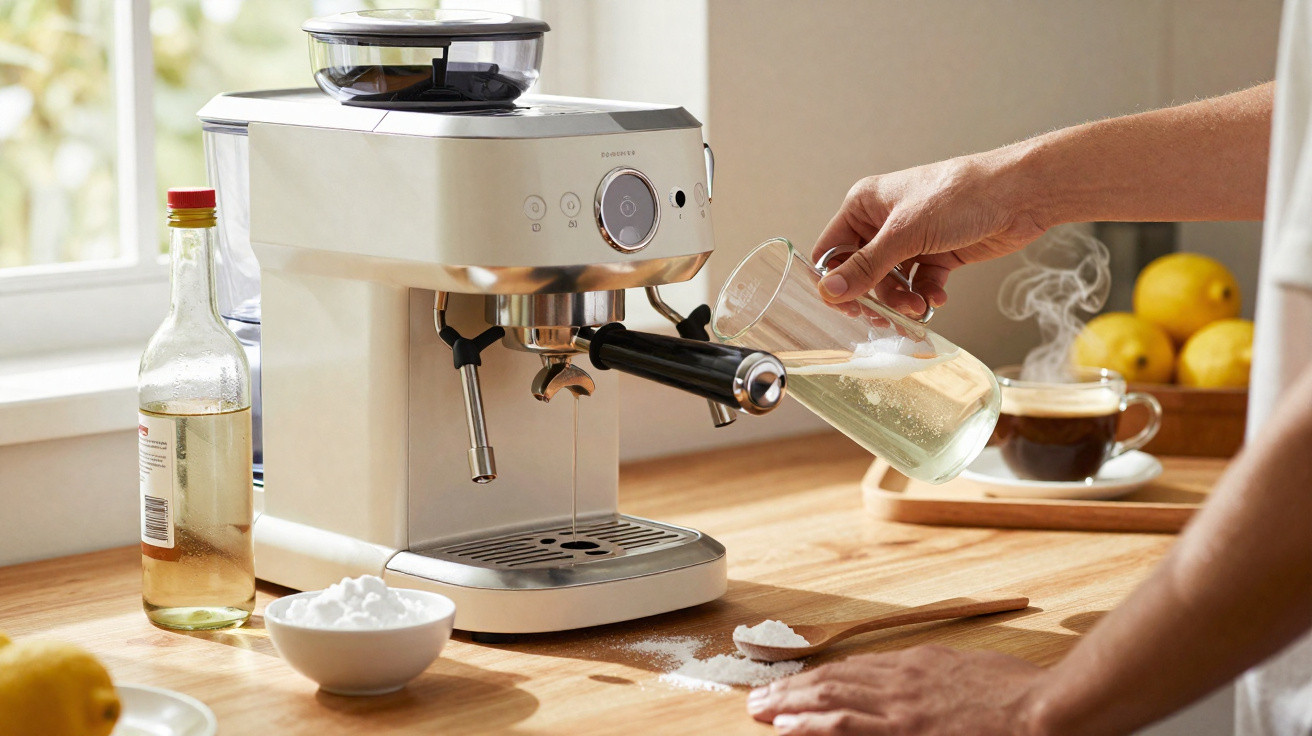
It is still almost dark when the first alarm rings and you shuffle into the kitchen half asleep. The flat is quiet; only the coffee machine is humming – or rather, trying to. The brew cycle drags on, coffee drips out at sluggish intervals, and instead of the familiar aroma, a slightly musty smell emerges from the machine first. You look into the cup, frown, take a sip – and know straight away: something is not right. There is a hint of metal, a bitter edge and less crema. Then the thought appears at the back of your mind: “I really should descale it again.”
Why limescale quietly sabotages your coffee machine
Anyone who uses a coffee machine every day will not notice limescale appearing overnight. It creeps in like dust on the back corner of a shelf. First the coffee becomes quieter, then slower, and then it suddenly tastes “different”. We all know the moment when you stand in front of the machine and think: it used to run more smoothly somehow. Limescale is not especially dramatic in itself – but it silently works its way into every component. Eventually, it is no longer only about flavour, but about how long your machine will last.
In many German kitchens, tap water deserves a closer look. In Munich or Cologne, for example, the water is considerably harder than in Hamburg or Freiburg. You can see it in a kettle: the white rings that form around it are exactly what ends up inside your machine’s hoses and heating elements. A friend of mine, a passionate espresso drinker, nearly ruined his portafilter machine because he thought, “I don’t use it as often as a café does”, so it would be fine. Three years later: a failed pump. The service technician said: “Limescale, as always.” Suddenly, a routine task had become an expensive repair appointment.
The reasoning is straightforward. Limescale builds up wherever water is heated or left standing for a while. The machine needs more energy to bring the water up to temperature, the pipes narrow and the pressure changes. Coffee no longer flows through evenly, flavour compounds are extracted differently, and the taste deteriorates. Let us be honest: nobody really descales every day. Yet this unremarkable issue can determine whether your machine lasts ten years or ends up at the recycling centre after three.
The best home remedies: what genuinely helps against limescale
Before reaching for costly specialist products, it is worth checking the kitchen cupboard. Vinegar is the classic option: many people swear by it, while others strongly advise against it. For basic filter coffee machines, a heavily diluted vinegar solution can work, but its acidity may damage seals and metal components in sensitive bean-to-cup or portafilter machines. Citric acid is gentler: add one or two tablespoons of powder to the water tank, top it up with lukewarm water, run it through, leave it to work briefly, then rinse thoroughly with clean water. This removes limescale without putting the machine under unnecessary strain.
A familiar household product that is often underestimated is bicarbonate of soda combined with warm water. It will not shift every heavy layer of limescale, but it can help with light deposits and odours. Another overlooked solution is using dedicated filters in the water tank or a simple countertop water filter. After only a few weeks, many users notice fewer limescale marks, longer intervals between descaling and a more consistent taste. And yes, simply running hot water through the machine without coffee from time to time flushes out small particles and stops limescale from taking hold so stubbornly in the first place.
What many people overlook is that not every home remedy suits every machine. Manufacturers of expensive bean-to-cup machines, for instance, specifically warn against vinegar, whereas a basic filter machine may tolerate it for years. Then there are the half-forgotten methods used by our grandparents – such as regularly boiling a slice of lemon in the kettle before the water ever goes into the machine. The plain fact is this: anyone who “pre-treats” their water introduces far less limescale into the coffee machine. Suddenly, descaling is no longer an emergency measure but a routine that barely takes any time.
How to use home remedies safely without ruining your coffee machine
A reliable basic approach for many coffee machines is: citric acid rather than vinegar, lukewarm water rather than boiling water, and two gentle cycles instead of one aggressive treatment. For a bean-to-cup machine, for example, mix one or two tablespoons of citric acid with one litre of lukewarm water, pour the solution into the tank and start the descaling programme, or run water through in stages. Then rinse the tank thoroughly and follow with at least two full tanks of clean water, so that no acidic aftertaste remains. The process may take around half an hour, but it can preserve months of good coffee.
Many people make the same mistake: they wait until the machine is already wheezing or a warning light is flashing constantly. Then they hurriedly press “quick descale”, rinse it somehow and push the issue aside for another six months. If you deal with it briefly once a month – or every two months, depending on water hardness – using home remedies, you can avoid those stressful moments. And yes, on a Sunday morning it is annoying when all you want is coffee but you are handling citric acid instead. Yet that small ritual saves your nerves in everyday life, because the first sip in the morning tastes like coffee again rather than tap water with a history.
A technician at a coffee machine repair workshop once put it to me like this:
“The best customers are the ones who never descale. At least for us. Not for their machines.”
To make this easier to put into practice, a short mental checklist helps:
- Use soft or filtered water – from the very first switch-on.
- Choose citric acid or bicarbonate of soda rather than vinegar, especially for bean-to-cup machines.
- After every descaling session, run two tankfuls of clean water through the machine.
- Establish a fixed routine: for example, descale briefly on the first Saturday of every month.
- Take warning signs seriously: slower brewing, different noises or thinner crema.
What remains once the limescale has gone
Anyone who has thoroughly descaled their coffee machine and then made their first espresso afterwards will recognise that small aha moment. The aroma is more intense, the extraction more even and the flavour more rounded. All at once, you realise how accustomed you had become to the gradual decline. It is a little like a window that has not been cleaned for years: only when it is clear again do you see what you were missing. At its heart, this is not only about technology, but about a small morning ritual working reliably once more.
Many of us live with these quiet compromises every day: a kettle with white marks, a coffee machine that “just takes a little longer”, a cup that no longer shines quite as it once did. Home remedies for limescale are almost a counterpoint to a throwaway mentality: a spoonful of powder, a little patience, some warm water – and an appliance that keeps going for years. Perhaps that is the real, quiet satisfaction in it: the feeling of having fixed something without immediately buying a replacement.
Ultimately, limescale is not a disaster, but an invitation to spend a moment looking after what carries us through every morning. Anyone who has experienced how much a descaled machine can change flavour, speed and mood will no longer see those white marks as an irritating footnote, but as a signal. A small, quiet sign: time to clear things out again – in the tank, in your mind and perhaps in the rest of the kitchen too.
| Key point | Detail | Benefit for the reader |
|---|---|---|
| Citric acid instead of vinegar | Gentler on seals and metal, easy to measure accurately | Longer machine life and fewer repairs |
| Filtered or soft water | Less limescale builds up from the outset | Less frequent descaling, consistent flavour and less effort |
| A regular descaling routine | Short, planned sessions instead of emergency measures | Reliable coffee flavour and a stress-free start to the morning |








Comments
No comments yet. Be the first to comment!
Leave a Comment