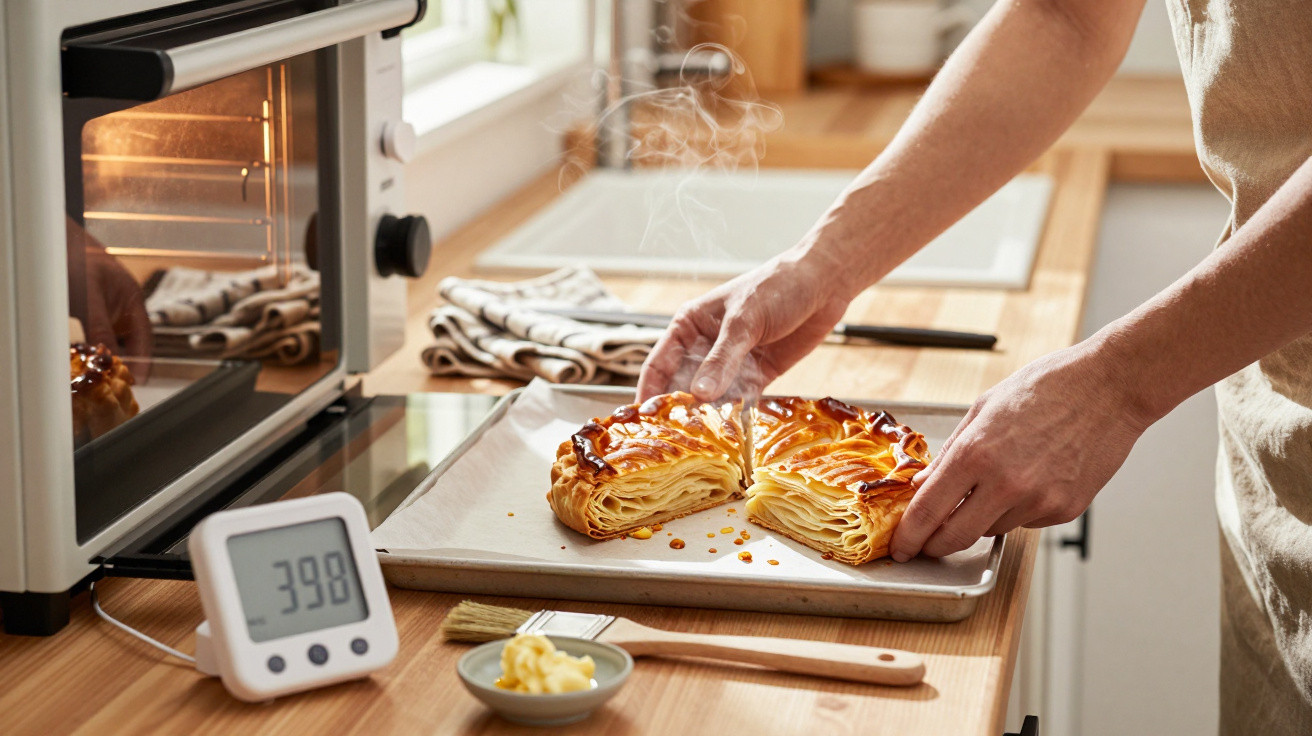
Chilled slices, impatient guests and an inviting microwave button: one thoughtless decision can reduce a flawless king cake to cardboard.
Throughout France, Epiphany brings galette des rois to the table, alongside a distinctly modern kitchen problem: how can it be reheated without spoiling its fragile puff pastry and tender filling? What seems like a minor issue is actually governed by techniques bakers rely on each winter, while many of us inadvertently ruin our own at home.
The common mistake that ruins your galette des rois
After the gathering ends, the galette has cooled, coffee remains hot, and somebody predictably requests “just one more warm slice”. This is often when a helpful host turns the oven up to maximum or puts the cake in the microwave “just for a minute”.
Apply heat too quickly and the surface scorches while the middle remains cold. Microwave it alone, and formerly crisp pastry becomes soft and rubbery. Cover it in foil, meanwhile, and trapped steam saturates the buttery layers.
Most reheating disasters come down to one thing: rushing. Puff pastry likes gentle, even heat and a little patience.
French pâtissiers regularly offer the same advice: handle a galette des rois as carefully as a quality croissant. Revive it gently rather than aggressively. The aim is straightforward: crisp pastry, a warm centre and a texture that suggests it has just been baked rather than reheated.
The baker-approved oven method for crisp pastry
Professionals first consider the cake's own temperature. A galette taken directly from the fridge responds to oven heat very differently from one left at room temperature for several hours.
Step one: let the galette rest
When the galette comes from the refrigerator, leave it on the worktop for 20–30 minutes. This brief interval reduces the contrast between a cold filling and a hot oven, helping to prevent patchy warming and soggy areas in the centre.
Step two: use low, even heat
For a standard puff-pastry galette with frangipane filling, bakers generally suggest the following:
- Preheat the oven to 150°C (about 300°F), or 140°C (285°F) using the fan setting.
- Put the galette on a baking tray lined with baking parchment, or on an oven shelf positioned above a tray. Do not use aluminium foil.
- Warm a whole cake for 10–15 minutes. Individual portions normally need only 5–7 minutes.
- After removing it from the oven, leave it on a rack for 5–10 minutes before slicing.
That resting period is more than an overly precise pâtissier's habit. It allows the filling to settle and excess steam to escape, preserving crisp layers. If you cut it too soon, the pastry structure is compressed and the crumbs clump together.
Think of reheating as a second, shorter bake: controlled, gentle and followed by a short rest, not a frantic rush to the plate.
The “luxury house” method: heat, then switch off
For an especially soft centre, some upmarket patisseries use a different technique. They heat the oven to 180°C (around 355°F), then turn it off immediately before putting in the galette. Residual warmth heats the cake gradually for 10–15 minutes without drying it out.
This approach is particularly useful when restoring a glossy top is the priority. Shortly before the final minutes, lightly brush the surface with simple syrup - equal parts sugar and water, briefly boiled and then cooled - for a subtle sheen. As before, allow the galette to cool a little on a rack before serving.
Adapting the method: frangipane, fruit and brioche crowns
King cakes are not all made alike. The classic Parisian-style frangipane galette is rich and relatively forgiving, whereas fruit versions and brioche crowns react differently in the oven.
Frangipane galette
Traditional almond cream comfortably withstands 10–15 minutes at 150°C. The pastry butter becomes crisp again, the filling softens and heats through, and the flavours become more expressive. Watch the colour, however: if the top browns rapidly, your oven may run hot, so reduce the timing by a couple of minutes.
Fruit galette
Apple and mixed-fruit galettes contain more moisture, meaning they require a slightly more delicate approach:
- Keep the oven at roughly 150°C.
- Warm for 5–8 minutes, inspecting the colour halfway through.
- Should the top start browning too strongly, loosely lay a sheet of baking parchment over it.
This shields the surface while still letting steam escape, which is particularly important with a juicy filling.
Brioche-style king crown
In southern France, a “galette” often means a soft brioche ring scented with orange and decorated with candied fruit. It behaves more like bread than pastry, so the aim is simply to warm it rather than restore a crisp exterior.
Two effective methods are:
- Quick warm-up: 4–5 minutes at 150°C.
- Softer heat: preheat to 180°C, turn the oven off, then leave the brioche inside for 10–15 minutes.
The crumb regains its softness, the buttery scent returns and the exterior remains tender rather than becoming dry.
Storing leftovers: room temperature, fridge or freezer?
Once the celebration has finished, the way you store the galette will affect the next reheating attempt.
| State of the galette | Storage advice | Reheating guide |
|---|---|---|
| From same day, at room temperature | Cover lightly and store somewhere cool | 10 minutes at 150°C |
| From fridge | Wrap it to keep out odours | Rest 20–30 min, then 10–15 minutes at 150°C |
| Already baked, frozen | Wrap securely in cling film and a freezer bag | Either thaw 2–3 hours then 10–15 minutes at 150°C, or heat from frozen for ~30 minutes at 150°C, covered with foil, removing it for the last 5 minutes |
Leaving the galette exposed on the worktop overnight dries it out quickly. Sugar draws moisture from the air before that moisture evaporates, taking softness with it. A basic cover or airtight container slows this process and makes reheating less of a recovery operation.
No oven? Using a microwave, air fryer or frying pan
A full oven is not available in every home, particularly in small city flats or student accommodation. Other appliances can be useful, although each involves compromises.
Microwave: a last-resort option
A microwave is practical but harsh on puff pastry. It warms water molecules unevenly, while steam cannot escape. Usually, this produces a limp crust and a texture more like sandwich bread than pastry.
If it is unavoidable:
- Reheat individual slices only.
- Select low power, around 300 W, for 20–30 seconds.
- If possible, finish under a hot grill for 1–2 minutes to dry the surface again.
This will heat the slice and restore a little exterior crispness, but the layers will never equal the result from an oven.
Air fryer: a reasonable compromise
Because it rapidly circulates hot air, the air fryer has become a popular appliance for reheating baked goods. Keep the settings restrained for king cake:
- Choose a temperature between 140°C and 150°C.
- Heat for 3–5 minutes, checking at the 3-minute point.
Excessive heat or time can dry the filling or make the top overly dark. A small piece of baking parchment beneath the slice helps stop it sticking and prevents butter from burning onto the basket.
Frying pan: the simple alternative
When there is no oven, a non-stick frying pan over very low heat can work better than a microwave. Put the slice in the pan with the pastry side facing down, then cover it with a lid left slightly open. Heat for 3–4 minutes.
The pan gently reheats from below while the semi-covered lid traps enough warmth to soften the filling without steaming the top.
The top will not become extremely crisp, but the base regains some crunch and the centre becomes pleasantly warm.
Five reheating mistakes that quietly ruin your cake
Every January, professional bakers encounter the same errors. Avoiding them already puts you ahead of most home cooks.
- Setting the oven to 200°C “to go faster”: the exterior burns while the centre remains only lukewarm.
- Covering it with aluminium foil, except when heating from frozen: the crust steams and becomes soggy.
- Microwaving a whole galette: the flaky layers collapse and turn chewy.
- Slicing it immediately after oven reheating: the pastry is crushed and filling runs out.
- Leaving leftovers uncovered until the following day: the cake dries out, and reheating intensifies that dryness.
Why gentle heat works: a brief pastry science explanation
King cake pastry consists, essentially, of hundreds of fine layers of dough and fat. During baking, water in the dough becomes steam and lifts those layers, while the fat keeps them apart. Reheating must reactivate this structure without melting it into one dense layer.
Intense direct heat drives the outer layers past caramelisation and into burning before the centre can catch up. Low, consistent heat gradually brings the entire cake into a similar temperature range. The fat then has time to soften and the starch can relax, producing what your teeth perceive as “fresh and flaky” rather than “stale and stiff”.
Practical scenarios: matching the method to your plans
Suppose you are hosting an informal Sunday lunch and expect dessert to continue through a long afternoon. One option is to bake or buy the galette in the morning, serve it slightly warm, then keep leftover slices lightly covered at room temperature. Later, a fast 5–7 minutes at 150°C returns them to ideal coffee accompaniment status.
For a workplace gathering, you may need to transport a galette and serve it from a basic office kitchenette. In this situation, slicing it before transport and then carefully warming the pieces in an air fryer or beneath a small grill may be more practical than trying to revive an entire chilled cake.
Families with young children often extend “galette season” over several January evenings. Freezing half a large galette after the first gathering makes it possible to enjoy an almost fresh cake another day. When it is tightly wrapped and reheated using the foil-on-then-off technique, the texture stays remarkably close to the original bake.
Beyond Epiphany: applying these tips to other pastries
The same principles apply beyond galette des rois. Croissants, pains au chocolat and puff-pastry tarts all benefit from mild, dry heat followed by a short rest before eating. Once you adopt the 150°C method and stop rushing the process, reheated pastries generally taste better across the board.
There is a food-safety consideration too. For cream-filled pastries or egg-rich frangipane that have been left at room temperature, heating through properly helps lower the risk of bacterial growth. Low and slow does not mean merely lukewarm; it means giving the centre enough time to reach a safe, comfortable temperature without burning the outside.

















Comments
No comments yet. Be the first to comment!
Leave a Comment