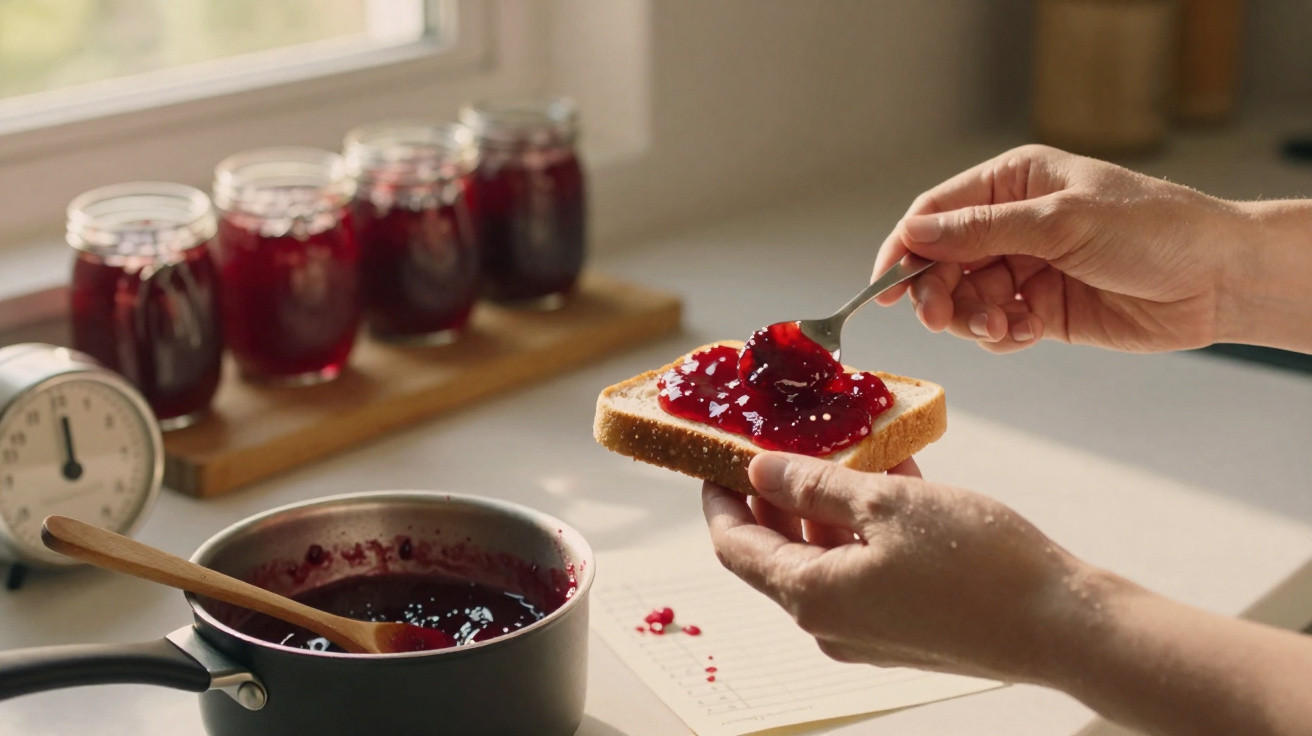
I wanted jars with a proper proud wobble, the sort of jam you could almost cut with a spoon.
What I kept making instead was fruit sauce that fancied itself as something grander. I followed recipes with model-pupil diligence: I sterilised jars, bought the posh sugar, watched the bubbles and used the frozen-plate test. Yet toast leaked, scones were swamped, and my alleged jam drifted around the plate like an unwilling dancer. After one especially gloopy strawberry batch, I sat by the open back door with sticky fingers, listening to the lids ping as they cooled and wondering what I had failed to understand.
The solution was a small adjustment, neither showy nor chef-like, but it changed everything. It was not a matter of adding more sugar, boiling harder or buying a particular pan. The important thing was the moment pectin joined in. Once I changed that timing, my jam began to set reliably, batch after batch. At last, the process made sense.
The jam wobble that never appears
We have all tipped a jar in the hope of seeing a firm jiggle, only to watch its contents slump like an exhausted pudding. I blamed myself endlessly. Perhaps I had not boiled it long enough, perhaps I had been too cautious, or perhaps low-pectin berries and smug online tutorials had somehow cursed me. The frustration is not merely about cooking. It feels as though you have failed to pay attention to the fruit, despite standing over the pan with a wooden spoon raised like a conductor’s baton.
Fruit at a rolling boil has an aroma that takes over the house, and it deserves an ending worthy of that scent. My jars sealed perfectly well, but the contents remained syrup pretending to be jam. That distance between effort and outcome is where self-doubt starts to grow. I repeatedly read recipes again, as though an overlooked comma might hold the answer. Nothing improved until I stopped viewing pectin as an anonymous packet and began treating it as the main event.
What my jars were telling me about pectin
Pectin is delicate and slightly diva-like: it needs the right companions at precisely the right point. Expose it to too much heat for too long and it becomes uncooperative. Add too much sugar too early and it cannot hydrate. Leave out sufficient acid and it cannot join up with sugar molecules to create a set. For months, I was not exactly mistreating it; I was simply bringing it into the process at the wrong time, like serving cake while the band is still playing its introduction.
In reality, few people test pH in their kitchen or study the tiny instructions on pectin packets every day. We tend to cook by instinct, sound and the moment the bubbles change from polite to volcanic. I embraced those signals, listened carefully and discovered that the opportunity for a good gel is remarkably brief, almost theatrical. You arrange the audience, prepare the lights, and then allow the star one minute-quite literally-to deliver its line.
Powdered and liquid pectin follow different cues
Here is the useful science without the fuss. Powdered pectin needs to hydrate in the fruit before the main quantity of sugar is introduced. Imagine soaking porridge oats before pouring syrup over them: it requires access to the fruit juice so it can swell and distribute evenly. After hydration, sugar and acid help it build the network that creates a set. Continue boiling for too long afterwards, however, and the strands start to degrade, leaving you with a loose slosh again.
Liquid pectin works in reverse. Start by cooking the fruit and sugar together until the mixture reaches a full, unstoppable rolling boil. Then pour in the liquid pectin at the end and let everything boil wildly for a brief minute. They reach the same result, but their stage directions are different. I had been confusing those cues, and my jam suffered for it.
The pectin timing trick that fixed my jam
This is the sequence that transformed my jam. When using powdered pectin, I stir it into the fruit while the mixture is cold or only just warm. I do not tip it straight in from the packet. Instead, I combine it with one or two tablespoons of sugar to stop it clumping, then scatter it in while stirring with purpose. I bring the pan gently to a simmer and leave it there for two to three minutes, allowing the pectin enough time to hydrate. Only after that do I add the remaining sugar and lemon juice, stir until dissolved and turn up the heat decisively.
You are looking for a rolling boil that cannot be stirred away. It sounds like a thudding, hissing rhythm, while the bubbles pile up like glass pearls. This is the one point at which I keep a close eye on the clock. As soon as the boil becomes fiercely rolling, I hold it there for 60 seconds-no longer-then remove the pan from the heat. If foam appears, I skim it off, take a breath and ladle the jam while it is still fiercely hot.
With liquid pectin, reverse the process. Cook the fruit and sugar first, rapidly, until the boil is impossible to control. Next, add the liquid pectin in a thin, steady stream as you stir, maintain that roaring boil for the same 60-second period, then take it off the heat. In either case, the actual setting happens later, on the worktop as the jars cool, like a promise quietly fulfilled.
Small details that make the timing work
One further habit helps this method along: macerate the fruit with a small handful of sugar for twenty minutes before starting. This releases juice and gives the pectin somewhere to disperse. A wide, shallow pan brings the mixture to the boil swiftly and evenly, so the pectin is not subjected to heat for ages. If you are using fruit with notoriously low pectin levels-strawberries or peaches, for instance-keep apple cores and lemon rinds in the freezer. Add a few during the early simmer, then remove them before the sugar goes in.
If I want extra precision, I occasionally check the thermometer and am pleased when it reaches 104–105°C. That is the useful range for a typical high-sugar jam. I will not claim to hit it every time. Since changing the pectin timing, though, the room for error has become much more forgiving and human.
When the jam stays on your toast
The first batch that set properly was almost cheeky. The spoon slipped in with a gentle sigh and emerged carrying a neat, glossy mound. Spread over toast, it stayed where it belonged, like a good winter jumper that does not sag at the elbows. As the lids pinged during cooling, the noise felt like more than a practical signal-it sounded like applause.
There is something beautiful about light catching a row of jars on a shelf. They contain more than food: Saturday morning at the market, a raspberry stain on your thumb, and a fragrance that travelled through the hall. A proper set allows the flavour to reveal itself rather than running away. If you have spent evenings chasing a gel that refuses to form, that composed, confident wobble feels like a small miracle you have earned.
Troubleshooting jam with timing rather than panic
Occasionally, you wake up to a soft jar of jam, and the instinct is to sulk or reboil it furiously. Pause first. If it is tasty and easy to spread, leave it alone; not every jar needs to be a rigid badge of honour. Should you want to firm it up, return it to a strong simmer for another minute with a little additional pectin or a splash of lemon juice, while respecting the same timing window as before.
The cold-plate test remains helpful, but I now regard it as gossip rather than a rule. A wrinkle on a chilled saucer suggests you are close, not that you have definitely arrived. Timing the boil and putting pectin in the best possible position from the outset have proved more dependable than chasing mythical “sheeting” from a spoon. If your jam is too firm, stir a spoonful of hot water into the jar after opening it and it will happily loosen up.
The five-minute rescue re-boil
If a batch remains stubbornly soft the following day, I tip it back into the pan, whisk in a small amount of pectin prepared correctly-powdered pectin mixed into a little sugar, or reserved liquid pectin-and warm it gently until dissolved. Then I bring it to a rolling boil for exactly one minute, take it off the heat and jar it again. It is not glamorous, but it is straightforward work, and the second set generally succeeds. The essential thing is not to let it boil for ten minutes, which simply bullies the pectin until it stops working.
Adjusting the rhythm for different fruits
Strawberries steal hearts but rarely commit. They need assistance. I add powdered pectin early, use lemon juice for acidity and brightness, and depend on that one-minute boil. Apricots are more cooperative, although their silky texture benefits from a little extra structure, so I allow the hydration stage to proceed patiently. Blackberries can set with such enthusiasm that I deliberately undercook them and allow the seeds to do their quiet work.
Citrus has an orchestra of its own, with plenty of natural pectin concealed in the peel. A bag of sliced peel, simmered separately in water, creates a pectin-rich liquid that can be stirred back into the fruit. Stone fruits sit in the middle: neither hopeless nor automatic. When I reduce the sugar slightly for flavour, I remember that I am also giving pectin a tougher job, so I do not then force it through a marathon with an extended boil.
Kit that helps without overcomplicating things
I once believed I needed jam sugar containing pectin granules to make everything behave. Now I simply keep a box of plain pectin in the cupboard and a lemon in the fruit bowl. My entire supporting cast is a wide pan, a sound wooden spoon and a timer. If I am feeling particularly nerdy, a thermometer keeps me accurate, though the sound of a rolling boil remains the clearest signal in the kitchen.
Jar temperature is one detail I still take seriously. Putting hot jam into hot jars avoids thermal shock and encourages a smooth seal. I use clean lids, tighten them only to finger-tightness, then leave the jars untouched as they cool so the set can form. It is an uncomplicated, quietly pleasing routine, like placing school shoes neatly by the door each evening.
Sensory signals for judging the crucial minute
Just before the important boil, the foam changes from broad and lazy to fine and shimmering. Individual bubbles no longer burst separately; they collapse in layers, almost like fabric. The steam develops a deeper smell, nearly reminiscent of caramel, and the spoon leaves a brief bare line along the bottom of the pan before jam flows back over it. That is the edge of the window. Once the boil is fierce and constant, the minute starts.
I do not stir wildly during that minute. I stir only enough to distribute the heat evenly. More than anything, I listen: the sound becomes sharper, then softens the instant I take the pan off the heat. It is oddly exciting, this tiny piece of theatre performed for an audience of one.
Why pectin timing succeeds where recipes fall short
A recipe cannot see your hob, pan, fruit or impatience. It can only offer estimates and optimism. What recipes do not always make clear is that the gel comes from a handshake between pectin, sugar and acid, created during a short surge of heat. Let pectin hydrate while it has liquid to drink, rather than when it is submerged in sweetness. Add the sugar and acid at the point when it is ready to bind. Then stop attacking it.
I wish someone had explained this to me earlier, although I suspect I would not have listened until I was ready. Repeated failures do something useful: they tune your ear. Once you have heard that minute, you cannot unhear it. Once you have watched jam set as it should, you begin trusting your hands more and your panic less.
Notes I wrote on the fridge
Powdered pectin should go in early with the fruit, hydrate, and only then meet the sugar. Combine it with a spoonful of sugar to prevent lumps, stir it into cold fruit, bring it to a simmer for a couple of minutes, add the remaining sugar and lemon, then boil fully for one minute. With liquid pectin, cook the fruit and sugar first, then add the pectin at the roaring end and boil for one minute. Different paths, identical destination.
When I use soft, bashful fruit, I keep a contingency plan close by: an extra half-sachet of pectin, a lemon ready to squeeze at the last minute, and a firm intention not to boil for too long. If a batch is slightly too firm, it is still wonderful stirred through yoghurt or brushed on a cake as glaze. If it stays soft, it can become an ice-cream ripple or a generous drizzle over pancakes. There is room for pleasure in either direction.
A small ritual worth preserving
Making jam stretches out time: fruit, sugar, a pan, a wooden spoon and one minute that matters more than all the others. That was what steadied me-the knowledge that there is a precise, small window in which everything comes together, through choice rather than luck. This timing turned jam from a coin toss into a ritual I actually trust. More than any recipe, that ritual is what brings me back to the hob.
Now, when friends ask why their jam will not set, I do not send them a spreadsheet. I tell them to listen for the boil that cannot be stirred down, give it sixty brave seconds, and treat pectin as the star it is. The set isn’t magic; it’s rhythm. Once you know the beat, your jars will sing. Breakfast stops being a rescue operation and becomes a calm, generous celebration of fruit doing what it was always meant to do.

















Comments
No comments yet. Be the first to comment!
Leave a Comment