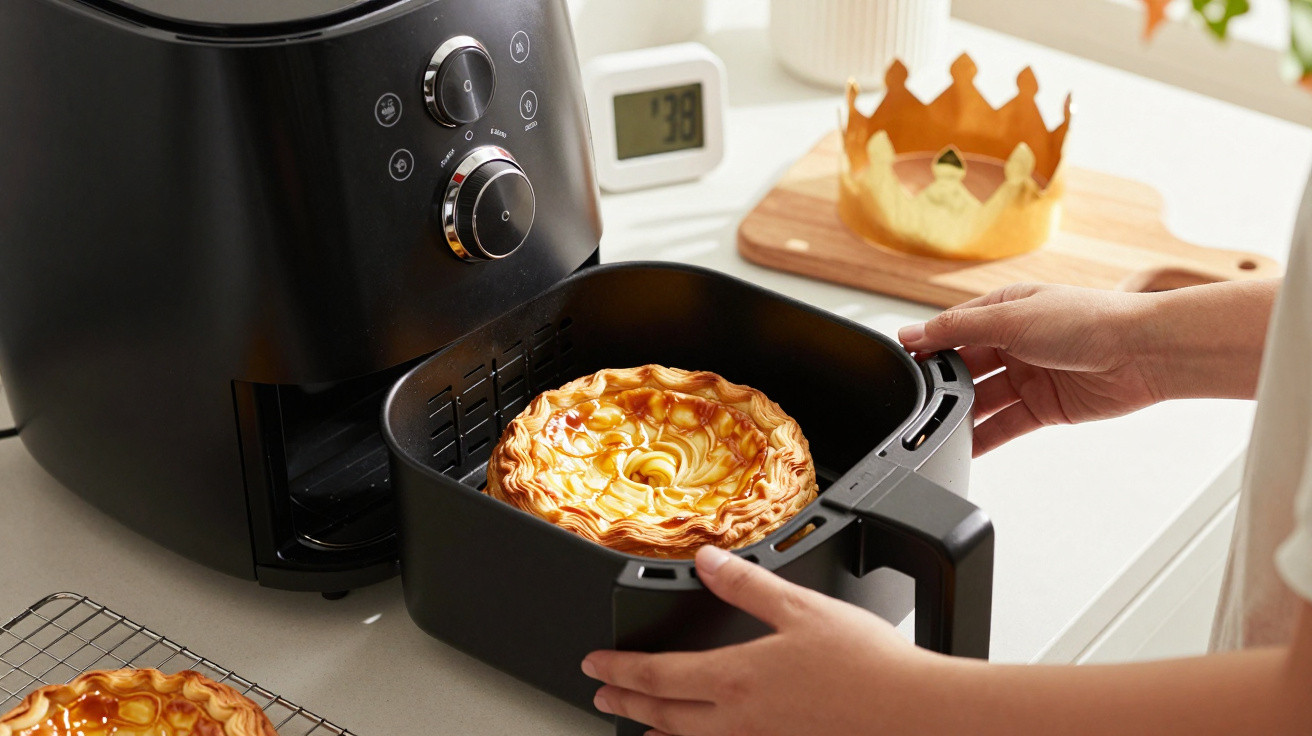
Cold slices of galette des rois after Epiphany are a common sight, and few people relish eating them straight from the fridge.
The French galette des rois - the crisp, almond-filled king cake - tastes best warm, with flaky pastry, rather than softened in a microwave or dried out by the oven. As air fryers become standard appliances in kitchens across Europe and the United States, the same question returns each January: can this small machine revive a day-old galette without damaging its fine layers?
Why the air fryer matters for king cake
Throughout France, galette des rois is enjoyed during the month surrounding Epiphany, so leftovers are almost inevitable. One cake served with tea, another after dinner, a slice put aside “for later”… before long, half a galette is left on the worktop, cold and rather unappealing.
The usual approach is to warm it in a conventional oven. Although effective, preheating a full-sized oven can seem wasteful when only one or two slices need heating. A microwave is quicker, but its moist heat often leaves puff pastry chewy.
The air fryer behaves like a tiny fan oven: powerful, fast, and able to crisp puff pastry again without soaking it.
This is precisely why French home cooks have begun reheating galette des rois in an air fryer. Its rapid air circulation dries the exterior sufficiently to bring back the crunch, while mild heat reaches the almond filling. Used carefully, it can produce a texture remarkably similar to a freshly baked galette.
Yes, galette des rois can be reheated in an air fryer
For a galette that has already been baked, an air fryer is not merely an option: it is often handier than switching on the main oven. Regardless of brand, most appliances use the same method, circulating hot air rapidly around food in a compact chamber.
That speed brings two important benefits. The pastry heats through within minutes, and much less energy is wasted than when heating a large oven for just a couple of slices. For many households, this is reason enough to give it a try.
Think of the air fryer as a reheating tool, not a second bake: your goal is to wake the galette up, not cook it again.
Moderation is essential. Excessive heat or time will draw butter from the puff pastry and make the almond cream firm, rather than leaving the interior soft and fragrant.
Ideal air fryer temperature and timing
Puff pastry does not respond well to harsh heating. Moderate temperatures provide the safest results. French pastry chefs commonly recommend a “gentle but decisive” reheating curve for galettes, and the same principle works perfectly in an air fryer.
Suggested settings for different situations
- Single slice, at room temperature: 140–150°C for 3–4 minutes.
- Single slice, from the fridge: 150–160°C for 4–5 minutes.
- Whole cake, at room temperature: 160°C for 5–7 minutes.
- Whole cake, from the fridge: 170–180°C for 7–10 minutes, checking regularly.
Treat these timings as guidance rather than fixed instructions. Results will vary according to the appliance’s wattage and the thickness of the galette.
| Factor | Effect on reheating |
|---|---|
| Size of the galette | Bigger cakes require lower heat and more time to warm evenly. |
| Starting temperature | Chilled slices need a few additional minutes compared with those at room temperature. |
| Air fryer power | More powerful models brown food faster; lower the heat slightly to prevent burning. |
One straightforward practice makes a significant difference: remove the galette from the fridge 20–30 minutes before warming it. This brief rest reduces thermal shock, allowing the middle to heat without overcooking the outside.
Common mistakes that spoil the pastry
Home cooks commonly make three mistakes that can turn a promising reheating attempt into a disappointing one.
- Temperature too high: above 190°C, the outside colours rapidly while the centre remains only lukewarm.
- Time too long: just a few extra minutes can dry the edges and make the frangipane hard.
- Multiple reheats: reheating the same slice twice removes moisture each time, leaving the pastry leathery.
The microwave also deserves consideration. It may be acceptable for a single mouthful that will be eaten immediately. With a whole galette, however, it generally creates a soft, slightly rubbery texture, undermining the appeal of the flaky layers.
If the top begins to brown before the centre is hot, cover the galette loosely with foil and drop the temperature by 10–20°C.
This foil “tent” slows colouring on the surface while the interior catches up. A single check halfway through reheating should be sufficient. You are looking for a golden crust that is crisp when touched, with a centre that gives gently under light pressure.
Step-by-step reheating routine
For a whole galette
Start by taking away any decorative card, plastic crowns and paper bases. Set the cake directly in the air fryer basket or on a perforated tray, allowing hot air to move beneath it.
- If refrigerated, leave the galette at room temperature for around 20 minutes.
- Preheat the air fryer at 160°C for 3 minutes.
- Put the galette in as a single layer, ensuring its edges do not overlap.
- Warm for 5 minutes, then inspect it; the pastry should be lightly crisp.
- If the middle remains cool, continue in 2-minute intervals. Lower the temperature to 150°C if it is browning too quickly.
For individual slices
Slices are more delicate because their filling can spill if they become too hot. Transfer them with a spatula and do not stack them.
- Preheat the appliance to 150°C.
- Place the slice flat in the basket, with space around it.
- Heat for 3 minutes, then touch the top: it should be warm and faintly crisp.
- Add 1–2 minutes if necessary, watching the edges closely.
The best reheated galette is eaten straight away. Ten minutes on the table and the magic fades again.
Texture, safety and leftover management
From a food-safety perspective, reheating galette des rois once is usually acceptable within 48 hours of baking or purchase, provided it has been stored correctly. The greater issue is not the pastry itself, but repeated changes between refrigerated and room temperatures.
A practical rule is to portion the cake realistically. If only half will be eaten, cut and warm that half alone. Keep the remaining portion chilled and untouched for another day, then follow the same one-reheat approach.
Beyond Epiphany: other pastries for the air fryer
The same technique suits many laminated or layered pastries. Croissants, pains au chocolat, Danish pastries and even sausage rolls respond well to this fast, dry heat. Reduce the suggested timings by around a minute, since these pastries are often thinner than a galette.
At the opposite end of the scale, delicate cakes filled with cream do not cope well with strong air movement. For these, use very low temperatures and shorter heating times, or a conventional oven at a gentle setting.
When things go wrong: rescue scenarios
If your galette is overly dark on top but perfect inside, there are still ways to serve it. A light dusting of icing sugar can disguise minor overbrowning. Offering slices with custard, cream or a scoop of ice cream can offset dryness and highlight the contrast between temperatures.
You can discreetly trim dry edges before serving the cake. The crisp offcuts make excellent cook’s treats, or can be crushed to use as a topping for yoghurt or fruit.
Lastly, if a slice cools again before it reaches the table and you are tempted to heat it for a second time, consider repurposing it instead. Cut it into cubes, toast them briefly in the air fryer, then use them as almond-rich “croutons” in a dessert trifle. It will not regain a bakery-fresh texture, but it avoids waste and creates a different, comforting pudding.

















Comments
No comments yet. Be the first to comment!
Leave a Comment