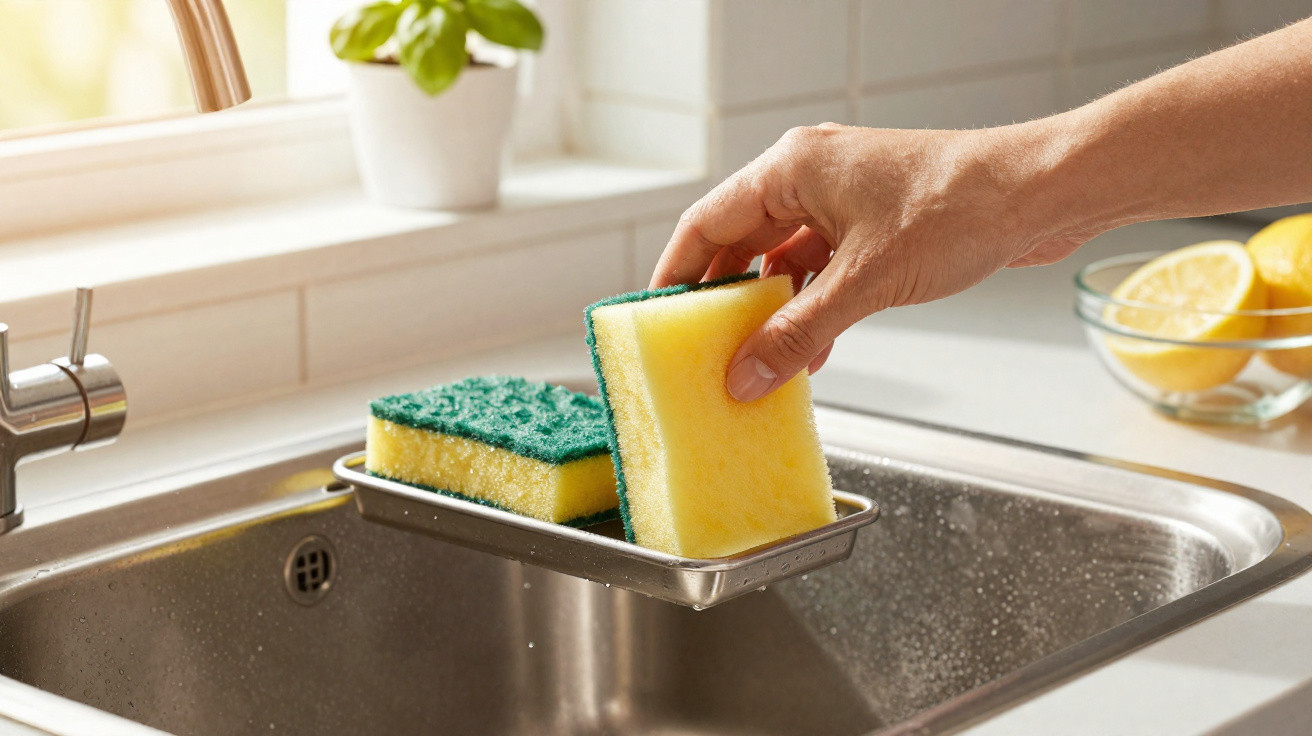
You open the cupboard beneath the sink, reach for the sponge, and catch it: that subtle, boggy smell signalling that your “cleaning tool” is slowly turning into a miniature petri dish.
It may not appear too bad. The edges are slightly soft, the colour has faded a little, yet it still seems capable of tackling plates and pans. You hold it beneath hot water, squeeze it, add washing-up liquid and hope the odour will somehow vanish.
You already know that it will not.
Later that night, once the washing-up is finished, the sponge collapses into a miserable damp pile at the base of the sink. It remains in its own puddle, absorbing all the things you would rather not consider.
The straightforward habit that keeps it fresher is almost ridiculously simple. Which is precisely why people tend not to do it.
Why your sponge becomes unpleasant sooner than it should
Kitchen sponges lead two lives. In the morning, they smell of lemon washing-up liquid; by evening, they have discreetly soaked up meat juices, milk froth and whatever was left behind on the chopping board.
When they are left wet, they remain warm and comfortable - exactly the conditions bacteria want. The sponge turns into a soft hotel, welcoming millions of microscopic guests.
At first, you notice a mild smell. Then it becomes slimy. Eventually, you are washing supposedly clean plates with something you would never allow anywhere near your face.
One Tuesday evening in a small Leeds flat, Hannah cleaned her worktop using a sponge she had owned “since before Christmas… I think”. She had just prepared chicken. The sponge had already washed the dishes, scoured a pan and “sort of lived” in a metal holder covered in water marks.
She described the odour as “just… kitchen smell”. A microbiologist would use a different description. Studies have shown that kitchen sponges may contain more bacteria than a toilet seat, particularly if they are kept wet and compressed.
Most people do not discard them as regularly as health guidance recommends. It is not necessarily laziness; throwing away something that still appears usable feels wasteful. You stand there thinking: it is only a little smelly, it still works, I will keep it for one more week.
That “one more week” is exactly the period in which bacteria flourish.
The science is harshly straightforward. Bacteria favour three things: moisture, food residue and warmth. Your sponge provides every one of them throughout the day.
Leaving a sponge flat in a wet sink or inside a closed caddy creates a tiny greenhouse: no light, no airflow, only damp fibres and particles of leftover food.
Rinsing it in hot water offers a little help, but it is not enough. The water loses its heat almost immediately, while most bacteria remain in place. They’re tougher than we like to imagine.
The real difference comes not only from how you clean the sponge, but from what happens to it during the hours after the washing-up is complete.
The simple sponge habit that keeps it fresher for longer
The habit is this: after every use, rinse the sponge thoroughly, squeeze out as much water as possible, then store it upright in open air so that it can dry completely before you use it again.
That is all. No expensive accessory or specialist product is required. Simply rinse thoroughly, wring thoroughly and let it breathe.
Stand it vertically on a small rack, over the sink divider or in a holder that keeps it elevated and exposed to air. The aim is to allow air to circulate around as much of the sponge as possible.
Dry fibres make conditions difficult for bacteria. They do not like them. Within a few days, your nose will detect the change.
On a difficult day, the sink becomes a general dumping area: plates, mugs, three forks sitting in cold tea - plus a sponge submerged at the bottom.
Most people give it a partial rinse, perhaps a quick squeeze, and then leave it lying flat. They are tired and want to sit on the sofa. They will “sort the kitchen later”.
Let’s be honest: nobody really does this every day.
Even so, standing the sponge upright takes three seconds. Time is not the real obstacle; the issue is habit. Once the dishes are done, your mind has already moved on, so you do not think about what happens next.
When you link “last plate rinsed” with “sponge rinsed, wrung and propped up”, the routine becomes far easier to maintain.
One cleaning expert I spoke to put it bluntly:
“People treat the sponge like a disposable rag, then act surprised when it behaves like one. Treat it more like a toothbrush – it needs to dry, and it needs a life span.”
A short routine can help:
- Rinse the sponge beneath hot water for 10–20 seconds after washing the final dish.
- Squeeze it firmly several times, until almost no water comes out.
- Stand it upright on a rack, hook or sink divider, rather than leaving it flat in a puddle.
- Give it one “day off” each week by switching to a fresh sponge while it dries fully.
- Replace it altogether every 1–2 weeks, even when it “looks fine”.
None of this has to be done perfectly. Real kitchens are untidy, and real evenings are busy. Yet this small ritual quietly reduces both odour and germs, without requiring you to become someone who sanitises the sink as though it were an operating theatre.
What happens when your sponge dries properly
Something subtle changes when your sponge smells neutral rather than sour. You pick it up without that slight wince. You no longer wonder what invisible layer you may be spreading across your supposedly clean plates.
The entire sink area seems more settled. It feels less like a damp, chaotic corner and more like somewhere you genuinely want to cook. It is a modest psychological benefit rooted in a truly hygienic improvement.
There is also a quiet feeling of control. The kitchen is where you feed yourself, perhaps your family, or flatmates arriving home late and hungry. Knowing that your main cleaning tool is not secretly working against you offers a subtle sense of relief.
You may find that your other habits change too. A sponge that dries properly can encourage you to wipe the sink more frequently or to avoid leaving dishes sitting around for quite so long.
Not because of guilt, but because the space feels easier to manage.
And when somebody else in the house picks up that cleaner, lighter-smelling sponge without saying a word, you will know the habit is doing what it should.
| Key point | Detail | Benefit for the reader |
|---|---|---|
| Let the sponge dry fully | Rinse, wring firmly and store upright in open air | Reduces odour and bacteria without additional products |
| Replace it regularly | Change it every 1–2 weeks, even if it looks fine | Limits hidden germ build-up and cross-contamination |
| Create a micro-routine | Link “last dish done” with “sponge rinse and dry” | Makes the habit automatic and easier to sustain over time |




Comments
No comments yet. Be the first to comment!
Leave a Comment