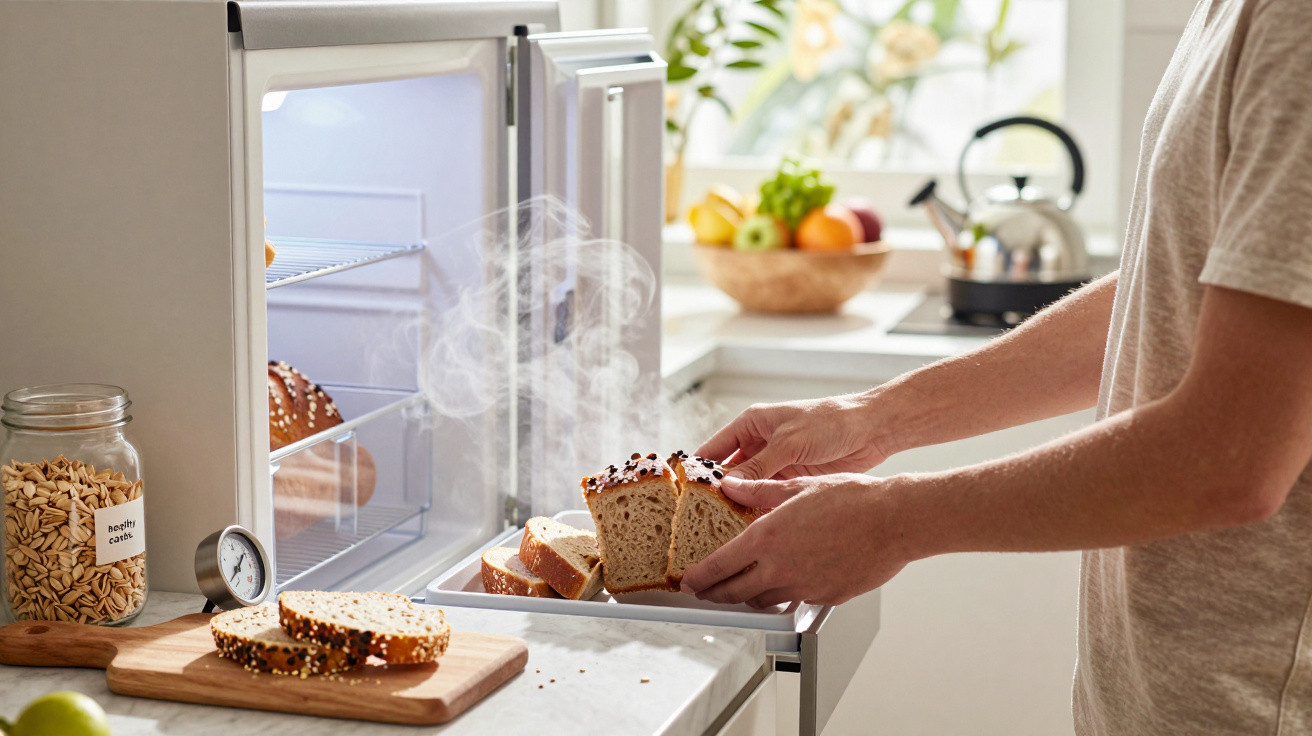
Keeping rolls, baguettes and wholemeal bread in the freezer is a common way for households to cut food waste. It is undoubtedly convenient. The more interesting issue is whether freezing harms your health – or whether frozen bread may even offer benefits for the body.
Why so many people freeze bread
It is a familiar scenario: half a baguette is left after dinner, yet it is already tough by the following day. Into the freezer it goes. This habit has become established in countless kitchens and saves plenty of loaves from ending up in the bin.
Bread provides complex carbohydrates, fibre, B vitamins and minerals including magnesium. People freeze it in the hope of retaining these nutrients while also preserving freshness and flavour. But does that work, or does it simply produce a soggy compromise?
Properly frozen bread is primarily a way to prevent waste – and it can also have surprisingly positive effects on blood sugar.
What freezing does to nutrients
From a nutritional perspective, bread performs rather well in the freezer. Its key components are relatively unaffected by low temperatures.
Vitamins, minerals and fibre: are they retained?
- Carbohydrates: The starch in bread is essentially retained during freezing, although its structure changes to some extent.
- Fibre: Fibre is highly stable and survives freezing without any meaningful losses.
- B vitamins: The greatest losses occur during baking and lengthy storage at room temperature, rather than in the freezer.
- Minerals: Magnesium, iron and similar minerals are not sensitive to cold.
Timing is what matters: freezing fresh bread promptly once it has fully cooled preserves its nutritional state almost at that point. Leaving it around the kitchen for a long time is considerably more harmful than subsequently storing it at minus 18 degrees Celsius.
Hygiene: when frozen bread can become a risk
When health is the subject, many people first think about germs. It is worth looking more closely, because cold halts growth but generally does not kill microorganisms completely.
When germs have an opportunity to grow
The main problems arise from poor handling:
- Leaving it out too long before freezing: Bread left uncovered on the table for hours may pick up mould spores or bacteria. Freezing only slows these down; it does not remove them.
- Poor packaging: Open or leaky packaging can expose bread to moisture, odours and potentially germs from the freezer.
- A slow defrosting period: Allowing bread to thaw very gradually at room temperature can temporarily create mild, slightly damp areas, where microorganisms thrive.
During normal household storage of one to three months, the risk remains low provided the bread was hygienically sound when frozen. Over time, losses in flavour and texture are more noticeable than any health risk.
As soon as bread smells musty, develops strings or shows visible spots, it belongs in the bin – whether it is fresh or was previously frozen.
How frozen bread can affect blood sugar
Less widely known is that freezing changes more than just bread’s texture: it also alters the structure of its starch. This can have measurable consequences for blood sugar.
The key term: “resistant starch”
Through the sequence of baking, cooling, freezing and reheating, part of the starch becomes what is known as resistant starch. It is less readily broken down in the small intestine and behaves in a similar way to fibre.
One small study involving adults compared three versions:
- Freshly baked white bread
- White bread that had been frozen and thawed
- White bread that had been frozen, thawed and then toasted
The findings were certainly interesting:
- Bread that was simply frozen and thawed caused a considerably lower rise in blood sugar than fresh bread.
- The rise was slightly lower still when the bread had been frozen and then toasted.
Frozen bread that is later toasted can cause blood sugar to rise by noticeably fewer percentage points than fresh white bread.
For people with diabetes, insulin resistance or concerns about weight, this is not a licence to eat unlimited amounts. Portion size remains crucial. However, the effect may form one small part of a well-considered everyday diet.
The best rules for safe, tasty frozen bread
Handled correctly, bread can be frozen without concern, and careful defrosting will also give better results in terms of flavour.
How to freeze bread successfully
- Freeze bread on the day it is bought or baked, as soon as it has cooled completely.
- Freeze it in slices or individual portions so that only the amount actually needed has to be defrosted.
- Use airtight freezer bags or securely sealed containers, ideally labelled with the date.
- Store it at home for no more than one to two months to maintain its aroma and texture.
How to defrost bread safely and enjoyably
- Warm smaller portions straight from frozen in the toaster or briefly in a preheated oven.
- Defrost larger pieces in the fridge, then bake them in the oven until crisp.
- Do not leave bread partly frozen at room temperature for hours.
- Never freeze bread again once it has thawed: refreezing increases the risk of germ-related problems and significantly worsens texture and flavour.
People with weakened immune systems, very young children and pregnant women are safer choosing thoroughly baked, still-warm slices rather than leaving bread exposed to thaw for a long time.
How to spot problems early
Frozen bread can theoretically spoil, especially if the cold chain has been interrupted or it has been stored incorrectly. Watch for these warning signs:
| Sign | Possible cause | Action |
|---|---|---|
| Grey, green or black spots | Mould growth | Dispose of it immediately |
| Strings inside the bread, a slimy texture | “Ropy” bread caused by bacteria | Do not eat it |
| Severe freezer burn, large ice crystals | Long-term or uncovered storage | Quality greatly reduced; it is best discarded |
| Rancid or “fridge-like” smell | Transfer of odours, fats oxidised | Inedible; dispose of it |
Which types of bread freeze particularly well
Not every type of bread behaves the same way in the freezer. Here is a brief overview:
- Wholemeal bread: Usually freezes very well and remains reasonably moist because of its higher fibre content.
- Mixed-grain loaves: Well suited to freezing in slices, with only a small loss of quality.
- White bread and baguettes: They become tough more quickly after defrosting, so benefit greatly from brief reheating or toasting.
- Bread rolls: Placed in the oven briefly straight from the freezer, they become nicely crisp again.
Anyone who freezes bread regularly can deliberately choose varieties that still seem reasonably fresh after thawing. With very airy baked goods in particular, cutting thin slices with a sharp knife helps ensure more even toasting.
What terms such as “resistant starch” mean
The phrase may sound technical, but it explains why blood sugar levels can be slightly lower. Resistant starch passes through the small intestine largely undigested and reaches the large intestine, where bacteria process it. This produces, among other things, short-chain fatty acids that serve as an energy source for the intestinal lining.
Freezing’s effect on the amount of this starch is not a miracle solution, but it is a useful side benefit: the body often needs slightly less insulin to achieve the same feeling of fullness. Combined with fibre-rich toppings such as hummus, avocado or cheese, this can ease the strain on metabolism further.
Practical everyday ideas for a healthy bread supply
Anyone wishing to manage their bread intake a little more consciously can use the freezer strategically. A few ideas:
- Slice bread immediately after buying it, freeze it in portions and defrost only what will genuinely be eaten.
- Keep small slices ready for morning toast and put them straight from the freezer into the toaster.
- Freeze leftover wholemeal bread and use it later for croutons, breadcrumbs or bread salad.
- For people whose blood sugar fluctuates: freeze darker varieties, toast them later and eat slowly.
In this way, the freezer becomes not an anonymous bread graveyard but a planned store cupboard that eases the pressure on your budget, your nerves and, in many cases, your metabolism.

















Comments
No comments yet. Be the first to comment!
Leave a Comment