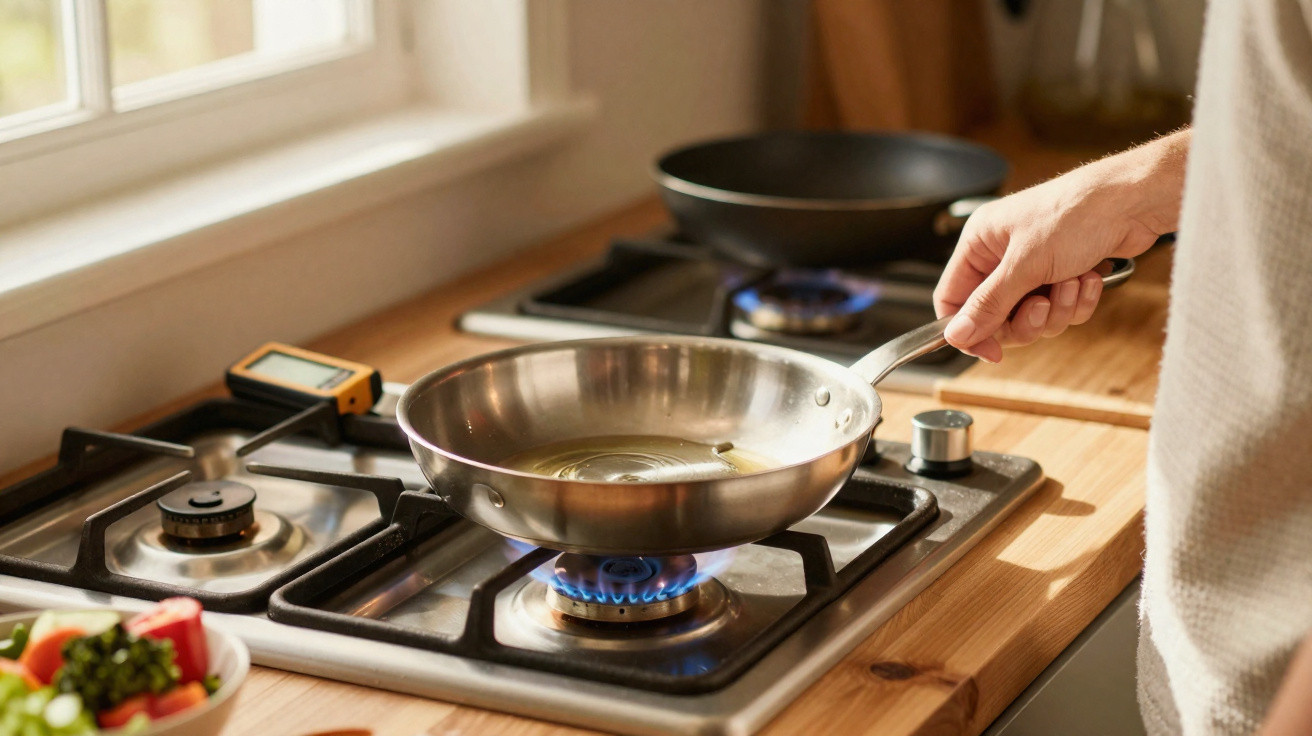
The smoke alarm is beeping, oil is spitting and someone is quietly swearing in the kitchen. A frying pan sits on the hob, fiercely hot and already tinged blue. The steak that was meant to be “properly restaurant-style at last” is black around the edges and still cold in the middle. Next to the pan, a phone is paused on a TikTok video: “Super-crispy chicken breast over MAXIMUM HEAT”. We all know that moment. You only wanted to make something good without much fuss. Instead, you are standing there, waving a tea towel to clear the smoke and wondering why it always looks so effortless when other people do it. Perhaps the issue is not a lack of skill. Perhaps it is the temperature.
Why we turn the heat up so mercilessly
In many kitchens, cooking begins with a reflex: switch on the hob and turn the dial straight to level 9. When we are hungry and short of time, we instinctively assume: “More heat = food ready faster.” The frying pan becomes a turbo shortcut, a way of speeding up cooking. Nobody wants to wait while something heats up “gently”. It feels like wasted time. So, full power it is. Then we wonder why everything goes from raw to burnt in seconds.
A chef from a small bistro in Cologne once told me that he sees the same pattern in amateur cooks almost every time: “The pan is too hot, there is too little fat, and their impatience is hotter than anything else.” During cookery classes, he demonstrates this with an experiment: two identical frying pans, one on level 9 and the other on level 6. Each receives the same piece of salmon. After three minutes, the fillet in the first pan is already dark on the outside, stuck to the surface and leaking protein. In the second pan, the skin is glossy and crisp while the flesh remains juicy. Then comes the sentence that hangs in the room: “You do not lack talent; you are simply using too much heat.” People laugh, but you can see something click for some of them.
Part of the reason runs deep: we confuse pressure with effectiveness. High heat feels like action. Something is happening. It sizzles and crackles. By comparison, quiet, controlled warmth can seem almost boring. We also have an image of “proper searing” from television programmes, where everything steams dramatically. In reality, good frying is more quiet than spectacular. And, honestly, in everyday life nobody preheats a pan precisely according to the textbook when their stomach is rumbling and the children are already asking when dinner will be ready. The dial at maximum often wins over every piece of kitchen wisdom.
What “properly hot” should actually feel like
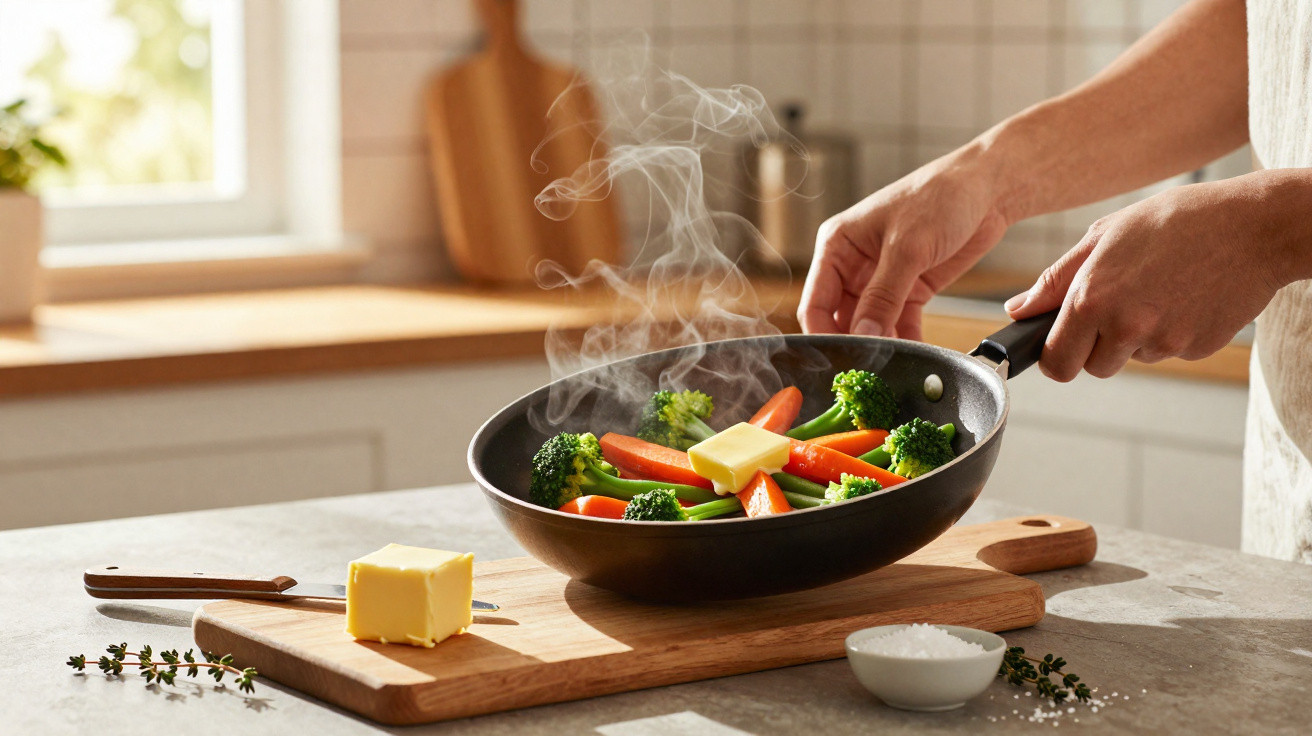
Professional chefs use a straightforward technique that works just as well at home: the frying-pan timing test. Set the pan to a medium or medium-high heat, wait two to three minutes, then drop in a little water. If it instantly breaks into hundreds of tiny beads that dart around wildly, the pan is too hot. If it moves slowly across the surface as one small bead, you are in the right range. Only then should you add the oil, followed by the food. It sounds unremarkable, but it changes everything. Starting this way suddenly means vegetables develop colour rather than char, and meat no longer sticks so frustratingly.
Many people make one of two familiar mistakes. They pour oil into a cold pan and turn the hob to maximum, hoping the pan will heat up “together with the food”. The result is that the food sits in lukewarm fat for too long, absorbs it before any real browning flavours develop, and by the time the pan overheats, the outer few millimetres are burnt while very little has happened inside. The other error is heating an empty pan so fiercely that it is smoking before anything comes near it. For many, this seems like the secret sign of a professional. In truth, it is a warning. Oil has a smoke point: above it, flavour turns bitter and unhealthy substances form.
“Good frying is like good storytelling: you need heat, but you must not burn the story.”
A chef from Berlin put it like this. If you want to burn less food, follow this short list:
- Begin over a medium heat – the highest setting is a specialist tool, not the default mode.
- Preheat the pan first, then add oil, then the food – in that order.
- It is better to wait a few seconds longer until the surface lightly shimmers than to rely on smoke as your signal.
- With thicker cuts of meat, start briefly at a higher heat, then reduce it so the centre stays juicy.
- If it smells brown rather than golden-brown, you have already gone far beyond the right point.
Why it is not only about food, but about us too
Watch people cook and you can often see their mood reflected in the frying pan. When someone is stressed, tired or irritated, they instinctively turn the heat higher. They want cooking to be over quickly. The pan becomes an outlet, with heat acting as a shortcut through the chaos of the day. But the price comes later: burnt-on residue, tough meat and a complaining stomach. Along with that comes the quiet feeling of having “failed to get it right again”. Many people carry this small kitchen frustration around without realising it.
There is also a less visible physical aspect. Overheated frying pans, particularly those with certain coatings, release substances at very high temperatures that nobody would willingly breathe in. Rapeseed oil, sunflower oil and butter all have their own temperature limits. Constantly exceeding them affects more than flavour; it affects the whole room. The good news is that you do not need to become obsessed with thermometers to avoid this. Basic awareness is enough. If the oil is already smoking angrily and the heat hits your face as you stir, you are well beyond the right temperature.
Ultimately, there is something reassuring about it all. Most “kitchen disasters” are not caused by a lack of talent, but by excessive heat. Turning the dial down a little often produces a strange effect: cooking suddenly feels calmer, more manageable and almost relaxing. There is more space to notice aromas, observe what is happening and make small adjustments. You can pause to breathe instead of desperately scraping burnt food from the pan. Perhaps that is the hidden lesson in this whole question of heat: not everything improves simply because we turn it up faster and louder.
| Key point | Detail | Benefit for the reader |
|---|---|---|
| Excessive heat is the standard mistake | Many people automatically begin on the highest setting, burning away flavour and texture as a result | The realisation: it is not a “talent problem” but a temperature problem – and one that can be changed immediately |
| Medium heat produces better results | The water-drop test and a short preheating time provide control instead of chaos | A practical method for juicier meat and crisp vegetables |
| Heat also affects health and mood | Smoking oils, frayed nerves and small everyday frustrations in the kitchen | Motivation to cook more gently and put yourself under less stress |






Comments
No comments yet. Be the first to comment!
Leave a Comment