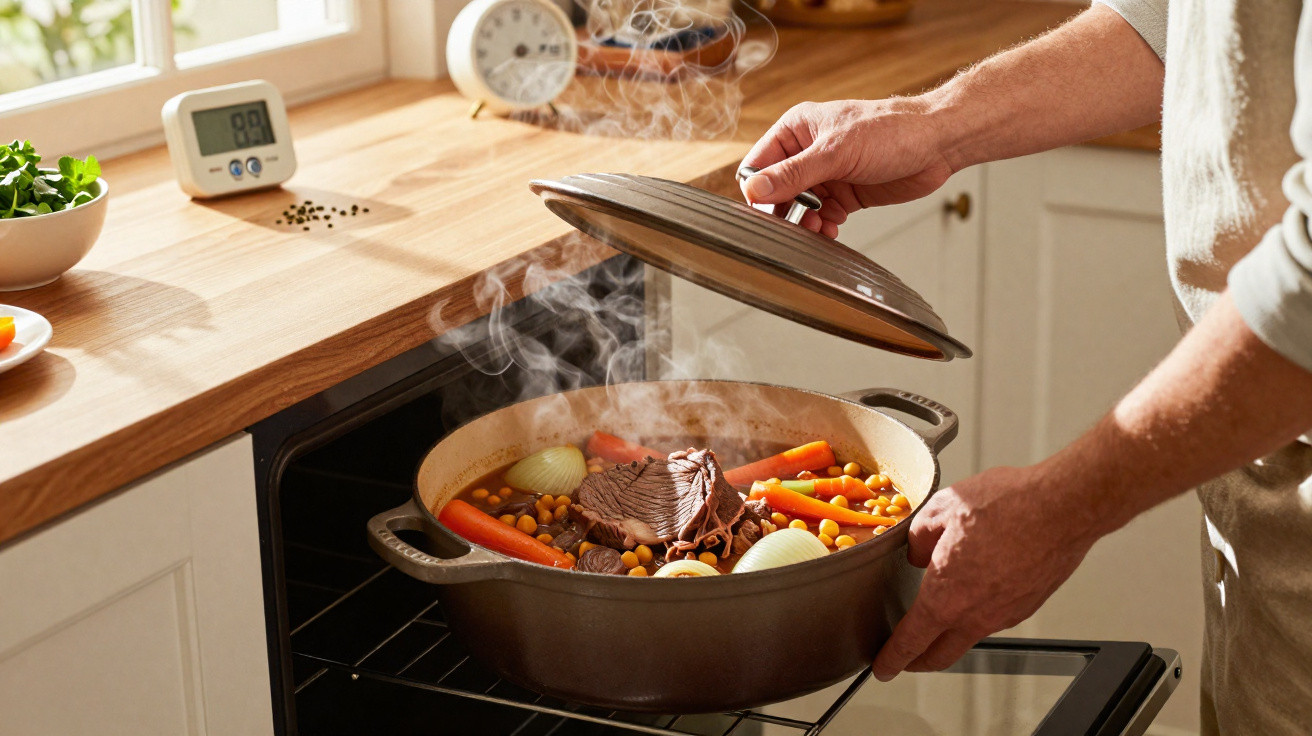
Gentle heat, patience and a covered pan can quietly produce profound flavour, pure juiciness and tender results.
Many home cooks pursue fierce heat to create a quick crust. Yet tough cuts benefit more from a low oven and need no additional oil. Gentle, consistent heat transforms collagen into silky gelatine, retains moisture and makes economical shoulders taste remarkably indulgent.
Why slow-oven cooking transforms tough cuts
Tough cuts contain plenty of connective tissue. At high temperatures, this collagen stands in the way of tenderness. In a slow oven, however, it gradually unwinds and melts into gelatine. That gelatine lends the cooking juices substance and creates a luxurious mouthfeel without cream or butter.
The ideal range is 225°F to 250°F (105°C to 120°C). Temperatures here reduce drying at the surface, prevent muscle fibres from tightening excessively and forcing out moisture, and let the meat cook in its own humid environment beneath a lid or tightly sealed foil.
Collagen starts converting to gelatin around 160°F (71°C) and keeps going toward 190°F (88°C). Holding meat in that zone softens connective tissue without drying lean muscle.
What low heat actually does
With low heat, evaporation happens more slowly, leaving steam inside the pot. That steam distributes heat evenly while shielding the exterior. Salt has time to work its way further into the meat, while aromatics soften and become sweeter. As gelatine thickens the liquid, the juices develop into a naturally made sauce.
High temperatures can drive the outside above 300°F, encouraging a crust but risking a dry band beneath it. A low oven instead narrows the difference between the surface and centre temperatures. The result is meat that becomes tender right through from edge to middle.
Set up your slow-oven routine
Select a suitable cooking vessel. A Dutch oven, or another substantial pot with a lid, holds in moisture effectively. A roasting tin sealed firmly with foil also works well. Heat the oven to 225–250°F (105–120°C) before cooking, and resist opening it repeatedly, as temperature fluctuations lengthen the cooking process.
- Salt in advance: target 1.0–1.5% salt relative to the meat’s weight, ideally 8–24 hours before cooking.
- Include aromatics: onion, garlic, bay, fennel, citrus peel, star anise or whole spices.
- Keep it lean: use a small splash of water, tea or stock, and leave out the oil. The meat’s own juices provide the flavour.
- Seal it tightly: a lid or foil maintains high humidity. Placing parchment beneath the lid further limits evaporation.
- Begin with the meat cold from the fridge. Put it directly into a thoroughly preheated oven for a safe rise through the danger zone.
No added fat is needed. Gelatin and reduced juices deliver body, while a final blast of high heat builds color.
Time, temperature and safety
For greater control, use a probe thermometer. Timing varies according to the cut’s size, shape and whether it includes bone. Aim for an internal temperature that allows collagen to soften, followed by a rest so the juices can settle.
| Cut | Oven temp | Target internal | Ballpark timing |
|---|---|---|---|
| Beef chuck/shoulder (3–5 lb / 1.4–2.3 kg) | 250°F / 120°C | 195–205°F / 90–96°C | 4–6 hours |
| Beef shank (2–3 lb / 0.9–1.4 kg) | 245–250°F / 118–120°C | 190–200°F / 88–93°C | 4–5 hours |
| Pork shoulder/butt (5–8 lb / 2.3–3.6 kg) | 240–250°F / 115–120°C | 198–205°F / 92–96°C | 6–10 hours |
| Lamb shoulder (4–6 lb / 1.8–2.7 kg) | 240–250°F / 115–120°C | 190–200°F / 88–93°C | 4–7 hours |
| Brisket flat (5–7 lb / 2.3–3.2 kg) | 225–245°F / 105–118°C | 200–205°F / 93–96°C | 7–10 hours |
Transfer the meat promptly from the fridge to the heated oven, keeping it refrigerated until it is time to cook. A covered pan helps it pass more quickly through 40–130°F (4–54°C). Once cooked, leave the meat covered to rest for at least 20 minutes.
Flavour without adding fat
A slow oven develops flavour gradually. Build layers of impact that do not depend on oil: a teaspoon of tomato purée brings umami, while anchovy paste disappears into the dish and increases savouriness. Vinegar or citrus cuts through richness without adding grease, and a little soy sauce deepens the flavour of beef and lamb.
For colour, use a high-heat finish. Put the uncovered pot on the upper shelf and grill for 2–5 minutes. Alternatively, lift out the meat and roast it on a rack at 475°F (245°C) for 8–12 minutes. This creates browned flavours while keeping the centre tender.
Vegetables and beans ride shotgun
Root vegetables perform particularly well with low heat. Large pieces of carrot, onion, celery, turnip, fennel and celeriac hold their shape. After soaking, chickpeas or white beans can be added to the pot; they simmer in the juices and absorb collagen-rich richness. Add delicate vegetables such as courgettes only for the final 30 minutes so they do not fall apart.
The pot liquor turns into a natural glaze. Spoon it back over sliced meat. Chill leftovers to lift the solid fat, then rewarm the gelatin-rich jell for a clean, glossy sauce.
Common mistakes to avoid
- Oven too hot: the muscle fibres tighten sharply and press out moisture.
- Loose cover: escaping steam causes the pot to dry prematurely.
- Too little salt: seasoning cannot work its way in over a long cooking time.
- No thermometer: estimation can leave collagen insufficiently softened or the meat overcooked.
- Skipping the rest: juices do not redistribute, making slices appear dry.
Braise or slow roast? Pick your path
Both approaches rely on low temperatures. In a braise, the meat is partially submerged and cooked under a lid, making it suited to shreddable meat and saucy dishes. With a slow roast, the meat sits above a shallow pool of liquid, usually on a rack; the pan is generally covered at first and uncovered later. This maintains more exterior texture and helps slices remain whole.
For fatty cuts, cook covered initially, then allow a longer uncovered finish. With lean cuts, leave the cover on for nearly all of the cooking time and give the meat a rapid final sear.
Beyond meat: gentle heat for fish and more
Thick salmon fillets respond well to 250°F (120°C). Season them, add slices of citrus, cover loosely and bake for 20–30 minutes until they reach 120–125°F (49–52°C) for moist, flaky fish. Cod and haddock are better at 275°F (135°C) for a shorter period. Halved whole garlic heads become soft, spreadable cloves after 60–75 minutes. Sweet potatoes become velvety after 90 minutes at 250°F when wrapped in foil.
Troubleshooting and small upgrades
If the internal temperature of the meat pauses at around 170–180°F, that is expected: collagen conversion uses energy. Keep the lid in place, and consider lining the pot with a parchment wrap to limit evaporation. When time is limited, raise the oven to 275°F (135°C) for the final hour, watching the internal temperature carefully.
For large shoulders, plan an overnight cook. Begin at 10 p.m. at 225°F (105°C), then set the probe alarm to 200°F (93°C). If your oven permits it, hold the meat warm at 170°F (77°C). Preparing this way makes for a relaxed lunch service and meat that slices cleanly after an extended rest.
Smart, lean meal prep
Cook once and eat three times. Slow-oven beef chuck can serve as taco filling one evening, form the base of barley soup the next, and top a grain bowl afterwards. Refrigerate the pot juices to remove the fat, then warm the gelatine-rich stock again for a glossy finish with no added oil.
Two technical points give you more control. First, salt moves slowly through meat, so salting the surface the night before creates even seasoning without the need for containers of brine. Second, gelatine provides body even at very low concentrations, meaning a little reduced pot liquor can thicken vegetable stews and bean ragouts without cream or butter. This approach reduces added fat, extends flavour and makes modest cuts into memorable meals with minimal effort.






Comments
No comments yet. Be the first to comment!
Leave a Comment