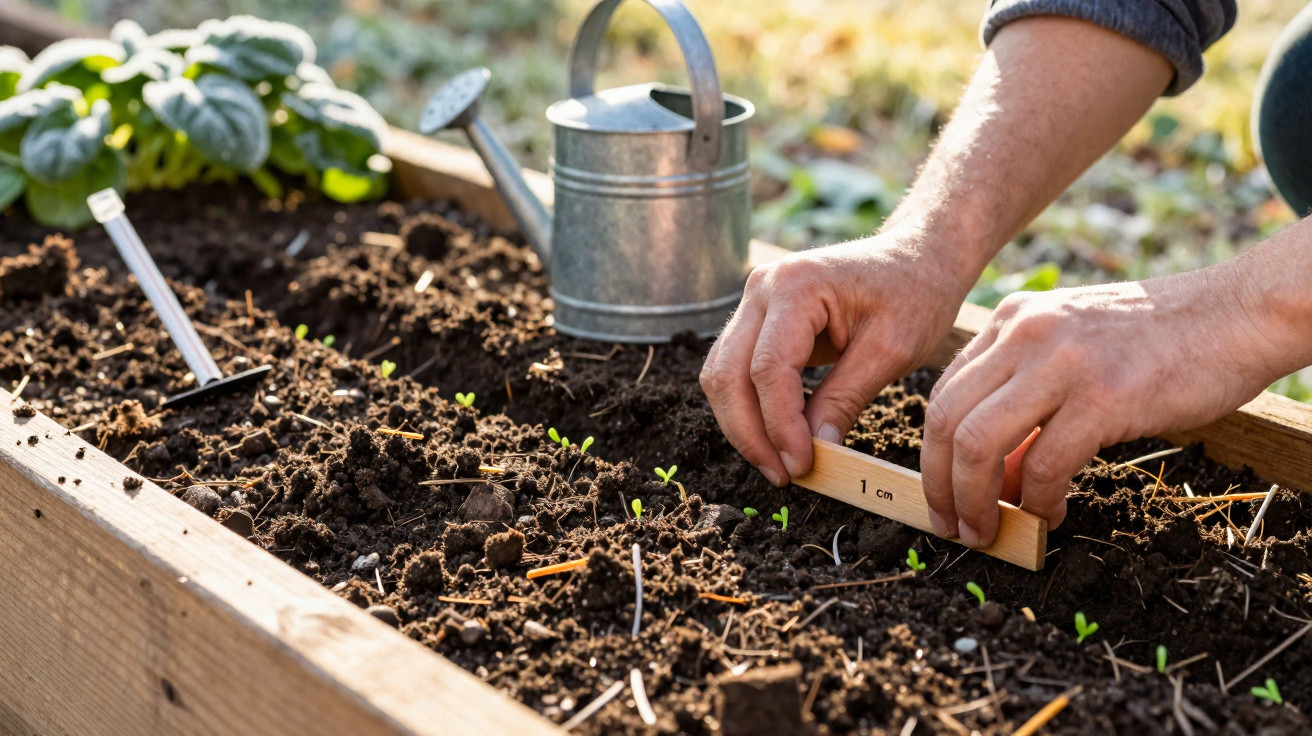
Across the UK and US, winter vegetable growers repeatedly make one tiny error: they plant seed a little too deeply, then fault the frost, the seed packet or “bad luck” when no seedlings appear.
Why a 1cm rule is suddenly dividing winter gardeners
This year, seasoned growers have been increasingly repeating one message: sow spinach in mid-winter within the top centimetre of soil or risk losing the crop. It may sound overly precise. It also contradicts lessons many gardeners have followed for years, prompting debate on allotments, in community gardens and across online forums.
Laid bare by repeated failures, gardeners are discovering that in January, depth matters more than variety, fertiliser or even seed quality.
The disagreement stems from the conflict between instinct and plant biology. Instinct says, “protect the seed from the cold, tuck it in deeper”. Plant physiology says, “keep the journey to the surface as short as possible, or the seedling runs out of fuel before it sees light”.
Spinach in January is not spinach in April
Spinach is widely regarded as a robust and forgiving crop. Spring growing guides present it as hardy, straightforward and dependable. That reassurance often leads gardeners to handle winter sowings exactly as they would April rows: rake the bed, make a drill, cover the seed by a couple of centimetres, water and wait.
Winter weather, however, reverses the usual approach. During January and early February:
- Soil remains cold for several days following every frost.
- Water persists in the ground and can saturate the upper few centimetres.
- Germination slows dramatically, turning a process of days into two weeks or longer.
- Daylight remains limited, meaning newly emerged seedlings develop slowly.
Together, these conditions make each additional millimetre of soil a greater hazard. A spring sowing depth of 2–3cm that seems harmless can become a difficult underground obstacle course in winter.
The hidden killer: cold, wet soil that never lets up
At ground level, a failed winter spinach row simply appears bare. Beneath the surface, the outcome is very different: seeds have swollen, shoot tips have turned pale, and embryos have rotted before completing their journey.
Slow germination gives rot a head start
In warm ground, a spinach seed rapidly becomes active, splits open, sends out a root and then raises a small hooked stem towards the light. This can take only a few days, sometimes even fewer, leaving microbes little opportunity to cause damage.
Cold, waterlogged soil slows every stage. The seed takes in water and its enzymes begin to operate, yet the whole process proceeds at a crawl. It stays soft for longer, while the tiny root is slow to advance. Fungi and bacteria, by contrast, are not delayed: constant moisture and cool conditions suit them well.
The longer a spinach seed sits buried in cold wet soil, the higher the odds that rot destroys it before it ever breaks the surface.
Sowing depth intensifies the problem. Seed planted at 3cm requires a longer stem, more time and more energy to reach daylight than seed set at 5–8mm. Disease pressure continues increasing throughout that extended period below ground.
Why the warmest place in winter soil is almost the surface
There is another surprising factor: during January, protection is often found nearer the surface rather than deeper down. The upper few millimetres react quickly to even weak sunshine. A short sunny interval can raise their temperature by several degrees while lower layers remain persistently cold.
Seed positioned in the first centimetre can respond to these daily changes. Small shifts between warmth and cold provide a germination signal. Seed buried further down experiences an unchanging thermal dullness, nearer refrigerator-level temperatures. The systems responsible for germination never properly start working.
The one-centimetre ceiling: how deep is too deep?
Cool-climate horticultural researchers consistently return to a similar winter-sowing threshold for small seed: roughly 1cm, preferably slightly shallower. Once this is exceeded, failure rates rise sharply in cold, wet ground.
For winter spinach, 1cm is not a guideline. It behaves like a hard limit. Cross it and you are asking a weakened seedling to do the work of a strong one in hostile conditions.
The comforting myth of the “nice deep, warm bed”
Many gardeners remain attached to the belief that deeper sowing gives better insulation. It is an appealing picture: seed resting beneath a thick soil blanket, protected from ice, wind and birds. Yet that image overlooks several issues:
- Lower soil levels remain cold for longer after frost.
- Air levels decline with depth, although roots require oxygen.
- Water drains more slowly, keeping seed in prolonged dampness.
- Surface crusts can become a barrier that weak shoots cannot break through.
For January spinach, this supposed “warm bed” is more like dense, cold concrete. The result is sparse emergence or no emergence at all.
The seed’s battery runs flat underground
Every spinach seed contains a finite energy reserve within its tissues. That “battery” must support root development, stem extension and cotyledon growth until leaves reach light and photosynthesis begins.
Cold soil makes every biochemical process take more time and use more energy. Where a stem must travel through 2–3cm of firm, chilled ground, much of that reserve is spent merely pushing upwards. As the shoot approaches the surface, its battery is nearly exhausted. A single cold night or a compacted soil crust can then finish it off, killing the seedling only millimetres from daylight.
| Depth of sowing | Energy used before light | Risk of rot/failure in January |
|---|---|---|
| 0.5–0.8cm | Low | Moderate |
| 1.0cm | Medium | High if soil is waterlogged |
| 2–3cm | High | Very high in cold, wet soil |
How to actually hit that 1cm in real soil
The principle is straightforward, but applying it can be difficult, particularly in uneven beds damaged by winter rain. A shallow sowing can fail as soon as a seed drops into a crack or settles inside a small dip.
Start with a flat, fine seedbed
Before opening the seed packet, winter growers are now giving the surface more attention. They break up clumps, rake the bed level and remove stones. The aim is a thin, uniform upper layer rather than rough tilth.
Uneven ground quietly sabotages shallow sowings: a seed that slips into a 3cm depression no longer lives in the safe zone, whatever the gardener intended.
In heavy clay or compacted urban plots, gently scratching the surface with a fork or hand cultivator is useful. Restricting the work to the top few centimetres retains the deeper structure while creating a consistent place for seed to rest.
Cover with something finer than your soil
A useful winter spinach technique is to separate the layer supporting the seed from the material covering it. Many growers now:
- Place seed straight onto the prepared soil surface at the right spacing.
- Scatter a light layer of fine seed compost or sieved garden soil along the row.
- Use only enough material to conceal seed from birds, rather than adding a full centimetre of cover.
- Firm lightly with a board or the reverse of a rake, ensuring contact without compacting the soil.
This approach makes the seed position consistent while providing the shoot with a soft layer to pass through. The soil underneath retains moisture, while the fine covering is less likely to form a hard crust after rain.
Watching the first centimetre like a hawk
After sowing, the focus moves from depth to moisture. Seed close to the air layer benefits from additional warmth, but has less protection and may dry out rapidly during windy weather.
Moist but not drowned
For winter spinach, the upper centimetre of soil should remain gently damp most of the time. Saturated conditions encourage rot, while drying stops germination. Achieving the balance involves:
- Watering with a fine rose so that droplets do not shift the seed.
- Not watering heavily before severe frosts, as ice may form around the seed.
- Covering with fleece or a low tunnel to reduce wind and raise temperatures slightly.
When weather conditions are favourable, shallow-sown spinach commonly produces green hooks in 10–15 days, even during late-winter weather, whereas deeper sowings from the same packet may still show no sign of growth.
Beyond spinach: what this rule hints at for other winter crops
The spinach 1cm debate points to a wider change in winter gardening practice. Growers are beginning to view sowing depth as an active setting that can be adjusted, rather than as an approximate instruction on the seed packet.
Small-seeded crops including lettuce, Asian greens, lamb’s lettuce and certain herbs encounter similar winter challenges. Many benefit from exceptionally shallow sowing beneath cloches or in trays, followed by planting out once their roots hold the soil together. Others, including broad beans and peas, still need greater depth because their larger energy stores can support a more forceful push upwards.
The new winter playbook treats each seed like a tiny stored battery. The colder the soil, the shorter the journey to light must be, unless that battery is huge.
Gardeners who like to experiment can use a simple trial to improve their local methods. Mark three short rows in one bed. Sow one at the packet-recommended depth, another at around 1cm and a third with barely any covering. Record which row appears first, which loses plants and how the surviving plants look after two weeks. Repeating this small experiment over a season produces genuinely site-specific knowledge that is much more useful than general guidance.
There is a psychological element as well. Following the 1cm limit requires gardeners to accept what can seem slightly unsafe: seed nearer the weather and covered by little more than a dusting of soil. This move from “bury to protect” to “lift to accelerate” may influence not only January spinach growing, but also the way winter crops are understood more broadly.
















Comments
No comments yet. Be the first to comment!
Leave a Comment