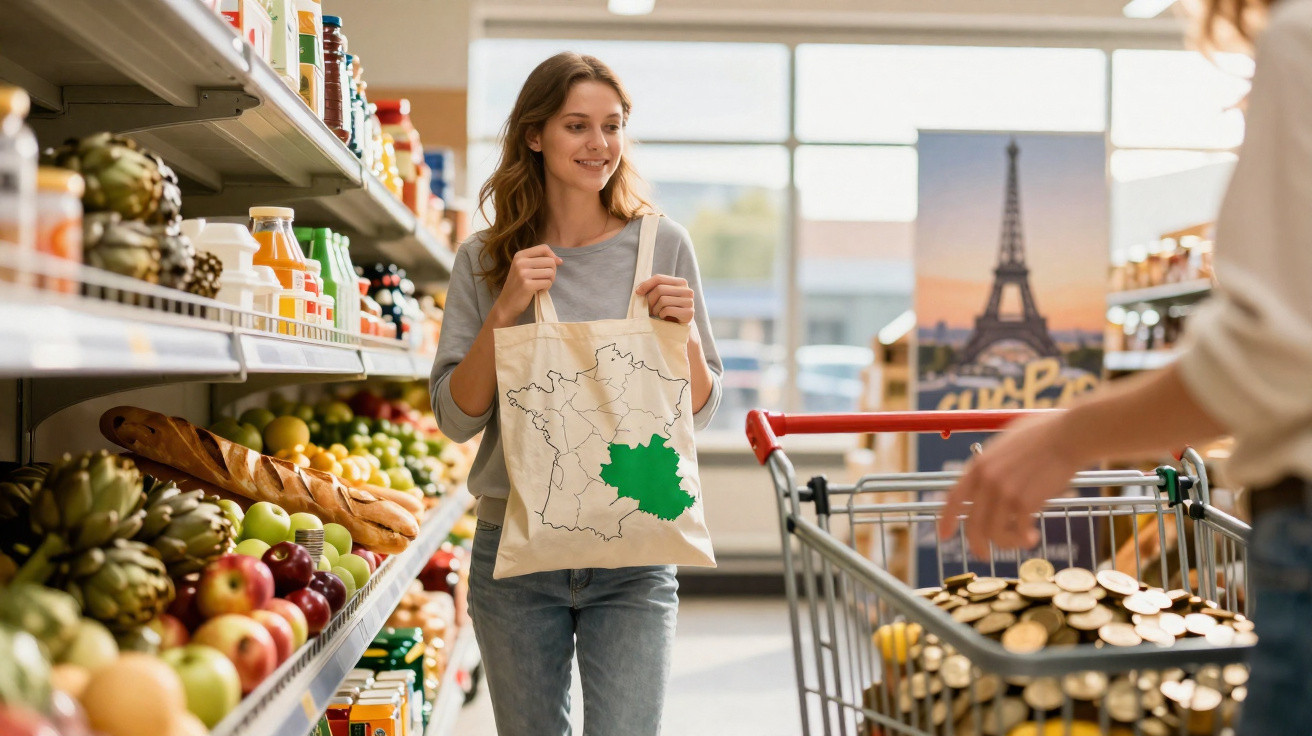
Some French families spend hundreds more every year on identical milk, pasta and butter purely because of where they live.
From coastal Brittany to Paris’s crowded streets, the cost of a basic food basket can vary dramatically, shaped by rents, distribution costs and retailers’ pricing power. These regional differences increasingly determine where household budgets have some breathing space and where every till beep stings.
Why the same basket costs so much more in Paris
Data from TF1 and NielsenIQ reveals differences of up to 23% between certain French departments. Shoppers in the Paris region generally face a noticeable surcharge for the very same everyday goods.
The main reason is straightforward: premises are expensive - exceptionally so - in and around the capital.
Where commercial rents and warehouse land prices soar, the extra cost almost always lands on the receipt.
Supermarkets require warehouses, loading areas, parking and retail floor space. In Île-de-France, each square metre reduces their profit margins. Sites close to logistics centres or within tightly packed urban districts command high prices, and retailers transfer some of that cost to shoppers.
As landlords increase rents or suitable retail premises become harder to find, supermarket groups have less flexibility. They may renegotiate supplier agreements, reduce staffing, introduce self-service tills or lower marketing costs. However, those savings have limits, with the remainder appearing in higher prices on the shelves.
A further factor affects wealthy or highly sought-after areas including Paris, Hauts-de-Seine and the French Riviera (Alpes-Maritimes): shoppers are more willing to tolerate higher prices. Many local households already pay substantial housing costs, so their food spending rises accordingly. Retailers recognise this and offer less aggressive discounts than they do in areas where customers are more price-sensitive.
Logistics, labour and dense cities
Expenses extend well beyond rent. Deliveries in cities are persistently difficult, with narrow roads, congestion, restricted delivery hours and a requirement for smaller but more frequent loads.
- Delivery lorries spend longer in traffic and must comply with access restrictions.
- Small city-centre shops have little storage space, requiring more warehouse deliveries.
- Labour is more costly in major cities, including for warehouse workers and checkout staff.
These obstacles raise the cost of placing every pot of yoghurt, bag of rice or cleaning product on the shelf. Across thousands of product lines, even a few additional cents per item can alter a region’s average basket cost.
Brittany, the quiet stronghold of cheaper groceries
At the cheaper end of the price map is Brittany, where the average basket is often a few percentage points below the national figure. According to the TV report, shoppers in departments including Finistère and Côtes-d’Armor can pay roughly 3% less than the French average for comparable products.
Brittany has both cheap land and fierce supermarket competition, a rare combination that benefits local shoppers.
Two major retailers, Leclerc and Système U, originated in western France, and that heritage remains significant. The local chains developed alongside one another, competed for market share and created a culture of firmly competitive pricing. Where several powerful supermarket brands compete within a small area, they negotiate forcefully with suppliers and compete to be seen as “the cheapest nearby”.
Breton shoppers benefit indirectly from this price battle. Promotions are more common, while own-brand ranges remain competitively priced. Some shops accept slimmer margins on essential products such as milk, pasta and coffee to retain loyalty, making up the difference through non-food and premium goods.
The power of local sourcing
Brittany also benefits from its location. Supermarkets can obtain much of their fresh produce locally, including dairy products, meat, vegetables, fish and seafood. Shorter supply routes reduce both transport expenses and the likelihood of waste.
As a supermarket director in Morbihan explained in the report, when fish is sourced only a few kilometres away, the retailer avoids long-distance distribution, refrigerated lorries travelling hundreds of kilometres and several intermediaries. That saving is reflected directly in fish-counter prices.
The principle applies, though less strongly, to fruit, vegetables and certain processed products. When farmers and manufacturers are located close to distribution centres, fewer stages are needed between the farm and the shelf.
| Region / area | Typical price level vs national average* | Main drivers |
|---|---|---|
| Paris & inner suburbs | Up to +20% | High rents, dense urban logistics, stronger purchasing power |
| French Riviera (Alpes-Maritimes, etc.) | Often above average | Tourism, expensive land, affluent clientele |
| Brittany (Finistère, Côtes-d’Armor…) | Around –3% in some departments | Strong competition, local sourcing, cheaper land |
*Figures based on reported ranges from TF1 / NielsenIQ; values vary by product and store.
How competition reshapes the grocery bill
Competition is influenced by more than the number of shops available; store format and commercial strategy also matter. In some semi-rural parts of France, a single out-of-town hypermarket may cater for almost the entire local population. If alternatives are limited - with few discounters, little click and collect provision and few local markets - the dominant retailer can maintain relatively high prices.
In contrast, several chains frequently serve the same catchment area in parts of Brittany and western France. Customers can readily move between Leclerc, Intermarché, Système U and Lidl. This possibility compels each retailer to watch its price image closely and amend shelf prices whenever a competitor undercuts it on important products.
Where shoppers can change supermarket with a short drive, price tags stay under pressure; where they cannot, they pay more.
Online comparison tools create an additional level of transparency. Apps and price-monitoring websites encourage some chains to promote “low-price baskets” or frequent price comparisons with rivals. Such campaigns are more prevalent in already fiercely contested markets, reinforcing the advantage of regions that were cheaper to begin with.
South of France and suburbs: the opposite equation
Many southern areas and parts of the Parisian belt bring together higher distribution costs and weaker competition. Urban sprawl lengthens delivery journeys, while land near motorways and ports is costly. Labour shortages increase wages, and retailers in tourist locations adjust prices for seasonal demand, particularly during summer.
In these places, discount retailers can limit price rises, but only where there are enough of them. Where a town has one large supermarket and only a few small local shops, households often have little genuine purchasing power through their choice of retailer.
What this means for French households-and for policy
For a family buying food once or twice a week, a 20% variation in the weekly basket represents hundreds of euros over a year. The additional pressure falls most heavily on lower- and middle-income households, especially those already dealing with expensive urban rents and transport.
French authorities monitor food inflation and margins throughout the supply chain, from farmers and processors to retailers. Regional differences, however, present a difficult question: should Paris and Brittany be regulated in the same way when their underlying costs differ so greatly? Some consumer organisations call for greater regional transparency rather than reliance on national averages alone, to better reflect local household budgets.
How a shopper can react to regional price gaps
Most people cannot relocate simply to reduce food costs, but several changes in shopping habits can ease the difference:
- Use price-comparison apps to identify nearby retailers with consistently cheaper baskets.
- Buy more own-brand products, which often resemble branded alternatives at a lower cost.
- Purchase more from outdoor markets or producer stalls when they beat supermarkets on seasonal fruit and vegetables.
- Make occasional bulk-buying trips to cheaper hypermarkets outside city centres, particularly for non-perishable goods.
For instance, someone in the outskirts of Paris could make a quick calculation: a monthly bulk purchase at a less expensive suburban hypermarket may outweigh the fuel and time involved if their usual nearby shop charges 10–15% more for cupboard staples. Recording the prices of a dozen key items in a basic spreadsheet or phone note can provide a realistic comparison after a few weeks.
Beyond food: the broader cost-of-living map
These regional variations also demonstrate how deceptive national averages can be. A Paris household pays not only higher rent: electricity, parking, childcare and food all form a financial reality very different from that experienced by a household in rural Brittany or central France. Grocery prices intensify these inequalities rather than balancing them out.
For analysts and policymakers, mapping these price zones makes it easier to assess genuine purchasing power instead of theoretical income. For retailers, it focuses attention on how far margins can be stretched before customers complain or move to discount stores. For households, the weekly food shop becomes a quiet indicator of their position within France’s divided cost-of-living landscape.
















Comments
No comments yet. Be the first to comment!
Leave a Comment