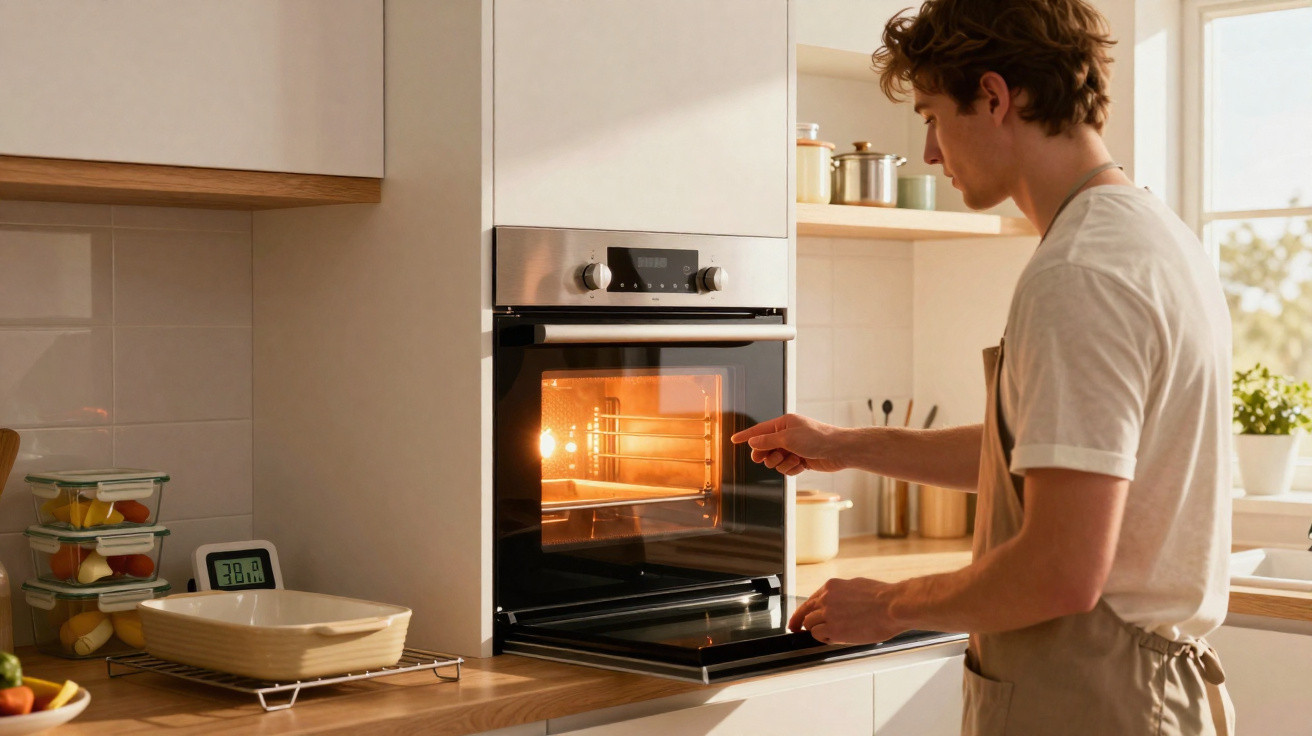
In almost every home, it sits there looking harmless, as much a part of daily life as coffee and washing-up liquid. Yet behind its glass door is an appliance that, at peak demand, draws as much power as dozens of refrigerators running at once. Understanding why this kitchen appliance uses so much energy – and how to rein it in – can make a noticeable difference to electricity costs.
The kitchen’s hidden energy guzzler
The appliance in question is the conventional electric oven. Whether it is a built-in model or a compact countertop oven, the electricity meter speeds up noticeably as soon as it starts heating. The reason is straightforward: an oven has to raise air and metal to high temperatures, then maintain that heat for an extended period. That requires a substantial amount of energy.
A refrigerator has an easier job. It maintains a cold environment inside a well-insulated cabinet and only needs to compensate when warm air enters. An oven does the exact opposite: it has to generate intense heat from scratch, time after time.
A single electric oven can draw as much power at peak as up to 65 refrigerators operating at the same time.
Typical figures illustrate the sizeable gap: a standard electric oven usually has a connected load of between 2,000 and 5,000 watts. Depending on the model, an ordinary refrigerator operates at around 300 to 800 watts. During the heating-up phase, the oven will often run close to its upper limit.
Why an oven becomes so expensive in everyday use
Over time, this adds up. People who cook and bake regularly can quickly use 40 to 90 kilowatt-hours (kWh) a month on the electric oven alone. Studies of US households show that, in some cases, the oven accounts for up to a quarter of total annual electricity consumption.
The range is wide. Among the factors that matter are:
- The appliance’s power draw (wattage)
- The oven’s size and construction
- The quality of its insulation and door seal
- How often and for how long it is used
- Cooking temperature and heating-up behaviour
A small mini oven used for 20 minutes to bake bread rolls consumes considerably less than a large built-in oven operating for several hours to cook a roast or bake casseroles. The fundamental point remains unchanged: the oven is one of the largest individual items on an electricity bill – far more than many people realise.
Four simple habits that reduce electricity use
The good news is that there is no need to give up lasagne, bread or a Sunday roast. A few straightforward changes to everyday routines can cut energy use significantly without sacrificing convenience.
1. Switch the oven off earlier
An oven’s interior retains heat very effectively. Making use of that stored heat saves electricity. Depending on the dish, switch the oven off 5 to 10 minutes before the stated cooking time ends. The residual heat is often more than enough to finish cooking the food.
Switching the oven off 5 to 10 minutes early saves energy – without any loss of flavour.
This works particularly well for casseroles, lasagne, cakes and bread. The important thing is to experiment gradually until you understand how your own oven performs.
2. Open the door as rarely as possible
Every time the oven door is opened, hot air escapes. Temperatures can drop by 20 to 30 degrees. The oven then has to reheat immediately – and that uses electricity.
A better approach is to make consistent use of the oven light and viewing window. Open the door briefly only when genuinely necessary, such as when sprinkling on cheese or turning oven-roasted vegetables.
3. Use suitable ovenware
The material and colour of baking tins and trays have more influence than many people expect. Dark, heavy cookware – such as cast iron or dark steel baking trays – absorbs heat more quickly and retains it for longer. This shortens cooking time.
Light-coloured, thin trays reflect more heat and do not warm up as effectively. Anyone who bakes regularly therefore benefits from energy-efficient cookware. Particularly suitable options include:
- Cast-iron roasting dishes and lidded pots
- Dark steel baking tins for bread and cakes
- Ceramic or stoneware dishes for casseroles
4. Avoid standby power use
Some modern ovens continue to use a small amount of electricity even when switched off, for example for the clock, display or smart functions. This is often only a few watts, but over a year it can become noticeable.
If the oven can be completely disconnected from the mains using a separate switch or a switched extension lead, it is worth doing so – especially in households where baking is infrequent.
Batch cooking and baking instead of constantly preheating
Heating the oven is a major source of cost. While it climbs from room temperature to 180 or 200 degrees, it operates at full power. If this happens several times a day, the kilowatt-hours soon accumulate.
It is therefore worthwhile grouping baking and cooking tasks together:
- Bake several dishes one after another, starting with a cake and then a casserole.
- Cook the evening meal, then put in bread for the following morning straight afterwards.
- Where practical, use fan cooking to make use of two shelves at once.
Planning one larger baking session instead of three separate 30-minute oven uses saves several full heating-up phases each week.
Compared: oven, tumble dryer and refrigerator
When people think of energy-hungry appliances, the tumble dryer is often the first that comes to mind – rightly so, as it also commonly operates at 4,000 to 5,000 watts. The difference is that a tumble dryer usually runs one or two clearly defined programmes, whereas an oven is more likely to be switched on spontaneously and sometimes almost as an afterthought.
| Appliance | Typical power | Use |
|---|---|---|
| Electric oven | 2,000–5,000 watts | Irregular, often involving preheating |
| Tumble dryer | 4,000–5,000 watts | Fixed programmes, clearly limited |
| Refrigerator | 300–800 watts | Continuous operation, low power |
With a refrigerator, continuous operation is the key factor. Even so, its annual energy use is often lower than the oven’s because its power demand is far lower and it does not have to heat up to high temperatures.
As an oven ages, its energy use rises
Over the years, heating elements and seals deteriorate. The oven takes longer to reach the target temperature, while heat escapes more quickly. Both push electricity use upwards without it necessarily being immediately apparent.
Warning signs of an inefficient oven include:
- Dishes take noticeably longer to cook than they used to
- Major temperature differences inside the oven, with the front cool and the back hot
- Visible cracks or a crumbling oven seal
- Constant reheating or a fan that continues running for a very long time
In these cases, a repair or replacement may be worthwhile – particularly if a kitchen refurbishment is already planned. Modern models with better insulation and more efficient heating systems often use substantially less electricity for the same level of use.
How smart kitchen equipment pays off
Choosing quality cookware carefully can make an oven even more efficient. Heavy dishes and pots store heat, while lids prevent heat from escaping upwards. This can often allow the temperature to be reduced by 10 to 20 degrees without compromising the result.
A practical example is oven-roasted vegetables in a lidded cast-iron roasting dish: they cook faster and more evenly than on a thin baking tray. At the same time, the residual heat remains in the pot for long enough that it can be left in the switched-off oven for a few minutes after cooking has finished.
A limited budget does not mean buying from an expensive specialist retailer. Second-hand shops and flea markets often have used cast-iron frying pans, roasting dishes and thick-walled casserole dishes available for a fraction of their new price.
Using an electric oven wisely: small changes, big results
The electric oven is not going to disappear from kitchens. It remains indispensable for many dishes, especially in family homes. However, anyone who treats it as an innocuous standard appliance can easily spend a three-figure sum each year on baking and roasting alone.
The key is not only major investments such as a new oven, but above all everyday habits: switching it off early, keeping the door closed, grouping baking days together, choosing the right cookware and eliminating unnecessary standby electricity. These apparently minor adjustments add up month after month – turning a hidden energy guzzler into a much more predictable household expense.















Comments
No comments yet. Be the first to comment!
Leave a Comment