You get home from work, open the fridge, and feel hungry and slightly fed up. There is that pasta container you “meal-prepped” two nights earlier, now resembling a dense block of beige disappointment. You warm it up, take a mouthful and find exactly what you expected: soft, sticky and faintly claggy. Neither the sauce nor the Parmesan can rescue it. You finish it regardless, but it tastes like settling.
Meanwhile, a restaurant kitchen may be sending out pasta cooked hours earlier that still arrives at the table perfectly al dente. How do they manage what we do not?
The restaurant timing behind perfect pasta
Walk into a packed restaurant at 7.45 p.m. and look along the line. Pans are moving, steam is billowing and tickets are printing, yet every pasta dish that reaches the dining room is firm, springy and shiny with sauce. Most guests never realise that much of this pasta was cooked well before the first order arrived. There is no magic involved; it is all about timing.
When the restaurant is full, chefs do not risk boiling each portion of pasta from scratch. Instead, they use a smart process that brings cooking to an immediate halt.
At a small Milan trattoria, a chef once showed me his Saturday-night preparation. By 5 p.m., large trays of penne, tagliatelle and rigatoni had been cooked and divided into portions. Tasted directly from the trays, they seemed undercooked, with a slightly chalky middle. When I pointed this out, he smiled. “By the time you eat it,” he said, “it will be perfect.”
He was not taking a chance. His method was precise: after boiling, he shocked the pasta in very cold water, then gently heated it in sauce at the last minute. This allowed him to serve 100 pasta dishes in under an hour without producing a single mushy mouthful.
The reasoning becomes obvious once you see it in action. Pasta continues to cook after it has been drained because the heat held inside keeps moving towards the centre. That is why pasta timed perfectly in the pan can go limp before you even sit down to eat. Chefs understand that the real challenge is not boiling it, but controlling this retained heat.
They therefore lift pasta from the water sooner than most home cooks would, plunge it into cold water to stop the cooking abruptly, and revive it later in a hot pan of sauce. They are not simply cooking pasta; they are planning its timing.
The chef’s pasta method: part-cook, shock and finish to order
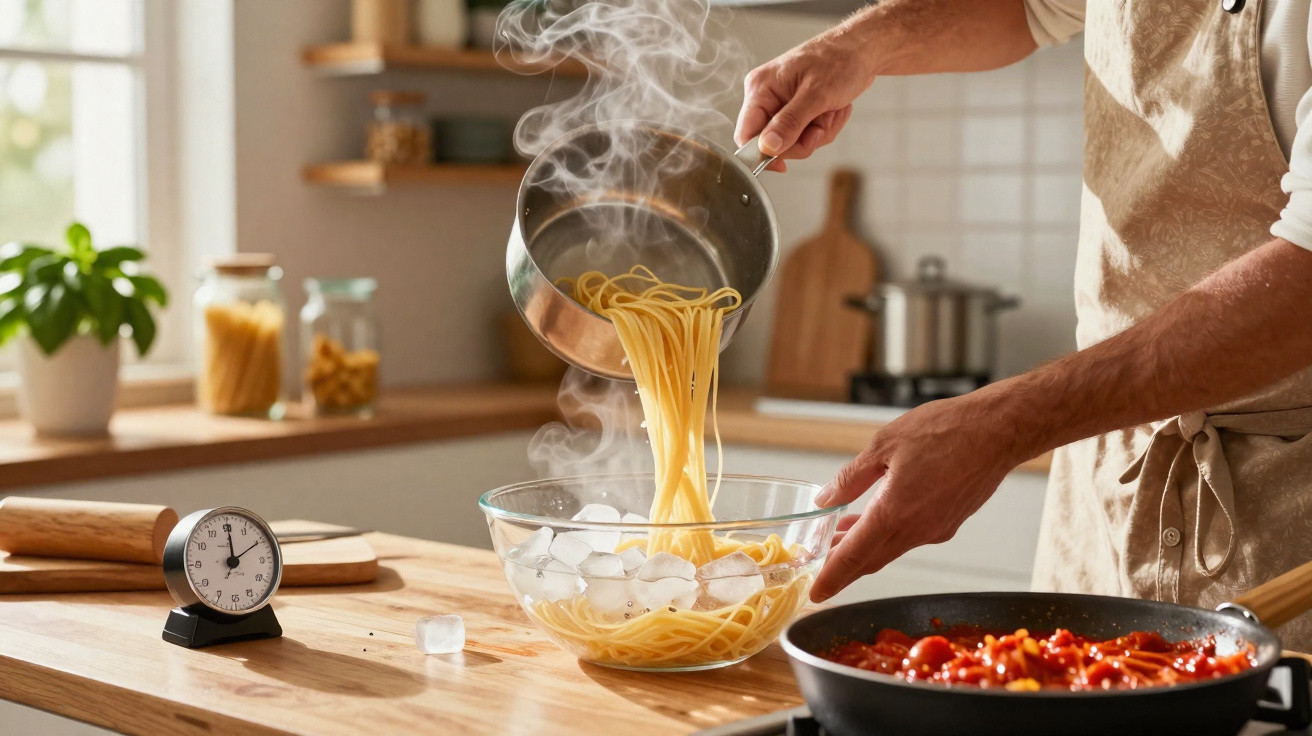
This is the essential technique chefs use to prepare pasta in advance. They cook it to only around 70–80% doneness, stopping just before it reaches proper al dente. The middle should still retain some resistance. They then drain it swiftly and immediately immerse it in a large container of very cold water, sometimes with ice. That cold shock is what stops the cooking process.
After the pasta has cooled, they drain it once more, coat it lightly with a neutral oil and divide it between containers. It can then stay in the fridge for several hours, or even for a whole day.
When an order arrives, the final stage begins. A chef will either put a portion of the pre-cooked pasta into boiling water for 30–60 seconds, or add it directly to a hot pan of already-bubbling sauce. During that final minute, it completes its cooking while taking on the sauce.
You can use the same approach at home on a Sunday evening: cook a large batch, leave it slightly underdone, chill it quickly, portion it into boxes and bring it back to life in sauce throughout the week. Your Tuesday lunch can suddenly taste as though it came from a restaurant kitchen rather than a lunchbox at the back of the fridge.
The small details are usually where home cooks go wrong. We fully cook the pasta, drain it, perhaps leave it hot in the colander, then put it into a container while it is still steaming. That trapped heat carries on cooking it, so the pleasant bite has disappeared by the time it is reheated. The pasta didn’t betray you; the timing did.
Chefs treat pasta as something with momentum. They respect the fact that it keeps changing even after it leaves the pot. When you begin to see it that way, the technique feels less like a clever hack and more like plain common sense.
How to use the chef trick in your kitchen
Begin with a large pan of generously salted water and your preferred dried pasta. Boil it for 2–3 minutes less than the packet's al dente instructions. Taste it: it should be nearly ready, but firmer than you would serve immediately. As it cooks, set a large bowl or pan of very cold water beside you. Ice cubes are especially useful here.
The moment the pasta reaches this “not quite ready” point, drain it fast and transfer it directly to the cold water. Stir it to ensure it cools evenly and stops cooking throughout. Once it no longer feels warm, drain it thoroughly, coat it with the thinnest layer of oil and divide it into containers.
Over the following days, heat the sauce before anything else. Bring it to a proper heat in a frying pan, loosening it with a ladleful of water or stock if needed. Add the chilled, pre-cooked pasta straight from the fridge. Toss it over a medium-high heat for 1–2 minutes, adding a splash of water if it seems dry. It will finish cooking and cling to the sauce rather than sit submerged in it.
One common way to spoil the result is microwaving it without any liquid. The pasta dries out and then becomes oddly rubbery. We have all had that moment of opening the microwave and immediately knowing we got it wrong. Realistically, no one will do this every day, but replacing even one or two microwave meals a week with this approach changes how your leftovers feel.
“Home cooks think restaurants work some special pasta magic,” says a Paris-based chef I spoke with. “The truth is we just control time and temperature better than most people at home.”
- Cook 2–3 minutes short of al dente: preserves a firm bite after reheating
- Shock in very cold water: immediately stops cooking and protects the texture
- Drain well and oil lightly: prevents sticking without coating it in excessive grease
- Portion into boxes: makes weekday meals ridiculously quick to put together
- Finish in hot sauce rather than plain heat: lets the pasta absorb flavour instead of drying out
A small change that improves every pasta night
This chef trick is so satisfying because it does not require you to become someone else in the kitchen. You still boil water, cook pasta and open the fridge after a tiring day. The real change is simply when you stop the cooking and how you warm it again. It is a minor adjustment that gradually changes your view of leftovers.
You may begin making two varieties of pasta on Sunday rather than one. Perhaps you will keep a jar of sauce in the fridge, knowing it can become a meal with half-cooked penne in three minutes. You may even discover that your children prefer pasta with a little chew. The technique is straightforward, but its effect is considerable: less waste, fewer disappointing meals and more evenings when a plate of “just leftovers” feels quietly, unexpectedly close to restaurant food.
| Key point | Detail | Value for the reader |
|---|---|---|
| Under-cook then shock | Boil pasta to 70–80% doneness, then chill in very cold water | Prevents overcooking and keeps an al dente texture later |
| Store smart | Drain well, toss lightly in oil, and portion into containers | Stops sticking and makes weekday meals faster to assemble |
| Finish in sauce | Reheat pasta directly in hot sauce for 1–2 minutes | Restores perfect texture while infusing more flavour |
FAQ:
Question 1 Can I use this method with fresh pasta as well as dry pasta?
Yes, but fresh pasta needs even less initial cooking. Remove it very early, shock it gently and expect it to keep for a shorter period: 1 day rather than 2–3.Question 2 How long can pre-cooked pasta stay in the fridge?
Usually 2–3 days in a sealed container. Beyond that point, the texture begins to deteriorate, even if it remains safe to eat.Question 3 Do I really need the cold water, or can I just drain the pasta?
Cold water is what stops the internal cooking. Without it, residual heat continues softening the pasta, especially when it is stored in a closed container.Question 4 Won’t rinsing in water wash away all the starch?
It does remove some surface starch, but you restore that when finishing the pasta in a starchy sauce or with a little pasta water. The improvement in texture makes it worthwhile.Question 5 Is oil strictly necessary when storing the pasta?
A very small amount helps prevent clumps, particularly with short pasta shapes. You can leave it out if you will reheat it in plenty of sauce and do not mind separating the strands by hand.









Comments
No comments yet. Be the first to comment!
Leave a Comment