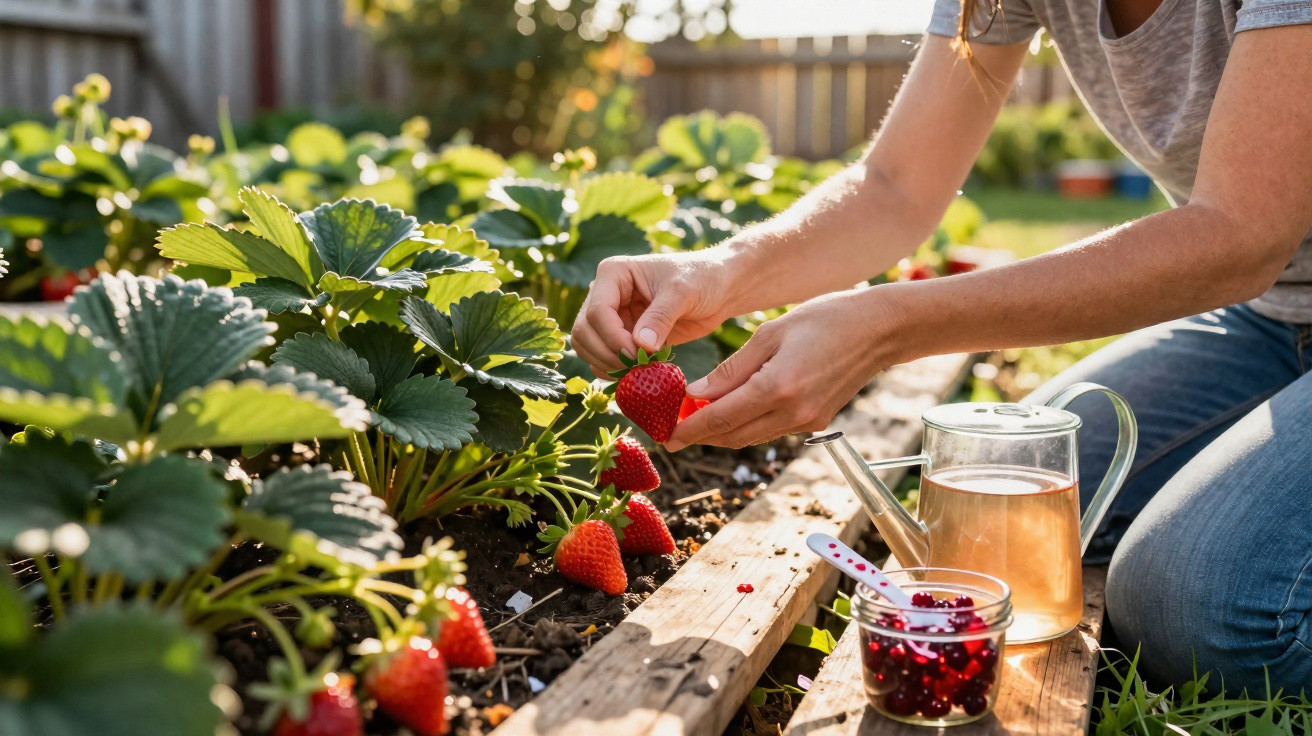
More and more gardening groups are sharing an unusual tip: yeast, water and a little sugar are said to make strawberries noticeably larger, sweeter and more productive. Although it may initially sound like an internet myth, the idea has a surprisingly sound basis in soil biology – and can be tried at home with only a few simple steps.
How the yeast-and-sugar mix turns strawberries into turbo plants
The basic recipe is straightforward and requires no chemicals. It uses the power of micro-organisms to stimulate the soil around strawberry plants.
“The trick is not simply to ‘feed’ the plants, but above all to make the soil more lively and fertile.”
The basic recipe for the strawberry booster
- 50 grams fresh yeast (or 1 teaspoon dried yeast)
- 1 litre lukewarm water
- 1 tablespoon sugar
Put all ingredients into a bowl or watering can and stir thoroughly until the yeast has dissolved. Leave the mixture at room temperature for around 24 hours. Fermentation begins during this time: the yeast and micro-organisms multiply rapidly, while the sugar provides their fuel.
After one day, dilute the liquid with water at a ratio of 1:5. In other words, use one part yeast mixture to five parts water. Around 0.5 litres of the diluted solution is enough for each strawberry plant.
How to apply the fertiliser correctly
- Apply it only to soil that is already moist, never to completely dry soil.
- Pour it directly around the roots rather than spraying it onto the leaves.
- It is best used during the growth stage and at the start of flowering.
- Repeat roughly every 2–4 weeks, depending on the condition of the soil.
If strawberries are growing in containers or raised beds, use a slightly lower dose. Nutrients build up more quickly there, and plants are more sensitive to overfeeding.
Why yeast works in the garden like a natural energy drink
Yeast contains a blend of B vitamins, proteins and minerals, including the plant-important elements nitrogen, phosphorus and potassium. When combined with sugar, it creates a genuine feast for soil organisms.
Soil biologists have stressed for years that soil rich in micro-organisms provides plants with a better nutrient supply and makes them more resilient. This is precisely where the recipe comes in.
“The more active life in the soil is, the more easily strawberries can access the nutrients they need for large, flavoursome fruit.”
Sugar stimulates bacteria and fungi in the soil. These break down organic matter, loosen the earth and create stable crumb structures. This improves water absorption and helps prevent waterlogging. The yeast adds further nutrients and supports root development.
Benefits of yeast fertiliser at a glance
- improved root formation and stronger growth
- greater resistance to stresses such as heat or dry spells
- larger, more evenly sized fruit
- better water-retention capacity in the soil
- inexpensive and easy to make from kitchen ingredients
There is also a practical advantage: gardeners who regularly use biological mixtures like these can often reduce their use of mineral fertilisers considerably.
Other natural fertiliser ideas for gardeners who like to experiment
The yeast-and-sugar mixture is not the only route to abundant strawberries. Many home gardeners combine several household remedies to provide a broader range of nutrients.
Four alternative natural fertilisers compared
- Old bread liquid: Soak stale bread in water, leave it for one week and stir it occasionally. Then dilute it with water at a ratio of 1:10. It mainly supplies readily available nutrients from the bread and also invigorates soil life.
- Nettle feed: Soak nettles in a bucket of water and leave them for 1–2 weeks, until the mixture develops a strong smell. Dilute it at a ratio of 1:20 before use. It is very high in nitrogen and is ideal during the plants’ growth stage.
- Milk-and-compost mix: Work small quantities of sour or out-of-date milk into compost, or combine it with compost-rich soil. This raises the calcium content, which encourages stable cell walls and therefore firmer plants.
- Diluted chicken manure: Anyone with access to it can dilute chicken manure with water at a ratio of 1:10 and apply it before flowering. The mixture is highly nutrient-rich and should be used sparingly.
These options vary in their nutrient profiles. With a little observation, gardeners soon discover what their strawberry varieties respond to particularly well. The important point is never to apply several very strong fertilisers at high doses at the same time, as this can lead to overfeeding.
Growing conditions: even the best strawberry trick needs sun and water
Even the most clever fertiliser can only partly compensate for a poor growing position. Anyone hoping to harvest truly large strawberries should focus on several key conditions.
| Factor | Recommendation |
|---|---|
| Sunlight | 6–8 hours of direct sun each day |
| Watering | Keep evenly moist, avoid waterlogging and do not water over the leaves |
| Soil pH | Slightly acidic to neutral, approximately 5.5–6.8 |
| Plant spacing | 30–45 centimetres, allowing air to circulate |
For gardening in very heavy, clay-rich soil, it is best to mix in sand and mature compost. For containers, a loose blend of potting compost, compost and a little sand has proved effective.
Common strawberry fertilising mistakes – and how to avoid them
Many issues in a strawberry bed are less about the chosen variety than about care mistakes. A cautious start is especially worthwhile when using homemade fertilisers.
- Fertilising too often: More is not better in this case. Excess nutrients result in plenty of leaves but fewer fruits.
- Pouring onto dry soil: This can damage roots. Water normally first, then apply the fertiliser.
- Applying in intense midday sunshine: Water in the morning or evening instead, when more moisture remains in the soil.
- Not observing the plants: Applying another strong dose straight after the first treatment can cause scorching or rot.
A sensible approach is to treat a small test area of the bed first, then watch how the plants respond for one to two weeks. If growth and leaf colour improve, the method can be extended to the entire bed.
What fermentation in the garden really involves
Terms such as “yeast liquid” or “nettle feed” may sound old-fashioned to many people, yet they are based on clear biological principles. During fermentation, micro-organisms break down organic material and produce substances that plants can absorb more easily.
These include organic acids, vitamins and, at times, growth-promoting hormones. At the same time, bacteria and fungi convert nutrients into forms that roots can take up efficiently. This explains why fermented household remedies can often be far more effective than plain watering with a little compost.
Anyone with a little patience and no fear of a mildly “spicy” smell can give their strawberries a kind of natural, on-demand nutrient source. Together with sunshine, water and a good position, this can genuinely turn weak little plants into impressively large, juicy strawberries.










Comments
No comments yet. Be the first to comment!
Leave a Comment