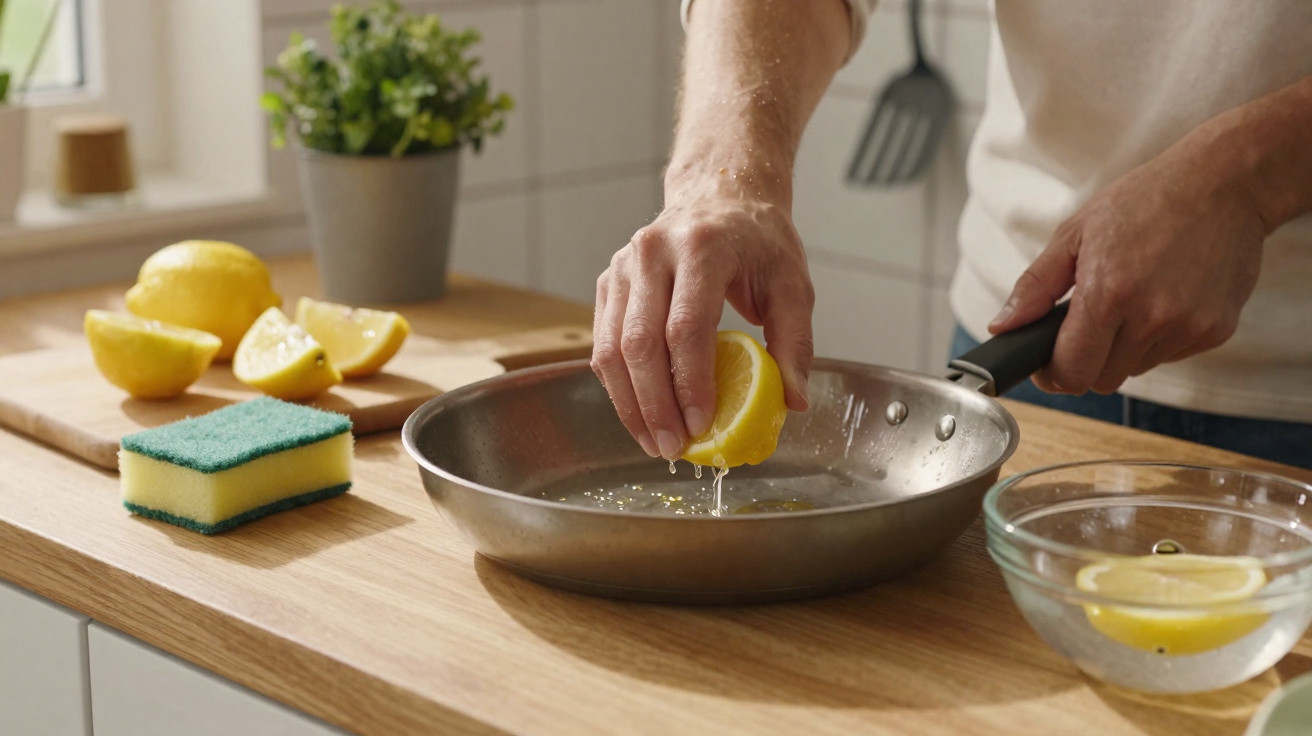
The frying pan seemed to taunt me from the sink. A stubborn ring of orange oil stuck to its sides, reflecting the light with the self-satisfied sheen that only cold grease manages. Last night’s “quick stir-fry” had become this morning’s lengthy scrubbing session, and the sponge already appeared beaten.
My hand automatically reached for the heavy-duty washing-up liquid, but I paused. On the worktop, half a lemon left over from yesterday’s salad looked back at me. More curious than convinced, I picked it up, pressed it against the pan and started rubbing.
The result was nearly immediate. The greasy coating started to split apart, the metal looked brighter, and the kitchen began to smell like a Mediterranean break rather than yesterday’s frying oil.
One inexpensive lemon, one effortless rub.
What sort of cleaning wizardry was this?
Why a simple lemon slice tackles stubborn cooking oil
Walk into any busy kitchen after a large meal and the picture is familiar: towering stacks of plates, pans left to soak and the faint hope that hot water will somehow “dissolve everything.” The usual culprit is the oily pan left sitting just long enough for its grease to set into a shiny armour.
That is when half a lemon changes from a garnish into a secret weapon. Press it onto the greasy surface and move it around in a few slow circles, and the fat begins to shift, almost as though it is melting. The resistant, squeaky feel vanishes and becomes a slick layer that washes away within seconds.
It seems like cheating.
In reality, it is simply chemistry tucked away in your fruit bowl.
Imagine a Sunday following a generous roast chicken. The roasting tin is covered in golden fat, with little burnt scraps clinging to the corners like confetti. You have eaten too much, you are tired, and spending twenty minutes scrubbing at the sink is the last thing you fancy.
Someone says, “Use lemon, it goes faster.” You roll your eyes but give it a go, and the roasting dish suddenly starts to come clean. Lemon juice works into the oil, the slippery layer loosens and the sponge glides rather than catching. The draining water becomes cloudy and milky - a familiar indication that the oil is breaking apart.
It does not seem miraculous. It feels more like finding out a useful trick you ought to have learned ten years earlier.
The answer lies in the lemon’s natural chemistry. Lemon juice contains plenty of citric acid, which helps break down fats and release them from metal or glass. The acid works rather like a gentle degreaser, weakening the bond between the oil and the pan.
Meanwhile, the pulp and peel of the lemon offer a very mild abrasive action, enough to remove stubborn residue without scratching most materials. Rubbing the cut side over a greasy pan that has already been dampened with hot water creates a sort of “natural cleaning paste”: acid + friction + warmth.
Add a small splash of washing-up liquid and the effect becomes even stronger, as the lemon helps the soap molecules attach to the oil.
That is why the grease suddenly releases its grip.
How to use half a lemon to clean greasy pans like a pro
Begin while the pan is still a little warm - neither piping hot nor completely cold. Add a small amount of hot water, just enough to soften the oil and loosen any food stuck to the surface. Pour away most of the water, leaving only a thin layer behind.
Take half a lemon - one already used in cooking is ideal - and use it as a scouring pad with the cut side facing down. Scatter a pinch of fine salt or add a drop of washing-up liquid to the lemon, then rub in circles over the oiliest areas. You will see the oil spread, then separate and finally disappear.
Rinse using hot water.
Should any residue remain, a brief second go with a sponge will generally be enough.
The technique is so straightforward that it is easy to overuse it or try it on unsuitable materials. Lemon is acidic, which is precisely why it is so effective against cooking oil, but that same acidity may be slightly harsh on certain surfaces. Non-stick coatings, unseasoned cast iron and delicate stone surfaces are not well suited to repeated acidic cleaning.
Use this lemon trick mainly for stainless steel, enamel, glass dishes and ceramic ovenware. With cast iron, hot water, a brush and salt are the better choice, as lemon may interfere with the seasoning built up over time. Also, keep the pressure gentle - the chemistry should do the work, rather than turning the lemon into sandpaper for your pans.
Let us be honest: hardly anyone does this every day.
Yet on evenings involving lots of cooking, it can save ten minutes and plenty of sighing.
Sometimes the most effective cleaning hacks are the ones our grandparents took for granted. As one home cook told me, “I started using lemon on my roasting trays because that’s what my grandmother did. I thought it was ‘old-fashioned’ until I realized it cleaned faster than my expensive products.”
- Use leftover lemons
Turn squeezed lemon halves from tea or salad into small scrubbers for greasy pans. - Add a pinch of salt
The grains increase friction and help remove baked-on bits without harsh chemicals. - Combine with a drop of soap
Lemon improves the degreasing effect of washing-up liquid, making rinsing much easier. - Finish with a hot rinse
Hot water keeps the oil runny, allowing it to leave the surface rather than stick again. - Keep it occasional
Think of lemon as an extra boost instead of a daily routine, particularly with more delicate cookware.
From cleaning hack to a small kitchen ritual
There is something unexpectedly satisfying about using a piece of fruit to tackle a pool of stubborn oil. In a world of fluorescent liquids and “ultra-power” sprays, it feels almost defiant. You slice a lemon, squeeze it over your meal and, rather than binning the remainder, give the pan a quick rub while watching the grease give way.
It is not magic. It is simply a modest, low-tech action that quietly changes how you view your kitchen. You begin to see leftovers in another light - the rind, salt lingering at the bottom of the jar, the final splash of boiling water. They’re no longer waste, they’re tools.
We have all experienced the point at which the washing up after cooking spoils the enjoyment of a meal. This small lemon ritual may not transform your entire life. It can, however, improve the five minutes spent at the sink, and on some evenings that is already quite a lot.
Give it a try the next time your pan looks beyond saving.
Then mention it to someone else at the table and see their expression when they watch it work.
| Key point | Detail | Value for the reader |
|---|---|---|
| Natural degreasing power | A lemon’s citric acid breaks down fat and loosens grease from metal or glass surfaces | Cuts scrubbing time and effort using an affordable, readily available ingredient |
| Simple method | Rub half a lemon over a warm, greasy pan with a little salt or soap, then rinse with hot water | An easy-to-remember routine that fits everyday cooking without additional products |
| Smart, occasional use | Most suitable for stainless steel, enamel and glass, as an occasional boost rather than a daily habit | Helps protect cookware while delivering the benefits of this clever kitchen hack |













Comments
No comments yet. Be the first to comment!
Leave a Comment