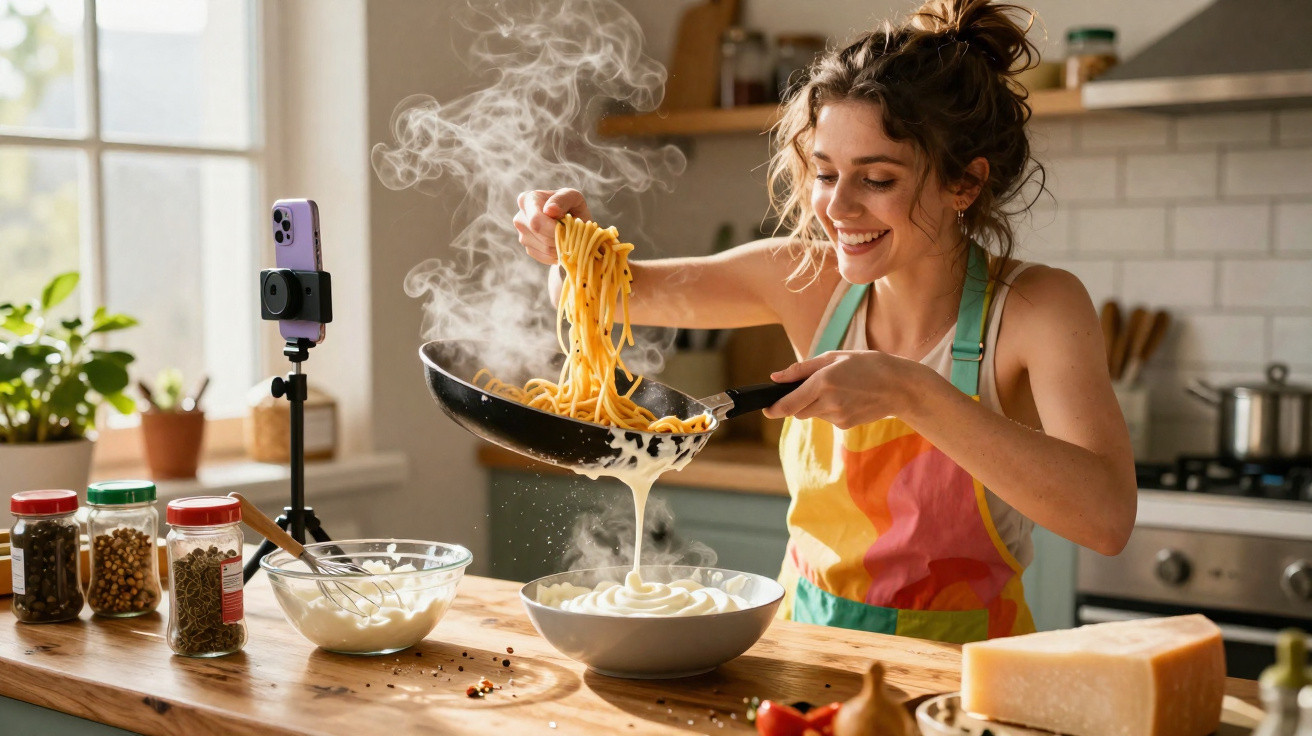
The camera is tilted slightly, the kitchen lighting is a touch too yellow, and Rocío is laughing as her toddler makes off with a strip of guanciale. A pan crackles like a miniature storm while a heap of steaming spaghetti is tipped not into boiling water, nor beneath a pour of cream, but straight onto beaten eggs and grated cheese. Rocío does not hesitate. She has the steady manner of someone who has made it hundreds of times and faced thousands of angry comments.
Then comes the line that has split TikTok: the secret to proper carbonara, she says, is to “pour the pasta over the cream.”
But her “cream” is not what it seems.
How a chaotic TikTok kitchen changed the carbonara rulebook
Rocío does not film in a polished Roman studio. Her videos come from an ordinary, mildly chaotic family kitchen, with magnets covering the fridge and somebody invariably asking for a snack. She describes herself as an “atomic mum”, because every part of her day seems ready to explode: children, work and the pasta timer.
That disorder is precisely why her carbonara clips spread so widely. The dish is traditional, but the presentation belongs entirely to the 2020s internet: brisk edits, household background noise and a handful of minor “mistakes” that spark enormous rows in the comments.
At the heart of every video is one seemingly radical act: she tips piping-hot pasta directly over a raw, shiny cream.
When Rocío first uploaded the video, she expected nothing more than another TikTok dinner post. Within a week, it had exceeded a million views. Italians argued fiercely in the comments: some called it a betrayal, while others immediately embraced the technique.
Rather than lecture viewers on the origins of guanciale or cite furious Roman chefs, she simply demonstrated what she made for her children on a Tuesday evening. Her relaxed certainty makes people stop scrolling. Viewers replayed the instant the pasta landed in the bowl, watching the “cream” thicken before their eyes.
That one image - pasta over cream rather than cream over pasta - became a small online ritual, recreated in thousands of compact flats with creaking chairs and second-hand frying pans.
Underneath the chaos is straightforward kitchen science. As the hot pasta meets the egg-and-cheese mixture, the noodles’ heat gradually cooks the eggs. They become neither scrambled nor raw, but reach the smooth middle ground that defines genuine carbonara. Starch clinging to the spaghetti loosens the sauce, rendered guanciale fat folds through it, and the resulting “cream” looks as though dairy had been added.
Rocío’s technique is not magic so much as an understanding of temperature and timing. She simply explains it like a mum trying to get supper on the table on time.
Carbonara becomes less about strict rules and more about knowing what takes place inside the bowl.
“Pour the pasta over the cream”: the move that changes everything
The viral step is over in moments. Rocío beats egg yolks with a blizzard of Pecorino and a little Parmigiano until it resembles a thick, pale custard. This is her “cream”: no carton or tub of cooking cream, only eggs and cheese with enough salt to wake you up.
She cooks the pasta for one minute less than the packet recommends. In a single weighty, steaming drop, it travels straight from the pan into the bowl, still carrying starchy water. She does not drain it thoroughly, pause or allow it to cool.
That meeting of hot pasta and cold cream is the entire point.
Most cooks take the opposite route. They boil the pasta, drain away too much water, return it to a fiercely hot pan, add the eggs and hope they do not scramble at once. Others soothe their nerves with actual cream, convinced it will protect the texture. Everyone knows the point at which a sauce becomes grainy and is then politely called “rustic”.
Rocío’s approach reverses that way of thinking. Rather than trying to create the sauce in the pan, she makes it in the bowl and lets the pasta provide the only heat. It means less pressure, less fuss and greater control.
In truth, hardly anyone makes it this way every day, but once you have tried it, it stays in your cooking memory.
She describes the process in simple language rather than in the style of a cookery manual.
“People think the sauce has to hug the pasta in the pan,” she says in one clip. “No. The sauce is waiting for the pasta like a warm bed. You throw the pasta in, then you tuck it in.”
She then sets out the method step by step, almost as though it were an on-screen checklist:
- Whisk egg yolks with finely grated Pecorino and Parmigiano until the mixture is very thick.
- Slowly render the guanciale and keep its fat.
- Boil the pasta until it is one minute short of al dente.
- Move the pasta straight into the egg-and-cheese bowl without cooling it; a little water is welcome.
- Toss rapidly away from any heat, adding the guanciale and its fat at the end.
All at once, the “trick” seems less like social-media chatter and more like a small, carefully targeted cooking lesson.
Beyond outrage and purism: what this viral “cream” reveals about modern cooking
There is something unexpectedly reassuring about seeing a TikTok stranger grapple with the same dinner uncertainties you do. Is there enough salt? Is that too much cheese? Will the children eat it, or will you be left finishing it alone on the sofa?
Rocío’s atomic-mum character works because she leaves those doubts visible. A piece of guanciale burns, a baby cries out of frame, the dog begins barking, and she laughs rather than editing the chaos away. The “cream” technique belongs in that world: it offers a modest assurance that excellent food can withstand a disorganised day.
There is no need for Tuscan tiling or a rack of copper pans. You only need a bowl, eggs and the confidence to pour pasta over something that does not yet appear safe.
| Key point | Detail | Value for the reader |
|---|---|---|
| Use “fake cream” | Swap dairy cream for egg yolks and hard cheese to create a naturally silky sauce | Discover a more authentic, fuller flavour while spending less and relying on basic ingredients |
| Reverse the order | Tip hot pasta over the egg-and-cheese mixture rather than adding eggs to a hot pan | Lower the chance of scrambled eggs and have more control over the texture |
| Keep off the heat | Toss the pasta and “cream” away from any flame, then add the guanciale and fat at the end | Produce restaurant-style carbonara without professional skills or specialist equipment |







Comments
No comments yet. Be the first to comment!
Leave a Comment