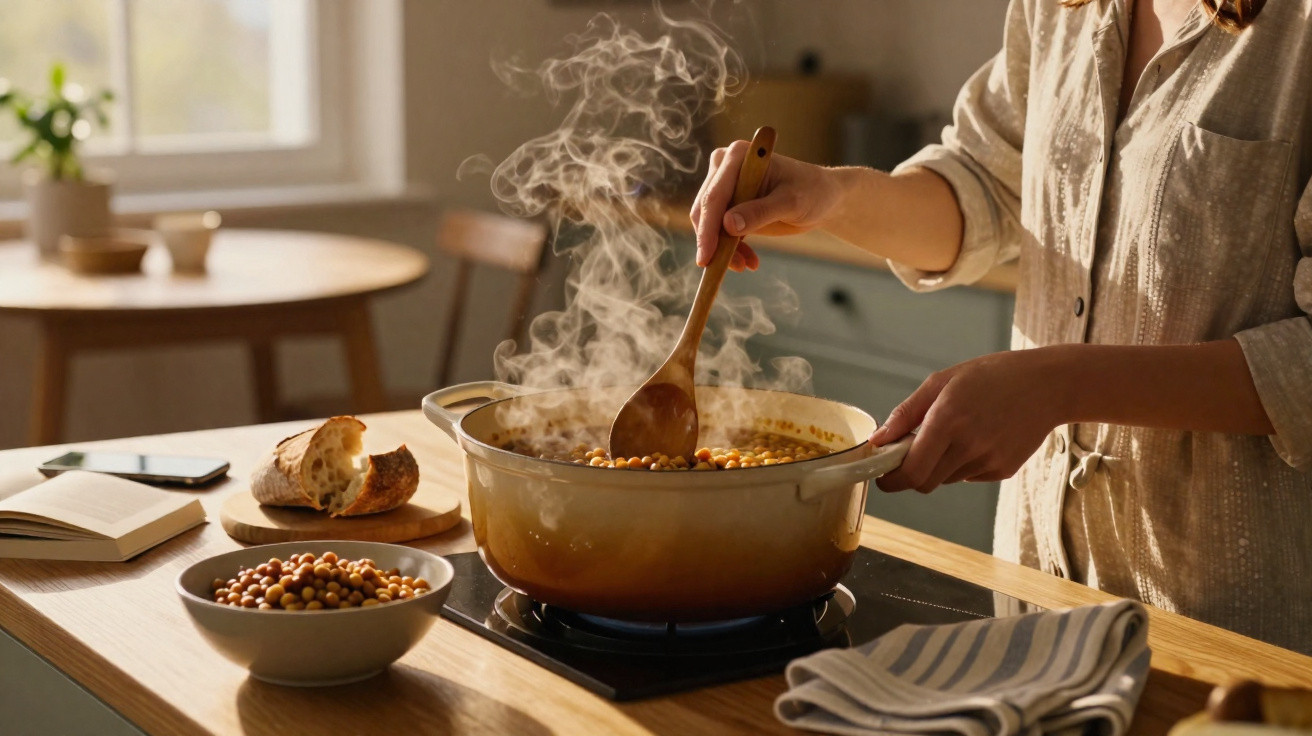
The emails do not stop, the group chat keeps flashing, and the washing machine beeps as though it has emotions of its own. My mind is racing, while my body is simply… there, wedged at the kitchen counter beneath a weary lightbulb. Beyond the window, cars whisper along the rain-soaked road. Indoors, my shoulders have practically climbed to my ears.
On evenings like these, I turn to the one thing I genuinely rely on.
I reach for the heavy pot. I dice an onion. I take out the lentils.
As soon as the oil meets the pan and that first hiss begins, the day’s noise starts to fade. Time does not truly pause, but it seems gentler somehow, with fewer hard edges. Steam clouds the glass. The wooden spoon sits easily in my hand.
This is the warming meal I make when I need the world to move more slowly.
And yes, it works every time.
The dish that turns a busy evening into a quiet room
It is a straightforward dish: a slowly cooked, tomato-rich lentil stew with tender carrots, garlic and an unhurried swirl of cream on top. There are no hard-to-find ingredients or restaurant-level methods involved. All it needs is cupboard essentials, a low flame and a little time.
The onions soften into sweetness and turn golden, the garlic mellows, and the spices release their fragrance. Lentils join chopped tomatoes and stock in the pot before disappearing beneath the liquid. Soon, the kitchen smells like a Sunday that never looked at the date.
It is not elaborate.
Yet, as it bubbles away, the entire room seems to breathe out.
Not long ago, on a Tuesday, everything was out of step. I had eaten crackers at my keyboard for lunch, failed to drink any water, and somehow agreed to three extra jobs I had no room for. By 7 pm, I was both hungry and wired, scrolling through food delivery apps like a zombie.
Then I opened the cupboard and spotted the familiar packet of green lentils. I nearly shut the door again. “Too much effort,” my brain complained. But my hands had already gone for the chopping board.
Twenty minutes on, the stew was softly bubbling. My screen lay face-down on the table. I had not replied to one message. I only stirred, tasted and added salt. All at once, the evening was no longer about catching up - it was about this pot, this spoon and this scent.
There is a reason an unassuming pot of stew can feel like pressing a slow-motion button. Preparing something that needs time without requiring constant attention helps reset our inner rhythm. Your body moves from reacting to following a pattern: chop, stir, taste, wait.
This meal asks for patience without demanding pressure. Lentils will not cook any sooner because you stare them down. Carrots do not become soft because you are anxious. Heat, water and time keep working whether you are spiralling or not.
So your nervous system quietly follows the recipe.
Simmer down, soften, absorb.
How I cook this lentil stew when my brain is already tired
I begin with the tasks I can manage automatically. Half an onion, roughly diced. Two carrots, sliced into rounds or hacked into uneven pieces - nobody is judging. A little oil goes into a heavy pot over a medium heat. I add the onion with a small pinch of salt, enough to draw out its sweetness.
As it cooks down, I wash a cup of lentils in a small sieve and listen to the water pattering through. The garlic goes in with the onions, followed by a teaspoon of smoked paprika and a pinch of cumin. When the spices meet the hot oil, the kitchen suddenly smells as if I had intended this all along.
In go the lentils, tinned tomatoes and enough stock to cover it all by a couple of finger-widths. I stir once, turn down the heat and put the lid on. This is the point at which the real slowing down starts.
The trick is this: I do not pursue perfection with this dish. On some evenings, I catch the onions a little. Other nights, I remember the carrots too late and add them when they are only half-cooked. The stew is forgiving.
When life seems to be measured with a stopwatch, recipes that allow for mistakes are undervalued. You can walk away to sort the laundry, answer the door or simply look at the wall for two minutes. The pot carries on quietly with its work.
Honestly, no one does this every day. Most of us live on strange leftovers, snacks or whatever can arrive quickest by scooter. That is completely fine. This dish is not about maintaining daily discipline. It is about having one dependable ritual to return to when everything is too noisy.
Once the lentils are tender - generally after 30–35 minutes - the stew will have become thick and look as though it knows secrets. I taste it, add salt, and perhaps finish with a squeeze of lemon or a spoonful of yoghurt or cream when serving.
That first spoonful is always when the day finally loosens its grip. It is warm, gently spiced and soft, while the lentils retain a slight bite. Without even deciding to, I eat slowly. There is bread if I happen to have some. Usually, there is quiet too.
Food doesn’t solve everything, but a warm, honest bowl of something you cooked yourself can change the weather inside your head.
- Onion, garlic, carrots
- Lentils (green or brown), rinsed
- Tinned tomatoes and vegetable or chicken stock
- Spices: smoked paprika, cumin, bay leaf if you have it
- Something creamy at the end: yoghurt, cream or olive oil
Why this simple pot of lentils feels like a small act of rebellion
Cooking a dish that takes its time on a hectic day is a quiet form of refusal. The world is yelling “faster, more, now,” while you stand at the stove, stirring and allowing food to take as long as it takes. You are nourishing yourself rather than merely refuelling.
This stew is not particularly photogenic. It is unlikely ever to feature on the cover of a glossy cookbook. Still, on nights when your mind is humming and your body feels overlooked, it arrives like an old friend carrying a blanket and a story.
You are not trying to become someone new.
You are simply recalling the version of yourself that breathes at an ordinary pace.
| Key point | Detail | Value for the reader |
|---|---|---|
| Simple ritual | Basic lentil stew with pantry ingredients and slow cooking | Gives an easy, repeatable way to unwind on stressful days |
| Built-in slowness | Chopping, stirring, and simmering at low heat | Helps calm the nervous system and shift out of “rush” mode |
| Flexible & forgiving | Works with imperfect chopping, swapped veggies, or missed steps | Reduces pressure and makes home cooking feel accessible, not stressful |
FAQ:
- Question 1 Can I use red lentils for this dish instead of green or brown? Red lentils cook more quickly and break down into a thicker, soup-like texture, but they work perfectly well. Simply reduce the simmering time to around 20 minutes and keep an eye on the consistency.
- Question 2 What if I don’t have tinned tomatoes? You can leave them out and use additional stock, then add a spoonful of tomato purée or even a dash of soy sauce at the end for depth. The aim is warmth and flavour, not rigid rules.
- Question 3 How can I make this more filling for a big appetite? Add diced potatoes, more carrots, or stir through leftover shredded chicken or sausage near the end. Serving it with rice or thick bread will also make it a more substantial meal.
- Question 4 Does this dish keep well for the next day? Yes, and it may even improve. The lentils absorb the flavours overnight. If it has become too thick, add a little water while reheating and adjust the salt again.
- Question 5 What spices work if I don’t like smoked paprika or cumin? You could take it towards Italian flavours with dried oregano and thyme, or keep it very simple with bay leaves, black pepper and good olive oil. The true magic lies in the slow simmer rather than the exact spice blend.

















Comments
No comments yet. Be the first to comment!
Leave a Comment