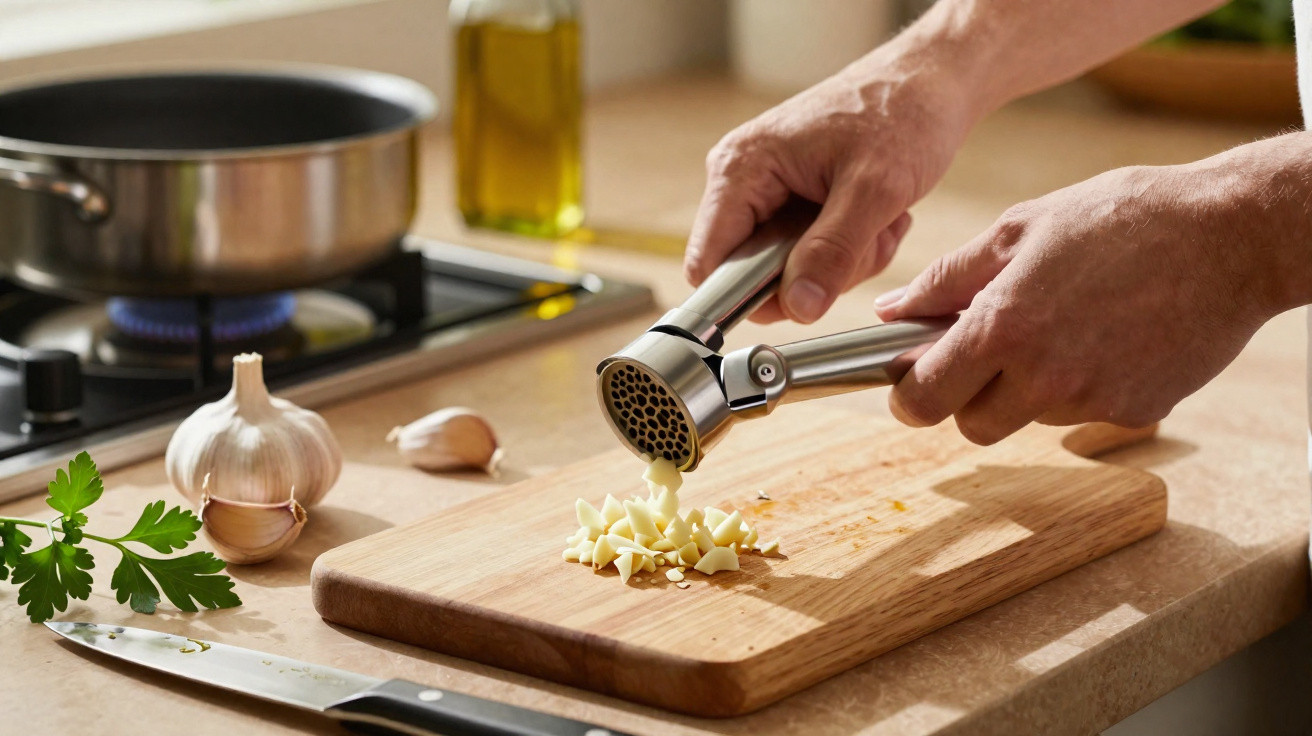
A tiny stainless-steel gadget simply turns the problem on its head.
Garlic is central to countless dishes, from pasta and roasted vegetables to quick weekday stir-fries. Yet it often sits ignored in the vegetable drawer for weeks. Peeling it, chopping it, dealing with the sticky residue on the chopping board and then the strong smell left on your fingers: for many people, it feels like more effort than it is worth. A small stainless-steel tool costing less than £9 removes precisely that irritation, making it easier to use garlic regularly again.
Why this specialist garlic tool is suddenly in demand everywhere
This understated utensil is an ergonomic stainless-steel garlic press that works with a rocking motion. It fits comfortably in the palm, requires very little force and is so straightforward that, after using it twice, you may not want to be without it. Unlike conventional tong-style presses, it works by gently moving it backwards and forwards, like a small rocker on the chopping board.
“Chop garlic, ginger or shallots in seconds without your fingers smelling of them for days – that is exactly what this tool is designed to do.”
Its biggest benefit is that garlic often does not even need peeling first. Place whole cloves beneath the curved stainless-steel head, make a few gentle rocking movements, and a fine, evenly crushed garlic mixture emerges through the numerous small holes. It can then be scraped straight into a frying pan or bowl with a knife or spoon.
How the stainless-steel garlic press works
Its shape resembles a slightly curved handle with a perforated underside. Rather than squeezing a pair of tongs shut, position the press over the cloves and push down while rocking it lightly back and forth. This rocking action spreads pressure more effectively than a traditional plunger-style press.
Less force, greater control
This is particularly useful for people with smaller hands, limited strength or joint problems. Anyone who finds chopping with stiff fingers or firmly squeezing a tong-style press difficult can usually manage the rocker surprisingly well. Your hand rests on top of the handle, while your body weight naturally provides assistance.
- Pressure is distributed across the whole surface.
- A moderate downward push from the wrist is enough.
- Garlic, ginger and shallots are crushed to an evenly fine texture.
- Hardly any large pieces remain to disrupt a sauce later.
Compared with using a knife, the difference is clear: fast chopping often creates uneven pieces, with some burning in the pan while others remain raw. Within seconds, the press produces an almost uniform consistency, making it ideal for marinades, dressings and quick sauces.
More than a garlic tool
This small stainless-steel helper does far more than crush garlic. Many users also use it for:
- fresh ginger for Asian dishes or tea
- shallots or very small onions
- deseeded chilli for hot oils and pastes
- small quantities of herbs that need to be chopped very finely
That means less knife work and fewer additional chopping boards left smelling of onion or chilli.
Why stainless steel is so useful in the kitchen
The garlic press is generally made from rust-resistant steel, often labelled “304”. This material has proved itself in the kitchen because it is sturdy, barely corrodes and handles water and washing-up liquid without difficulty.
“Stainless steel does not absorb odours, withstands dishwasher cycles and is unlikely to warp even with daily use.”
Another advantage is that, unlike many older presses with complicated joints, the rocking version has no corners where residue can become permanently trapped. Its perforated surface is smooth, with no hinges, springs or moving plungers. This makes cleaning much quicker.
Cleaning the garlic tool is remarkably easy
Anyone who has ever picked at tiny holes in a conventional press with a cocktail stick will know how frustrating it can be. With this model, that step is largely avoided.
- Immediately after use, scrape off residue with the tip of a knife or a spoon.
- Rinse it under hot water, running your fingers or a small brush across the perforated area.
- If necessary, place it in the dishwasher cutlery basket.
Timing matters: if the press is rinsed straight after cooking, almost nothing has time to dry on. Washing it several hours later takes a little longer, but still involves less effort than with many plunger models.
What to look for when buying one
Even at a price below £9, it is worth checking a few features before buying. Not every low-cost model is built to last.
Key criteria at a glance
| Feature | What to look for |
|---|---|
| Material | Rust-resistant steel, ideally marked “304” or “stainless steel” |
| Handle | A gently curved shape, optionally with a non-slip surface |
| Size | Usually between 11 and 17 cm long – choose a size that suits your hand |
| Cleaning | Smoothly finished perforated surface and dishwasher-safe construction |
| Uses | Suitable for garlic, ginger, shallots and small quantities of other ingredients |
Many comparable kitchen tools cost between £15 and £30 in shops. The fact that some models are now available for well under £9 makes them an affordable route into the “garlic without the hassle” category.
What really changes in everyday cooking
The real difference does not become obvious on the first evening, but on the fifth or tenth time you cook. If you notice that garlic cloves are disappearing much faster than they used to, the day-to-day test has clearly shown its value.
A typical weekday routine goes like this: pasta water is boiling, the frying pan is heating up and the oil goes in. Previously, the question might have been: “Do I really want to peel and chop garlic now?” With the stainless-steel helper, the answer is more often: “Of course, it only takes a few seconds.” More flavour and more aroma, without extra stress.
Everyday dishes that benefit from it
- Pasta with olive oil, garlic and chilli
- Roasted vegetables with a garlic and ginger marinade
- Quick pan-fried dishes with chicken or tofu
- Salad dressings made with fresh garlic instead of garlic powder
- Homemade herb butter or aioli
The more often garlic and ginger are genuinely used in everyday cooking, the less reason there is to reach for ready-made products or dried spice blends.
Why so many people dislike the smell on their hands
One key reason for leaving garlic out is the persistent smell it leaves on fingers and beneath fingernails. Even after washing several times with soap, a trace often remains noticeable the following morning. This is where the stainless-steel rocker performs well: the cloves go directly beneath the tool, so hands have very little contact with the cut surfaces.
Those who are especially sensitive can even push cloves from their skins with a small spoon and place them straight beneath the press. This keeps fingers almost entirely out of the process. Some people swear by briefly rubbing their hands on a stainless-steel surface afterwards – whether that truly has a chemical effect or is simply a kitchen trick is open to question, but many users still find it pleasant.
More flavour, less effort – why the trend is catching on
Trend gadgets come and go, but tools that genuinely reduce effort tend to stay. A compact stainless-steel garlic press is now becoming a kitchen essential in more and more homes, much like a vegetable peeler or tin opener. It costs little more than a lunchtime snack, sits discreetly in a drawer and does exactly what it should: it makes garlic, ginger and similar ingredients so easy to use that they become regular parts of cooking again.
Anyone who has often skipped fresh ingredients for convenience can achieve a noticeable improvement in the flavour of everyday meals with this small tool – without spending longer at the hob, dealing with sticky chopping boards or living with fingers that smell for days. That is why the stainless-steel garlic press is among the accessories that work quietly in the background while still making the cooking experience noticeably better.








Comments
No comments yet. Be the first to comment!
Leave a Comment