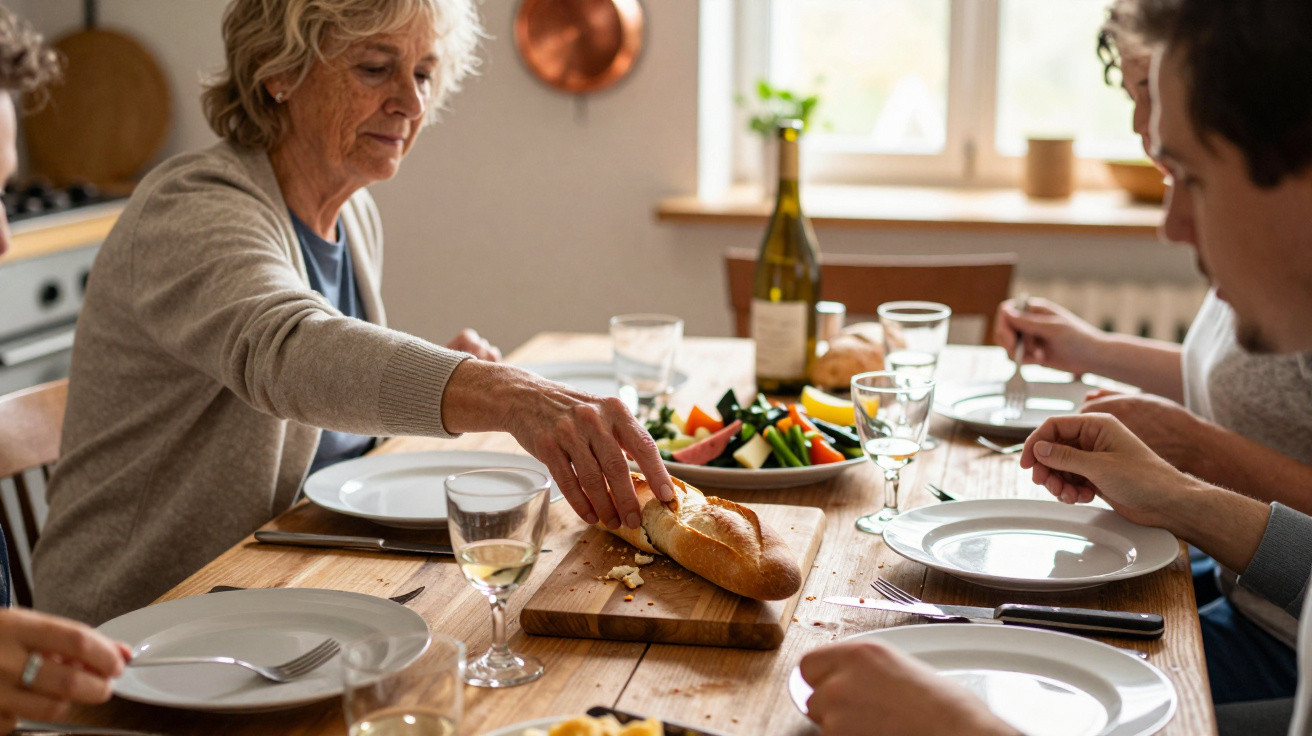
One small action at the dining table can transform an easy-going family lunch into a frosty, uncomfortable silence.
Plenty of grandparents still keep an eye out for it.
In France and elsewhere, older generations often carry an unspoken list of “things you just don’t do at the table”. Most are dismissed as old wives’ tales, but one minor custom involving bread can still make people uneasy, prompt disapproving looks and even be taken as an unlucky sign.
The lunch that soured before anyone ate
Imagine a Sunday lunch with your in-laws. You have taken every sensible step: called beforehand, offered to contribute something and been happily given responsibility for the bread. You arrive carrying two warm baguettes, fragrant from the bakery oven, and put them on the worktop.
The aperitif passes pleasantly. A joke gets a laugh, your mother-in-law smiles and your father-in-law gives an approving nod at your choice of bakery. Everything seems fine. Then everyone takes their seats and you put the baguettes in the middle of the table.
Suddenly, the mood shifts. The conversation trails off. Your in-laws share a familiar yet uneasy glance. Nobody speaks, but it is clear that you have breached an unwritten rule. In their view, at least, you have.
In many traditional households, placing bread upside down on the table is seen as a sign of misfortune, almost like inviting bad luck to join the meal.
The upside-down bread taboo dates back to the Middle Ages
This belief did not emerge by chance. Its origins lie in the Middle Ages, when public executions formed part of civic life and the executioner occupied a particular role within the community.
Florence Cane, an etiquette specialist and author of a book about the “magic of politeness”, explains that one kind of loaf was formerly set aside for the executioner. Bakers required an obvious, straightforward means of distinguishing it from every other loaf.
Why an inverted loaf signalled danger
The method was practical: the baker reserved the executioner’s bread by turning it upside down, with its rounded crust resting underneath. This acted as the warning.
- Ordinary loaves: set upright, with the domed crust on top
- Bread for the executioner: turned over, lying “on its back”
- Unmistakable marker: customers understood not to take the upside-down loaf
This arrangement served two purposes. The executioner could turn up late and still locate his bread. At the same time, other people could avoid bringing it home, fearing that it would carry the shadow of death into the household.
The upside-down loaf became a quiet code: this bread belongs to death’s employee, and no decent family should bring it to their table.
Why the superstition survives
The role of executioner disappeared long ago, whereas the gesture has endured. In many French households - as well as in certain Catholic and rural traditions across Europe - bread placed on its back is still disapproved of.
For people raised with this belief, how a loaf is positioned is not a matter of preference or appearance. It concerns respect, faith and security. Bread is frequently associated with life, everyday labour and, at times, religion. Handling it in the “wrong” manner can therefore seem thoughtless or even alarming.
When table manners overlap with superstition
Contemporary etiquette books occasionally refer to this custom without giving its full background. The usual instruction is brief: “Never put the bread upside down.” There is no argument, no lengthy account of its history, only a social boundary not to cross.
Younger generations often discover the rule unexpectedly: perhaps when a grandparent silently turns the bread over, or when a family meal is met with a sharp intake of breath. They then realise they have stumbled into a cultural minefield they did not know was there.
In families where the belief is strong, the upside-down baguette is read almost like an omen, even if no one truly expects tragedy to follow.
The easy way to keep everyone at ease
Fortunately, preventing this social mistake requires almost no effort. There is no need to slice the bread differently or use special wrapping. It simply has to be positioned the “right” way.
When placing bread on the table:
- Set it down with the rounded crust uppermost
- Do not rest it on its flatter side or leave it “on its back”
- If you spot it upside down, turn it over discreetly and without fuss
Its taste remains unchanged and its texture is exactly the same, but the mood at the table can be very different. To a grandparent brought up with this superstition, that slight adjustment conveys consideration, awareness and respect for family customs.
Other subtle bread rituals you may not know
The rule about upside-down bread is seldom an isolated one. In many homes, particularly in Europe and Latin America, bread is treated with a degree of ritual care for religious, cultural or simply sentimental reasons.
| Bread custom | What some people believe |
|---|---|
| Making a small cross on a fresh loaf before slicing it | Requesting protection or a blessing for the household |
| Never putting bread directly in the bin | Regarded as disrespectful towards food and those who are hungry |
| Slicing rather than tearing the first piece | A mark of respect for guests and the person who made the bread |
Such gestures are rarely found in official etiquette manuals, but they influence the emotional atmosphere of everyday meals. Ignoring them may not cause bad luck, yet it can lead to tension, sighs and the odd pointed comment.
What this small rule reveals about family life
On the surface, the taboo around upside-down bread may sound unreasonable. No scientific research connects the direction of a loaf with misfortune. Nevertheless, the response it provokes can be genuine and remarkably strong.
For older people, the custom is not truly about bread. It is about remembrance. It evokes famine, religion, food earned through hard work and eras when wasting bread was unimaginable. Observing the custom can feel like honouring that past.
Turning a baguette the “right” way is often less about superstition and more about saying: I see your habits, and I care enough to follow them.
What to do if you do not believe in superstitions
It may be tempting to dispute the belief, make fun of your in-laws or deliberately turn the bread over to show that nothing will occur. That approach rarely improves family relations. Where beliefs are tied to emotion, logic has only limited influence.
A more considerate response is straightforward: follow the rule at their table and save your scepticism for less sensitive occasions. At a quiet moment, you could ask about the origins of the custom. People often enjoy recounting the story and appreciate genuine interest rather than eye-rolling.
When hosting lunch yourself, you can still put the bread crust-up as a courtesy. It costs nothing and avoids uncomfortable glances from older guests who cannot fully settle when an upside-down baguette is in sight.
Practical situations: responding at different tables
Here are several situations you may encounter, with ways to handle them calmly:
- At your partner’s family home: Take your cue from them. If every loaf is placed crust-up, do the same; if somebody turns over a loaf you have put down, simply bear it in mind next time.
- At a restaurant with friends: Should someone quietly correct the bread’s position, do not make an issue of it unless they seem interested in discussing traditions. It may become an enjoyable conversation rather than a disagreement.
- At your own dinner party: If an older guest discreetly turns the bread over, there is no need to mention it. You might even adopt the practice next time if several guests share the belief.
These minor social adjustments are not so much about superstition as about understanding the atmosphere. They demonstrate adaptability, cultural interest and a measure of emotional intelligence at the dining table.
Ultimately, the old custom is simple: do not leave bread lying on its back. Whether it seems like a remnant of the era of executioners or an innocent family tradition, being aware of it may spare you that abrupt, chilly silence just as everyone is about to begin eating.
















Comments
No comments yet. Be the first to comment!
Leave a Comment