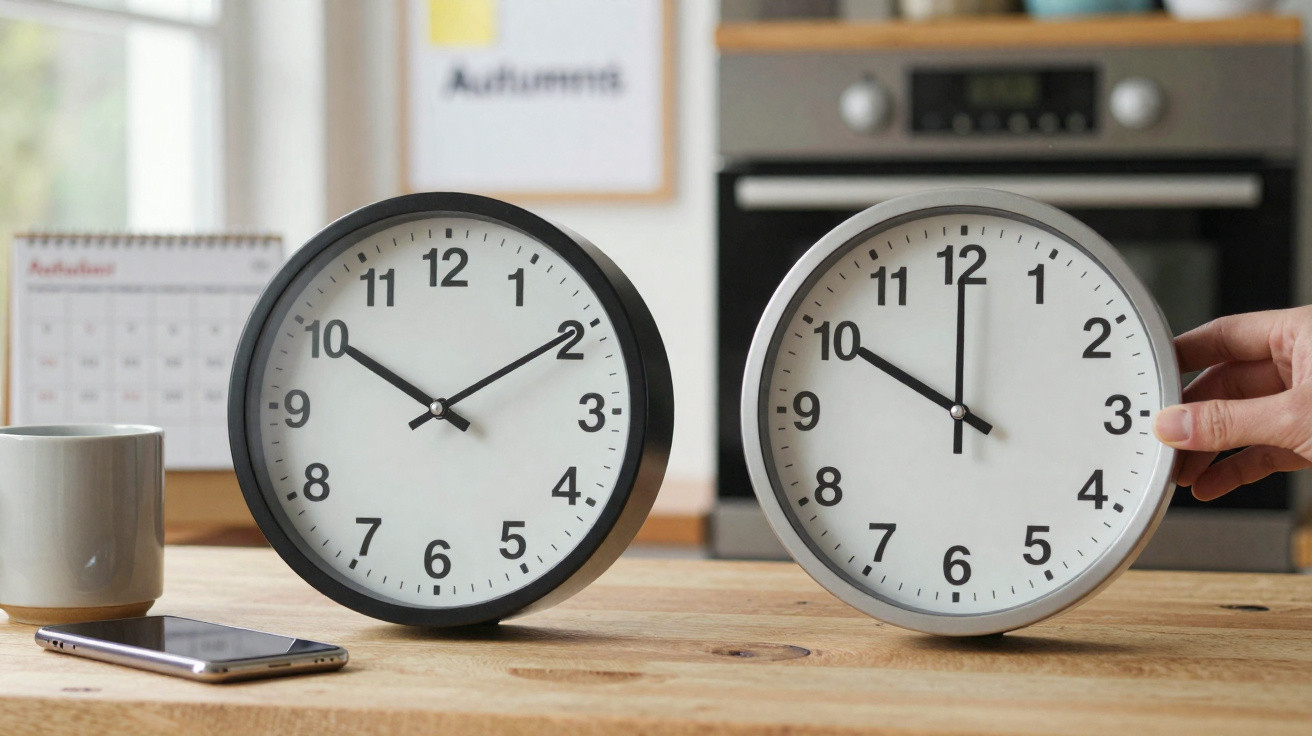
The autumn clock change can catch people out: the oven clock disagrees with your phone, an early train looks confusing, or you wake unsure whether you have gained an hour. In the UK, the clocks go back in the early hours of Sunday 25 October 2026.
The simple rule is: at 2am British Summer Time (BST), clocks return to 1am Greenwich Mean Time (GMT). Most devices should update by themselves, but household clocks, timers and some car displays may need attention.
The exact time the clocks go back in 2026
In the UK, clocks change at 2am on Sunday 25 October 2026. The time then becomes 1am, so the hour from 1am to 2am happens twice: first in BST, then in GMT.
The change applies across England, Scotland, Wales and Northern Ireland. Much of Europe also changes its clocks that Sunday, although the local times and time-zone names differ.
On Sunday 25 October 2026, the UK moves from 2am BST back to 1am GMT.
The local day has 25 hours rather than 24. Sunrise and sunset will appear an hour earlier by the clock, bringing lighter mornings but earlier darkness in the afternoon and evening.
Is it BST, GMT or winter time?
In everyday conversation, people often say the clocks go back for winter. Officially, the UK moves from British Summer Time to Greenwich Mean Time.
- BST is used from the last Sunday in March until the last Sunday in October.
- GMT is the UK’s standard time during the winter months.
- Daylight saving time, often shortened to DST, describes the seasonal practice of changing clocks.
GMT is aligned with Coordinated Universal Time (UTC) during the winter. For most household purposes, however, the important point is simply that the UK returns to GMT on 25 October.
Not every country observes daylight saving time. If you are speaking to someone abroad, travelling or arranging an online meeting, check the time zone rather than assuming clocks change everywhere on the same date.
Which way should you move the clock?
For the October change, set manual clocks back by one hour.
The familiar memory aid is “spring forward, fall back”. Although “autumn” is the usual British term, the phrase remains a handy way to remember the direction of the change.
- In spring, clocks go forward by one hour.
- In autumn, clocks go back by one hour.
- On 25 October, 2am becomes 1am.
If your phone says 8am on Sunday morning but a wall clock says 9am, the wall clock has probably not been changed yet.
What updates automatically - and what does not?
Most current devices obtain the time from the internet, a mobile network or satellite signal. They should update automatically if their date, time and time-zone settings are enabled. Even so, check them if you have an important alarm, shift or journey.
Devices that usually update automatically
- Smartphones and tablets with automatic time and time-zone settings enabled
- Internet-connected computers
- Smart speakers and smart displays
- Many smart TVs
- Radio-controlled clocks and some digital watches
- Some newer car systems
Clocks that may need changing manually
- Oven and microwave clocks
- Wall, mantel and alarm clocks
- Analogue watches
- Some car clocks
- Heating programmers and timer switches
- Older CCTV systems and smart-home hubs
A useful Saturday-evening checklist
- Confirm that your phone is set to update the time and time zone automatically.
- Check alarms for work, travel, school runs or care responsibilities.
- Change awkward-to-reach clocks before bed.
- Look at heating timers, security lights and smart plugs.
- If you manage staff rotas, bookings or online events, check that the time zone is clearly shown.
Use one reliable, automatically updated device - usually your phone - as the reference point on Sunday morning.
Why the repeated hour can be confusing
There are two versions of each time between 1am and 2am. This will not affect most households, but it can matter for night shifts, care arrangements, computer records, deliveries and overnight travel.
If you need to arrange something during that hour, be specific. Instead of saying “1.30am”, say 1.30am BST, before the clocks change, or 1.30am GMT, after the clocks change.
Check travel plans directly with the operator. Rail, coach and airline timetables account for clock changes, but overnight services can run to unusual schedules. Leave extra time for an airport journey, connection or cross-border trip.
Workers who are paid by the hour may want to know how an additional hour on a night shift is handled. Pay and working arrangements depend on the contract and workplace policy, so it is best to ask a manager, HR team or payroll contact.
Helping your routine adjust
The autumn change is often easier than the spring switch because it gives many people an extra hour in bed. The darker evenings can still take some getting used to, particularly for families and commuters.
A few practical steps can help:
- Keep waking and sleeping times broadly consistent.
- Get outdoors in daylight, particularly earlier in the day where possible.
- Avoid making a dramatic change to bedtime all at once.
- Plan dog walks, shopping trips and school collections with darker afternoons in mind.
- Check lights and reflective items for cycling, walking or pushing a pram after dark.
Children may wake earlier according to the new clock for a few days. Moving meals, naps and bedtime gradually can be easier than trying to reset the whole routine overnight.
If tiredness or sleep problems are persistent or affecting day-to-day life, consider speaking to an appropriate health professional.
Why the UK still changes the clocks
British Summer Time gives the UK later evening daylight during the warmer months. Clocks go forward on the last Sunday in March and back on the last Sunday in October.
The arrangement has been debated for years. Some people value lighter summer evenings, while others dislike the disruption and are concerned about the darker winter mornings that could result from keeping summer time throughout the year.
There is no confirmed change to the UK’s clock-change arrangements for 2026. The usual twice-yearly pattern therefore remains in place.
Changing the clock does not create extra daylight. It changes how the available daylight is arranged around the working day: after the October switch, sunrise and sunset both occur an hour earlier on the clock.
Common mistakes to avoid
A few quick checks can prevent an inconvenient Monday morning.
- Moving clocks forward: in October, always move manual clocks back one hour.
- Changing your phone manually: if automatic settings are enabled, this may leave it an hour wrong.
- Forgetting timers: check heating controls, security lights, plugs and kitchen appliances.
- Assuming every device synchronises: older equipment often needs manual adjustment.
- Relying only on a calendar alert for travel: confirm an early train, coach or flight with the operator.
- Leaving a 1am appointment unclear: add BST or GMT when the distinction matters.
For safety, never adjust a car clock while driving. Stop somewhere safe first, or change it before you leave. If resetting an electrical timer means removing covers, accessing wiring or interfering with a fused spur, follow the manufacturer’s instructions and use a qualified professional where needed.
Put Sunday 25 October in the diary
The 2026 UK clock change happens at 2am on Sunday 25 October, when the time goes back to 1am GMT. Before bed on Saturday, check essential alarms, manual clocks and timers.
On Sunday morning, compare everything with a trusted automatically updated device. Once your kitchen clock, watch, car display and heating timer are correct, you are set until the clocks go forward again in March 2027.

















Comments
No comments yet. Be the first to comment!
Leave a Comment