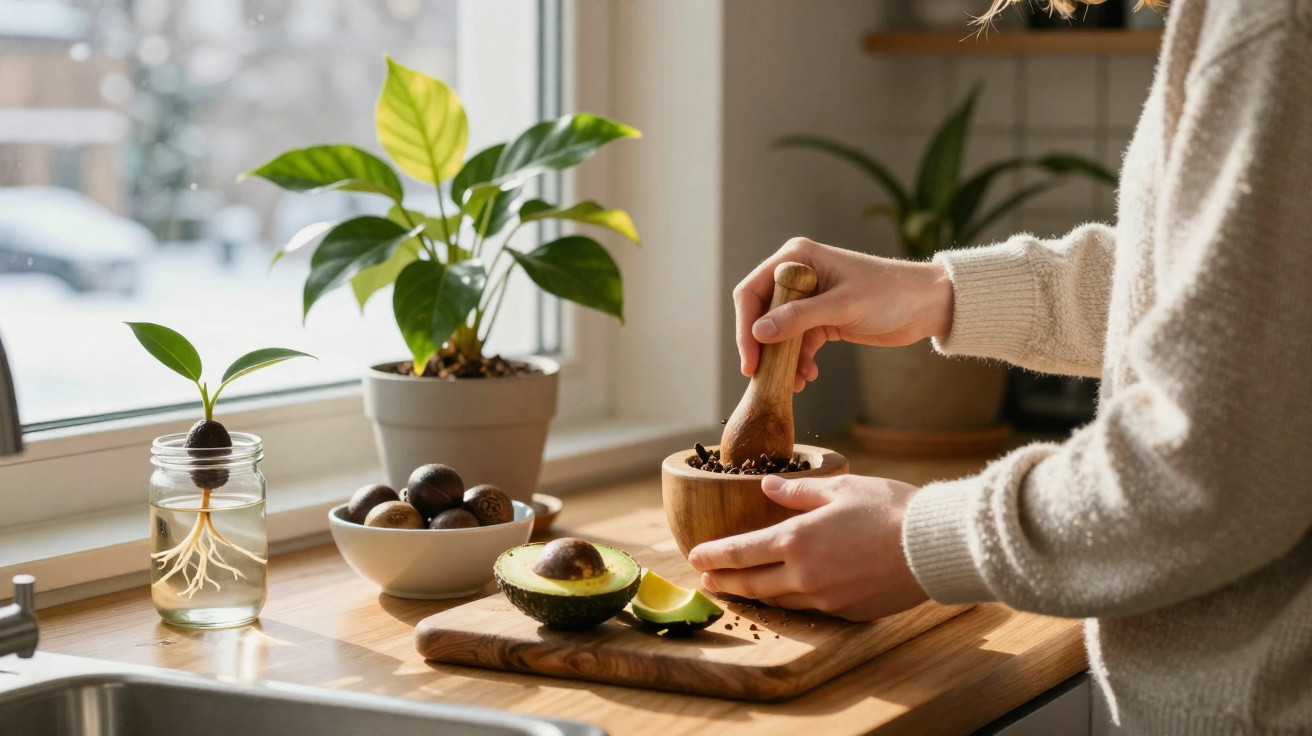
When winter leaves your houseplants looking subdued and your kitchen is scattered with avocado-toast crumbs, there is an understated solution right in front of you. The pit you would normally throw away can become a mild, waste-free feed to support indoor plants until spring arrives.
On the windowsill, a pothos reaches towards the faint December daylight, its leaves caught between meagre doses of light. Everything in the room feels unhurried, warm and slightly worn out.
I wash the pit automatically, one of those habitual tasks squeezed between breakfast and emails. Then my attention returns to the plants: soil that is just a little too dry, growth seemingly dormant, and foliage that remains attractive but lacks its usual brightness. Winter calls for patience and modest acts of care. Could this pit be one of them?
The pit is the answer.
Why one avocado pit can offer gentle winter support
For indoor plants, winter is not a complete shutdown; it is more like shifting into a very low gear. This is not the season for a heavy helping of fertiliser. Instead, plants need a small prompt that keeps the soil ecosystem active without encouraging vulnerable new growth.
That is the role avocado pits can play: not a miracle cure, but a gentle and gradual boost. They contain starch alongside trace amounts of minerals that microbes can process over time. This isn’t a miracle grow hack, but it is a smart habit.
I first tested the idea in the simplest possible way. I had two spider plants near a radiator, in identical pots and receiving the same light. One received a cup of diluted avocado-seed “tea” in January, then another in late February. By March, the treated plant had retained its colour more effectively and recovered a little more quickly as the days became longer.
It was not a laboratory experiment, nor did it create a striking before-and-after transformation. It simply meant less of a midwinter dip and leaves with a slightly more resilient feel. It is the sort of change you spot when you share your home with a plant, rather than merely seeing one while scrolling.
What, then, does the seed contain that may help? It provides carbohydrates, small quantities of potassium and nitrogen, plus a range of polyphenols on which soil microbes can feed. The main benefit is not about overwhelming the plant with nutrients; it is about nourishing the miniature ecosystem surrounding its roots.
Once microbes have a food source, they can convert organic matter into forms that plants can use, even at modest levels suited to winter. Think of it as fine-tuning the soil rather than putting your foot down on the accelerator: a small addition with a consistent effect.
The easy kitchen routine for turning avocado pits into plant feed
Wash the pit, dry it with a cloth, then leave it on a windowsill for 48 hours. Next, place it in a warm oven on a low setting - around 100–120°C (210–250°F) - for one hour, until it is dry and lightly tan in colour.
Break up the now-brittle seed using a rolling pin or the bottom of a mug, then grind it into a rough powder. Infuse one teaspoon of this powder in a cup of hot water for 10 minutes. Allow it to cool, dilute the cupful in a litre of room-temperature water, and give the plant a drink around its root area every 4–6 weeks.
Would you rather not make a liquid feed? Scatter a very small amount - half a teaspoon - over the soil, gently work it into the surface, and water normally. The aim is not to hide a treasure underground; it is to leave a trail of crumbs for soil microbes.
The most obvious mistakes are also the ones to avoid: using raw pieces of seed that can go mouldy, adding excessive amounts that encourage growth at the wrong time of year, or tipping warm tea directly over roots. Use very little and allow time to do the work.
Keep any unused powder in a dry jar for no longer than a month, and avoid using it on succulents and cacti until the days are longer. If a pet likes digging in plant pots, choose the tea method and store the powder safely out of reach. We have all seen what happens when a “harmless” kitchen project encounters an inquisitive cat. And, honestly, nobody keeps up this routine every day.
For a useful guide to quantities, a small plant in a 10–15 cm pot needs 100–150 ml of diluted tea once a month during winter. Use one cup for a medium-sized pot and two cups for a large pot.
“Avocado pits won’t turn a droopy plant into a jungle. They keep soil life warm and working when the light is thin-that’s the whole point.”
- Ensure the seed is completely dry before grinding it, to prevent mould.
- Use no more than one teaspoon of powder per litre of water.
- Feed plants every 4–6 weeks in winter, rather than every week.
- Do not use it for seedlings, stressed plants or genuinely dormant succulents.
- Pay closer attention to leaf colour and the smell of the soil than to measurements.
A modest avocado-pit ritual with wider effects
Winter care for houseplants is largely about holding back. It means giving the right quantity of water, the slightest suggestion of feed, and choosing a routine you can realistically maintain. That is the quiet strength of the avocado-pit method: it fits naturally into a breakfast you already prepare.
There is a change in perspective within it as well. Kitchen leftovers become part of plant care, while something considered “waste” turns into a small compost ecosystem visible in a pot. As daylight gradually returns, it also gives you a chance to practise patience.
A couple of minutes at the sink, a small amount of powder and one unassuming watering session: it is simple, repeatable and forgiving. Small inputs, steady plants, zero waste. Perhaps that is why the habit lasts.
| Key point | Detail | Benefit for the reader |
|---|---|---|
| How it works | Avocado-seed starch and trace minerals nourish soil microbes, rather than only the leaves | Provides safer winter support without forcing new growth |
| Simple method | Dry and grind the seed, infuse one teaspoon, dilute it in a litre, then water monthly | A clear, repeatable routine linked to everyday cooking |
| What to avoid | Raw pieces, overfeeding, warm tea and use on dormant succulents | Helps prevent rot, mould and stress during low-light months |















Comments
No comments yet. Be the first to comment!
Leave a Comment