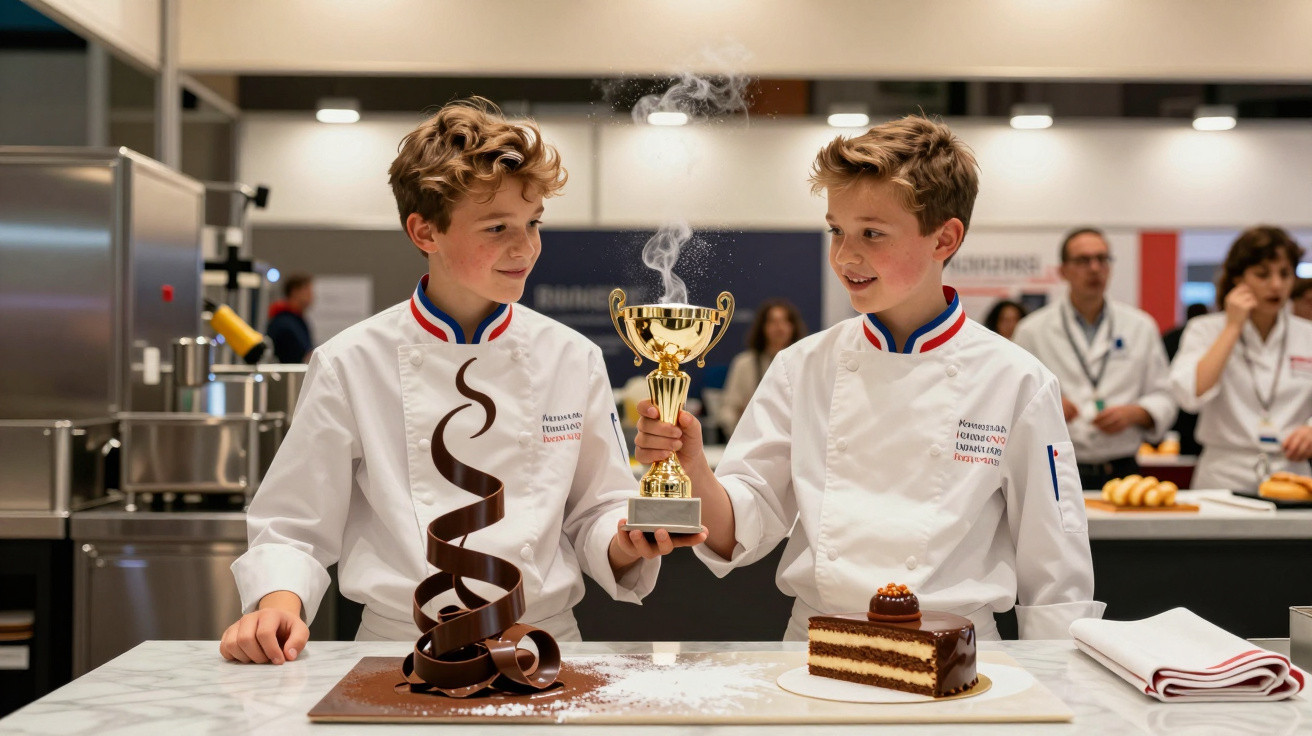
They entered as outsiders, contending with jet lag, pressure and 18 opposing teams. Ten hours later, chocolate-stained jackets and stunned expressions marked their place at the summit of junior pastry.
Twin brothers from an Alsace village conquer the world
The new junior pastry world champions are not celebrity chefs from Paris or Tokyo, but Mathis and Samuel Anstett. The twins come from Zimmersheim, a village close to Mulhouse in eastern France, where they grew up and trained alongside one another before claiming the same international crown.
They won at Sigep 2026 in Rimini, among the most demanding and technically exacting events on the professional pastry competition circuit. Staged in Italy every two years, the contest brings together emerging talent from across the continents for a punishing sequence of challenges with virtually no margin for uncertainty.
The championship allowed only ten hours for the full programme, forcing each team to balance speed with absolute precision.
Before dawn on 20 January, the Anstett brothers entered the competition kitchen. The clock then became relentless: they had ten hours, with no additional minute, to devise and produce a full pastry collection capable of impressing an international panel of experts.
Coffee, sourdough and a towering chocolate challenge
The junior world championship brief is unforgivingly varied. Teams must demonstrate flavour, creativity, technical command and structural skill in sharply contrasting formats. For Mathis and Samuel, the day became a tightly coordinated race.
The four centrepieces they had to create
- A fully vegan coffee cake
- A French-inspired street food dessert
- A breakfast product based on sourdough
- A 1.20-metre artistic chocolate showpiece
The vegan coffee cake required them to work without butter, cream or eggs, which are central ingredients in traditional French pastry. Its textures still needed to feel delicate and indulgent, while the coffee flavour had to be distinct and layered rather than harsh.
For the French-inspired street food dessert, they needed to create an item that could be eaten in the hand while retaining the polished appearance expected on a judging table. It had to sit somewhere between an elevated éclair and a festival treat: easy to carry, yet meticulously put together.
The sourdough breakfast product demanded an entirely different set of abilities: controlled slow fermentation, a balance of sweetness and acidity, and a soft crumb rather than a heavy one. The judges assess technical knowledge here as closely as they assess taste.
The centrepiece, a 1.20‑metre chocolate sculpture, had to stay perfectly stable while lights, heat and nerves worked against it.
This imposing chocolate construction is often the point at which teams see weeks of preparation fail, sometimes quite literally. A single fracture or improperly tempered piece can make a sculpture lean or break. The Anstett twins rehearsed their movements for months, until every action was instinctive.
Overcoming 18 international teams, including Asia’s rising stars
Nineteen junior teams made it to the final stage in Rimini, each having emerged from the strongest national or regional selection in its area. The field included respected teams from South Korea and China, countries recognised for detailed training systems and exceptionally consistent execution.
With guidance from French pastry chef Alexis Beaufils, the twins organised their work like a relay. While one completed the vegan cake, the other shaped the sourdough items; they then changed roles without losing valuable seconds. Their shared experience of training became a genuine advantage under intense pressure.
The panel commended the French pair for their steady pace and methodical organisation. While certain rivals hurried during the final phase, the brothers remained controlled, refining textures and details right up to the cut-off.
The judges highlighted the “coherence” of their work: flavours, textures and aesthetics seemed to speak the same language.
France shared the podium with South Korea and China, illustrating the intensity of modern competition in the field. To many watching in Rimini, the French success was also a reminder that established pastry nations must work harder than ever to remain ahead of rapidly progressing Asian competitors.
From television contestants to established talents
French audiences may already recognise the Anstett brothers from “Le Meilleur Pâtissier: Les Professionnels” on M6. The programme places pastry chef duos before cameras and celebrity judges, and their easy partnership and four-hands approach made an impression during the series.
Television brought visibility, whereas a world title offers a different form of validation: recognition from technical specialists and industry professionals. Sigep attracts hotel groups, luxury boutiques and restaurant owners seeking the next wave of talent.
The twins are now receiving numerous invitations, including international residencies and partnerships with established pastry houses. For two young chefs at the beginning of their professional lives, this creates both opportunity and a challenge to remain focused.
What this win changes for them
| Before Rimini | After Rimini |
|---|---|
| Known mainly in France through TV | Spotted internationally by chefs and recruiters |
| Working under established mentors | Approached for consulting, masterclasses and events |
| Short-term career plans in Alsace | Real options for projects abroad or branded boutiques |
Alsace pastry heritage meets a new generation
Food culture in Alsace is deeply rooted. Kougelhopf, bredele Christmas biscuits, flammekueche and generous tarts form part of the region’s identity. Winning an advanced global competition with vegan and street-food desserts creates a notable contrast with this traditional image.
However, the Anstett brothers do not view these influences as conflicting. They were raised around these classic recipes and continue to take inspiration from them. Spices associated with Christmas biscuits may appear in a modern entremet, while the outline of a kougelhopf can influence the mould used for a plated dessert.
Their victory shows that regional pastry can evolve without losing its roots, blending heritage with global trends like vegan and street‑style formats.
For Alsace, the title is also a message for young apprentices and local schools. It shows that global recognition does not require an immediate move to Paris or London. Determination, high-quality coaching and rigorous training can begin in a village laboratory.
The quiet benefit of being twins in a high-pressure kitchen
Being twins is more than an amusing detail in a competition setting; it influences how they operate. Years spent sharing schoolwork, sports and household responsibilities have created an almost wordless means of communicating at the workbench.
Throughout the ten-hour final, they had little need for conversation. One look could indicate that a tray should come out of the oven, while a brief gesture could mean, “I’ll handle the glaze, you finish the moulds”. Such smooth coordination saves time while limiting stress and friction.
At the highest level of kitchen work, fatigue can often trigger disagreements between partners. The Anstett brothers have dealt with those tensions countless times in everyday life, allowing them to recover quickly and continue working.
Lessons ambitious home bakers can take from a world championship
A professional laboratory is not necessary to apply lessons from Rimini. Several principles behind the winning performance can be used in everyday home baking.
- Work backwards from the deadline: establish when every component must be complete, then map out each stage from the finish back to the start.
- Repeat one recipe until the actions become automatic: practice leaves more mental space to correct fine points instead of merely getting through the process.
- Build flavours around one defined theme: as the brothers did with coffee, select one leading note and layer textures and aromas around it.
- Turn restrictions into creative impetus: vegan or gluten-free requirements can lead to unfamiliar ingredients and methods.
For anyone unfamiliar with the terminology, a pastry “showpiece” is a largely inedible decorative structure, typically made from sugar, chocolate or pastillage. Rather than being served, it demonstrates ability in sculpting, balance and finishing. Judges consider stability, gloss, neat joins and the overall story suggested by its forms.
Vegan pastry, another major condition of this championship, uses plant-based fats and proteins to reproduce the functions of butter, cream and eggs. This can involve aquafaba, or chickpea water, for meringues; oat or almond cream in ganaches; and oils or nut butters in place of dairy ingredients. When executed successfully, it can deliver the richness and texture of classic French recipes without seeming like a compromise.

















Comments
No comments yet. Be the first to comment!
Leave a Comment