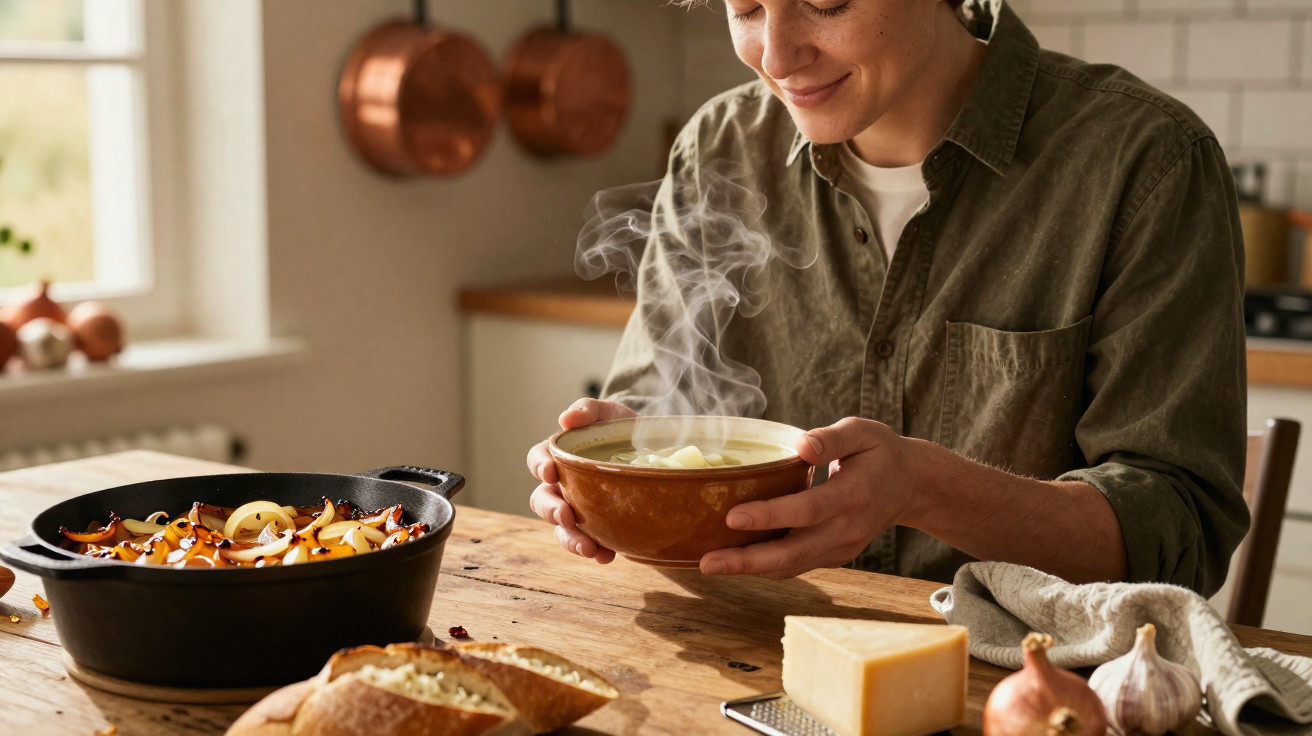
Between cough sweets and vitamin supplements, an old idea returns: French onion soup, slowly cooked, dark, sweet and rich. Can a bowl of soup really be something like medicine - and warm us from the inside?
Steam hangs in the room like a soft curtain as the landlord brings over the heavy bowls. It is late in a Paris bistro; quiet voices murmur indoors while the wet pavement gleams outside. Before me sits an amber-coloured broth, its onions melted to silkiness, topped with bread that turns crisp beneath the Gruyère. The first spoonful does not burn; it soothes. The cold takes a step back, my stomach relaxes and my shoulders drop. An elderly taxi driver at the next table nods. This, he says, has got him through night after night for years: “ça tient au corps”. I notice my pulse slowing, as though somebody has adjusted a dial. And it takes only four ingredients.
More than filling: why French onion soup feels warming
French onion soup does more than warm you; it feels like an internal blanket. Its secret is time: deeply caramelised onions lose their sharpness, releasing sweetness, umami and a distinctive gentleness. A robust broth provides minerals, bread brings texture, and cheese seals in the heat. Warms you from within is not marketing - it is a physical sensation that lingers.
Cooks in Paris market halls say the soup was already simmering on the stove at four in the morning. Market workers dipped in their spoons and their tiredness at the same time. Today, nurses finishing night shifts seek out precisely this kind of warmth: a bowl that does not argue, but simply delivers. Studies point to onions as a source of quercetin and sulphur compounds; for centuries, cooking has confirmed this with a shrug and a large pan.
So what is actually happening? Heat widens blood vessels, loosens muscles and softens stress signals. Broth supplies salt and potassium, supporting rehydration, while swallowing hot liquid moistens mucous membranes. Onions provide prebiotic fibre that feeds our gut; long, slow cooking reduces irritating compounds and unlocks their sweetness. It is not medicine, but a combination of biochemistry and ritual - and that is precisely where its strength lies.
The classic French onion soup recipe, French and mercilessly simple
This is the basic method for four bowls: halve 1 kg of yellow onions and slice them into fine half-moons. Caramelise them with 40 g butter, 1 tbsp olive oil and 1 tsp salt over a low heat for 45–60 minutes, stirring regularly and never rushing. Deglaze with 100 ml dry white wine (optional), then add 1 litre of robust stock, 1 bay leaf and a few sprigs of thyme. Simmer gently for 20 minutes. Toast the baguette, ladle the soup into ovenproof bowls, place the bread slices on top, scatter over 120 g Gruyère and grill for 8–10 minutes.
Mistake number one: the heat is too high, so the onions turn bitter rather than golden. Number two: not allowing enough time - real sweetness requires patience. Choose yellow onions rather than red ones, as they melt down more effectively; the stock can be boldly flavoured, because it carries the dish. We all know the moment when we think: I do not have the calm for this today. Let us be honest: nobody makes it every day.
So create a few small shortcuts without losing its soul.
“Slow is fast,” says the old proprietor on Rue Montorgueil. “The onion gives you everything if you give it everything.”
- Slow is fast: Set the heat lower than you think you should, and stir less often than you want to.
- Stock is the foundation: Vegetable stock makes it lighter, bone broth makes it deeper - either works.
- Let the onions rest for 10 minutes before cooking: this allows more protective compounds to develop after cutting.
- A dash of apple cider vinegar at the end lifts the sweetness if you are not using wine.
- Keep the cheese layer thin, otherwise it overwhelms the flavour.
Ritual rather than recipe: what French onion soup does to body and mind
French onion soup has its own pace. The pan slows you down, the aroma settles the room, and the first slurp tells the nervous system: everything is all right. Heat moves across the chest, steam loosens things up, saltiness awakens thirst - and suddenly you drink enough. This soup is no magic potion, but it often feels like one. Making it gives you a pause; eating it briefly places you in a calmer day.
The medical truth is sober but kind: there are no healing promises, only evidence for the things around it. Warm, salty, easily digested food can help when you feel as though you are catching a cold; the gut and mind appreciate routines, and onions feed the microbiome. It is the sum of its parts, not a single trick. Perhaps that is why there is such strength in a pot that looks not like spectacle, but like patience, a hob and quiet care for one another.
Share it. Cook it on Sundays and freeze individual portions. Take it to people chilled through by the day or by life. Soup is not an argument; it is a gesture - and gestures rarely cure illnesses, but they often lift moods. Sometimes that is enough to get through the night. Sometimes it is enough to make tomorrow feel appealing again. And yes: this warmth lasts longer than you might expect.
| Key point | Detail | Benefit for the reader |
|---|---|---|
| Slow caramelisation | 45–60 minutes over a low heat, stirring regularly | More sweetness, less sharpness, gentler on the stomach and mood |
| Robust stock | Vegetable stock or bone broth, well seasoned, with thyme/bay leaf | Minerals, depth of flavour, improved hydration |
| Hot gratin topping | Toast the bread, use a thin cheese layer, and grill briefly at high heat | Retains heat, adds texture, keeps you full without feeling heavy |













Comments
No comments yet. Be the first to comment!
Leave a Comment