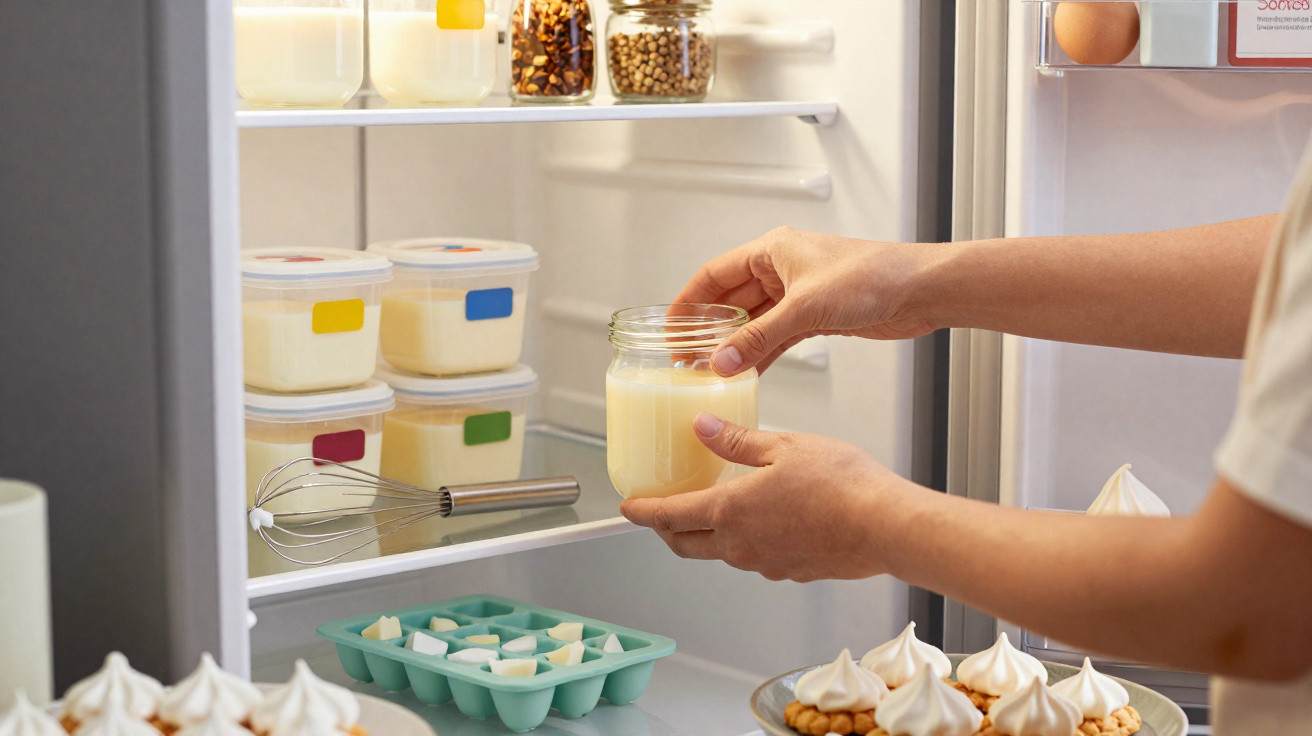
In many kitchens, leftover egg whites end up in a bowl in the fridge after baking, accompanied by the firm intention to turn them into meringues, pavlova or chocolate mousse “soon”. At the same time, there is an uneasy question: how long can raw egg whites genuinely be kept chilled without risking food poisoning?
How long can egg whites stay in the fridge?
Raw egg whites are a sensitive food. Bacteria can thrive in them, even though that may not be immediately obvious. Storing egg whites therefore means balancing the use of leftovers against food safety.
Recommendations for raw egg whites stored in the fridge range from no more than 24 hours for higher-risk uses to three or four days if they will subsequently be thoroughly heated.
Many recipe blogs and cooking forums state that egg whites will keep for three or four days in a properly cold fridge. In practice, this often works, particularly when the whites will later be baked thoroughly. The usual routine is simple: separate the eggs, place the whites in a clean container, fit the lid and refrigerate them at around 4 °C. They may later be used for macarons, almond crescents or a chocolate cake.
Food-hygiene guidance based on scientific recommendations takes a noticeably more cautious approach. It advises keeping separated egg whites in the fridge for just one day if you want to minimise risk. The reason is straightforward: the longer they are stored, the more opportunity germs have to multiply, even in chilled conditions.
Anyone wishing to avoid all risk should use egg whites that were separated that day or, at most, the day before. If you choose to store them for three or four days, they should only be reserved for recipes that will be cooked all the way through.
Raw desserts or oven heat: the intended use sets the time limit
Egg whites for mousse, creams and other unheated preparations
In dishes that are not exposed to sufficient heat, any germs in the egg whites remain present. Examples include:
- chocolate mousse where the mixture is not heated;
- raw whipped egg white used as a dessert topping;
- certain cold-mixed creams or foamy sauces.
In these preparations, the mixture never reaches temperatures that reliably kill harmful bacteria. Many germs are only destroyed at around 65 °C, maintained for at least 30 minutes at the centre of the food. A cold dessert cannot come close to achieving this.
For any use in which egg whites will not be thoroughly heated, they should be as fresh as possible and should have spent no more than about 24 hours in the fridge.
Extra care is needed for children, pregnant people, older adults and anyone with a weakened immune system. Even small amounts of germs can cause more severe symptoms in these groups. The safest option is to use only very fresh egg whites, or to choose desserts made with pasteurised egg whites, such as carton egg white.
Egg whites for cakes, meringues and other thoroughly baked recipes
Once the oven is involved, the rules change slightly. High temperatures dry meringues out, while the inside of cakes becomes considerably hotter than 65 °C. Provided the cooking time is long enough, this significantly reduces the risk.
For these recipes, many professionals and food-hygiene specialists accept a longer fridge storage period of three or four days, provided that the egg whites:
- have been kept chilled continuously;
- were stored in a clean, sealed container;
- have no unusual smell or slimy film.
There is also a minor practical effect: the texture changes over time. Egg whites that have been stored longer may whip less stably. Many bakers recognise this: the foam will still form, but it can be softer and have finer bubbles. This is usually not an issue for meringues or sponge cakes, although it can make a difference to especially airy foams.
How to store egg whites properly at home
Safety does not depend on storage time alone; the steps taken before and after storage matter just as much. A great deal can go right or wrong while separating the eggs.
Clean handling helps prevent problems
A few straightforward habits can substantially reduce the risk:
- Crack and separate eggs immediately before use rather than separating them in advance.
- Use a clean, dry, grease-free container for the egg whites.
- Seal the container straight away, using a lid or cling film.
- Store it in the coldest part of the fridge, ideally at around 4 °C.
- Do not leave egg whites at room temperature for more than two hours.
- Label the container with the date so that the storage period is clear.
If the smell, colour or texture of the egg whites seems strange, they are better in the bin than in a cake.
Smell is a particularly useful warning sign. Fresh egg white has a neutral smell. If it smells rotten, sulphurous or unusually sour, it should be discarded, regardless of how much time has passed.
When the freezer is the better option
If you already know that leftover egg whites will not be used soon, it is better to freeze them immediately. This avoids having to count the days and prevents the bowl from disappearing at the back of the fridge, only to be rediscovered after it has been forgotten.
Freezing egg whites: a practical method
Using an ice-cube tray is an easy approach, as it makes portions easier to manage.
| Step | What to do |
|---|---|
| 1 | Separate the egg whites carefully and briefly stir them to create an even consistency. |
| 2 | Pour them into ice-cube trays or silicone moulds and freeze them flat. |
| 3 | Transfer the frozen “egg white cubes” to a freezer bag or container, then label it with the date. |
| 4 | When needed, defrost them overnight in the fridge, not at room temperature. |
Stored this way, egg whites remain usable for around four to six months. Their texture will alter slightly, and after defrosting they often cannot be whipped to quite the same volume. However, they are generally still perfectly suitable for meringues, cake batter, pancakes, waffles or savoury leftover dishes such as omelettes.
How risky are bacteria in egg whites really?
The main concern behind this caution is germs such as salmonella and other pathogens that can cause gastrointestinal illness. These bacteria are found chiefly on the shell, but can enter the egg when it is cracked. Once the egg has been opened, its natural protection is gone.
Although many of these bacteria multiply much more slowly in the fridge, chilling does not kill them completely. Over time, they have more chance to reproduce. If the egg whites are then used raw, those germs are consumed directly.
Possible signs of food poisoning include:
- severe stomach pain;
- diarrhoea;
- nausea and vomiting;
- fever or chills.
Severe symptoms require medical attention, particularly when children or older people are affected. The simplest protection is to handle higher-risk foods such as raw egg whites with care and to maintain good hygiene.
Practical kitchen scenarios
Here is a realistic example: four egg whites are left over after a large serving of carbonara on Saturday evening. The cook pours them into a screw-top jar, seals it and refrigerates it at 4 °C.
If she plans to make an unheated chocolate mousse on Sunday, less than 24 hours in the fridge keeps her within the safer range. If she would rather bake a lemon cake topped with whipped egg white on Tuesday, the egg whites should be properly cooked through during baking. Three days of chilled storage is still within the tolerated range in that case, as long as the colour and smell remain normal.
Consider another situation: someone separates several eggs on impulse to make mayonnaise, uses the yolks straight away and tips the whites into a bowl that then sits on the worktop for several hours. Even if the egg whites are later transferred to the fridge, they have already spent considerable time in warmth. In that case, it is worth considering whether the risk is acceptable. For vulnerable people in particular, the safer choice is to put them in the food-waste bin.
Why a simple kitchen system saves a lot of stress
Anyone who bakes regularly can avoid a great deal of uncertainty with a few routines. A small note on the fridge, or a dedicated place for “waiting egg whites”, makes it easier to keep track. Some home bakers deliberately collect egg whites in the freezer so they can make a large batch of meringues or almond biscuits once a month.
If you enjoy cooking spontaneously, it can also help to note how many egg whites are in each freezer container. That removes the need for awkward measuring later. Another useful approach is to freeze them in portions, such as two egg whites together, because that quantity appears particularly often in recipes. This makes it possible to save food without compromising safety.







Comments
No comments yet. Be the first to comment!
Leave a Comment