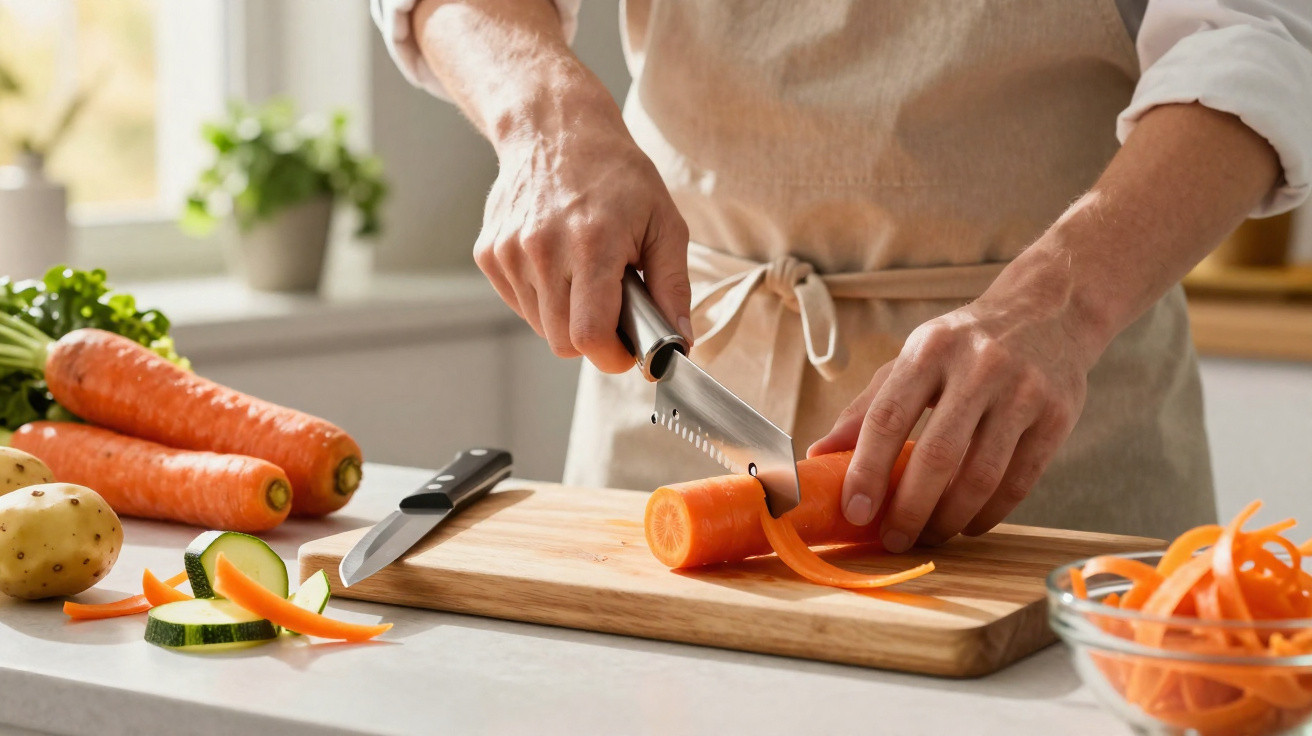
A simple TikTok video has highlighted something professional chefs have known for years: most people hold their vegetable peeler awkwardly in the kitchen, sacrificing speed, accuracy and safety as a result. The key lies in the motion and the pivoting double blade – and changing your technique takes only a few minutes.
Why so many people use a vegetable peeler incorrectly
The familiar scene in kitchens across Germany is always the same: a carrot or potato is held in one hand and the vegetable peeler in the other. Starting at the top, people pull one strip towards the hand, reposition the peeler, then pull it towards themselves again. It is the same short, inward tug every time.
Although this approach appears sensible, professionals consider it highly impractical. The arm moves in jerks, the grip becomes tense, and the vegetable peeler repeatedly loses contact with the vegetable's surface. Only part of the blade's potential is being used.
“Rather than creating a smooth flow, it produces a stop-start scraping motion – tiring, slow and riskier for your fingers.”
Chefs trained at catering colleges describe this as a classic trap: the range of movement is limited, while the forearm must repeatedly stop and restart. Anyone peeling an entire bowl of carrots, celeriac or parsnips will soon feel it in their wrist and shoulder.
There is another issue, too: the more you pull solely towards yourself, the closer your fingers get to the blade. Minor grazes and cuts are particularly common with uneven vegetables such as celeriac or with small potatoes.
How professionals hold a vegetable peeler
In professional kitchens, the vegetable peeler is treated as a miniature slicer. It is intended to work in both directions and, wherever possible, remain in contact with the vegetable. That is exactly what its moveable double blade is designed to do.
The basic principle is simple: the vegetable peeler should glide forwards and backwards in one calm, alternating motion, rather than making separate, choppy strokes. Your hand can remain remarkably relaxed throughout.
The step-by-step technique used in cookery classes
Anyone wanting to copy the professional method can follow this sequence:
- Hold the vegetable securely at one end.
- Place the blade roughly halfway along the vegetable.
- Push the vegetable peeler forwards with gentle pressure.
- Without lifting it away, immediately pull it back towards yourself.
- Turn the vegetable slightly, then repeat the movement in the same rhythm.
The angle is crucial: the blade should travel over the surface at a slight diagonal, around 15 to 20 degrees. If it is too flat, the peeler will merely slide over the skin. If it is too steep, it will dig in and tear deep grooves into the vegetable.
“When you do it properly, you hear an even, quiet rustle instead of a scraping sound – almost like using a slicer.”
Tests at cookery schools show that this back-and-forth technique can easily halve peeling time. At the same time, it keeps more distance between the blade and your fingers, because the peeler is not repeatedly reset in the direction of the hand but remains in a controlled rhythm.
What the double blade actually does
Many people assume that a vegetable peeler with two cutting edges simply makes it convenient for both right- and left-handed users. Historically, that is not quite true.
Modern vegetable peelers, including the familiar Y-shaped type developed in the 1940s, were deliberately made with a freely moving double blade. The aim was to create a continuous cut in both directions that adapts to the vegetable's shape. This technique is especially effective with long vegetables such as carrots and cucumbers.
When you guide it gently rather than gripping tightly, the pivoting blade automatically follows curves. The skin then comes away in fine, even ribbons instead of thick chunks that remove an unnecessary amount of edible flesh.
Benefits for speed, appearance and nutrients
Once you have mastered the professional method, the advantages quickly become clear in several ways:
- Faster preparation: A continuous back-and-forth motion replaces constant repositioning.
- Less effort: The forearm muscles stay more relaxed, and the wrist does less braking work.
- Finer peelings: The blade removes only a thin layer, leaving more of the vegetable intact.
- A neater finish: The surface stays smooth, with no deep grooves or tears.
- More nutrients: Many vitamins sit directly beneath the skin, so peeling more thinly means throwing less of them away.
“Carrots, potatoes and courgettes in particular take on a visibly more even finish – almost like they have come from a restaurant.”
There is also an often overlooked benefit: when the surface looks less damaged, vegetables do not turn grey or brown as quickly. This is because the plant fibres are disturbed less. The exposed areas react more slowly with oxygen, which can make a difference with potatoes if they are left for a while before the pan is heated.
The right vegetable peeler makes a difference
Not every vegetable peeler at home is actually suitable for the professional technique. Many very old designs have a rigid, single-sided blade with very little movement. For the modern method, it is worth checking the following features:
| Feature | What to look for |
|---|---|
| Blade | Double blade, stainless steel, pivot-mounted |
| Handle | Non-slip, fits fully in the hand, not too thin |
| Shape | Y-shaped or straight design, depending on preference; both should allow back-and-forth movements |
| Care | Easy to clean, blade readily accessible, no rust |
Anyone regularly peeling hard root vegetables may prefer a sturdier, heavier version. For delicate fruit or tomatoes, models with serrated blades are available to grip tender skins more effectively.
Practical tips for everyday work at the chopping board
A few small adjustments can make the switch from the old habit to the professional movement easier:
- Begin with larger carrots or cucumbers rather than small potatoes.
- Work deliberately more slowly until the rhythm feels comfortable.
- Keep the wrist relatively still and let the forearm create the movement.
- Adjust the pressure slightly: use less for thin skins and a little more for thicker ones.
- After a few minutes, briefly shake out your hand to notice whether you are tensing up.
If you like, test the vegetable peeler on an apple. Its curved shape quickly reveals whether the blade is genuinely following the contour or catching at certain points. If it works on an apple, long vegetables will be almost effortless.
What else you can do with a vegetable peeler
Once the new movement becomes natural, it opens up a whole range of uses beyond purely functional peeling. Fine ribbons of carrot, courgette or cucumber can quickly become colourful vegetable salads that look more impressive than traditional slices.
A vegetable peeler also works well for pasta alternatives: briefly toss strips of courgette or carrot in a frying pan, then combine them with a little oil, garlic and herbs for a light side dish. Even cheese, such as a firm block of Parmesan, can be turned into decorative shavings this way.
The technique is also useful for using up leftovers. Thin, clean peelings from organic vegetables can be fried or roasted in the oven until crisp, then lightly salted to make crunchy vegetable snacks. In this case, peeling thinly genuinely means more enjoyment and less waste.
Why relearning the technique is worthwhile
At first, the new hand movement can feel unfamiliar, especially for anyone who has used the same inward tug for decades. However, many users report that their body adjusts after two or three evenings of cooking.
Once you have seen how quickly a pile of carrots turns into smooth, evenly peeled batons, you will usually have little desire to return to the old scraping method. As an added benefit, the number of irritating minor kitchen injuries falls because fingers and blade cross paths far less often.
“One unobtrusive tool, one slightly altered angle – and suddenly preparing vegetables becomes noticeably more relaxed.”
In everyday life, when meals often have to be made between work, children and appointments, every simplification counts. Using a vegetable peeler properly saves minutes, is kinder to your hands and ensures that fresh ingredients look better, while more of what is inside ends up on the plate rather than in the food-waste bin.









Comments
No comments yet. Be the first to comment!
Leave a Comment