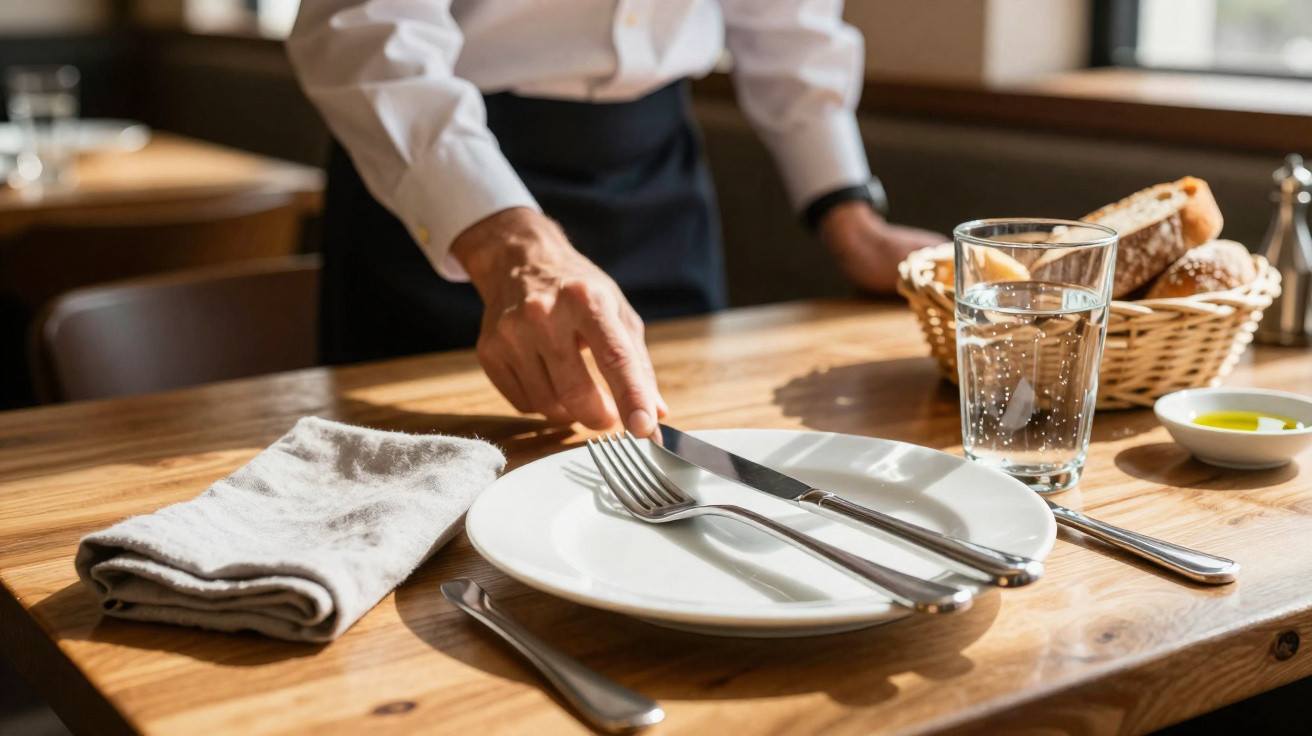
Empty plates, two glasses of red wine and low conversation. Then, calmly, the woman sets her knife and fork into a tidy cross at the centre of her plate. As the waiter passes, he looks down and his smile becomes slightly strained. In a quieter tone, he asks, “Was everything okay?” She gives a shrug. “It was fine.” His expression suggests he is not entirely convinced.
Most people would miss this small piece of theatre, but tiny actions carry considerable meaning in restaurant dining rooms. Across many countries, the way cutlery is left on a plate forms a kind of code: a wordless review. After a meal, crossing your knife and fork may communicate something far more critical than you intended.
It is one of those customs learned from relatives, films or the occasional online article. However, many waiters and chefs see crossed cutlery as a warning sign: a subtle indication of I didn’t like this.
Once you understand it, the plate before you starts to resemble a stage.
The hidden language of knives and forks
At the end of a busy service, a restaurant can look like it is hosting an unusual ballet. Partly cleared plates sit on tables, forks are left in untidy positions, and knives slide towards the rim. Within that disorder, though, certain arrangements appear again and again: parallel lines, precise angles and, occasionally, a pointed cross in the middle of a plate.
To restaurant staff, these placements are not accidental. A knife and fork positioned neatly together commonly say, “I’ve finished, and everything was fine.” A lone fork can indicate, “I’m still eating.” Crossed cutlery, meanwhile, is considered in many traditions to be the silent equivalent of a frown.
Most diners do not realise they are communicating anything at all. They might cross their cutlery because they always have, or simply because it appears neat, while their server interprets the steel arrangement as a negative review.
On a wet London evening, a server called Alex arranged empty plates along the pass. One plate held the remains of a steak eaten down to its final piece of fat, with chips that were almost completely gone. But the knife and fork had been placed in a firm cross. “She hated it,” the chef said from behind the pass. “Did she say anything?” Alex asked. “No. Just that,” he answered, gesturing towards the X.
Alex later spoke to the woman as she was leaving. She maintained that she had loved her meal. “Oh,” he replied, taken aback, “we thought the crossed cutlery meant you weren’t happy.” Embarrassed, she laughed. Her mother had taught her that crossing cutlery was simply “good manners”. Nobody had ever explained otherwise.
Similar stories occur in dining rooms in Paris, Madrid and Berlin, as well as in some American restaurants with a more formal style of service. The conventions do not always match exactly, but the underlying idea does. For staff, the position of a knife and fork is not merely decorative; it is feedback they use throughout the evening.
There is a practical reason for the system. In a full dining room, servers cannot pause at every table for a detailed chat. They depend on quick visual signs instead. Is the diner still eating? Is the plate ready to be removed? Did they enjoy the meal? Cutlery placement can provide those answers at a glance.
Crossed cutlery attracts attention because it disrupts that visual pattern. Two pointed lines meeting in the centre of the plate can resemble a small protest placard. In some European etiquette manuals, the cross historically meant “I’m not finished” or “I’m dissatisfied.” Over time, many restaurants reduced the code to a simpler version: parallel means “finished”, while a cross signals a “problem”.
As a result, making that X without thinking can tell your waiter that the meal disappointed you, that the sauce was wrong or that the steak was overcooked. They may relay the concern to the kitchen, and the chef may worry about a dish that does not need changing at all. One minor movement of a fork can trigger an entire chain of events.
How to use cutlery signals without speaking
To prevent an unintended message, there is a straightforward placement that works in most settings. Set your knife and fork parallel at roughly the 4 o’clock position on the plate, with their handles resting lightly on the rim. Whether the fork tines face up or down depends on your usual habit; keep the knife blade facing inwards and align both pieces like a sideways pause symbol.
This uncomplicated arrangement communicates two things to the waiter: first, that you have finished eating; second, that you had no significant problem with the food. It is a composed, neutral and nearly universal indication. In many restaurants, a server will notice those parallel lines and remove the plate without saying a word.
If you have not finished and do not want your plate taken away, leave the knife and fork separated, often in an upside-down V shape, or place the knife along the upper edge of the plate with the fork at the side. In effect, you are saying, “I’m still eating, don’t take this yet.” There is no fuss and no unintentional offence.
On a personal level, many of us find these tiny etiquette conventions uncomfortable. On an ordinary Tuesday evening, nobody wants dinner to feel like an examination in table manners. People are weary, children are restless and friends are trying to catch up. Fork placement is hardly the main concern. Let’s be honest: nobody really does this every day.
That is precisely why confusion arises. One diner stacks plates in an effort to help, while the server silently objects because they become more difficult to carry. Another crosses their cutlery to make the plate look tidy, and the kitchen assumes the dish has been a failure. Both parties have good intentions; the code is simply rather unclear.
At its heart, this is less about being posh than it is about consideration. Understanding a few of these signs reduces friction and enables staff to understand you without having to guess. In particularly busy or more upmarket restaurants, such minor gestures help service run efficiently and save you from repeated interruptions asking, “Are you finished?”
“Cutlery is part of the conversation with the guest,” explains Marta, a restaurant manager in Barcelona. “When they cross the knife and fork, for us it’s like they’re crossing out the dish. If they’re happy, we usually see the knife and fork sleeping together on one side.”
For an easy way to remember it, use this brief mental checklist:
- Parallel knife and fork at 4 o’clock: I’m finished, everything is fine.
- Utensils apart, without touching: I’m still eating.
- Fork on the plate, knife on the table: an informal setting with no definite message, though it is not a major issue.
- Crossed cutlery: often understood as “I’m unhappy”, or at least “Something was wrong.”
You do not need to obey every etiquette diagram found online. Everyday life is more untidy than that. Still, avoiding the crossed X after a meal is a simple adjustment that stops your silent message sounding more severe than you feel. If the food genuinely was poor, you can deliberately use the cross and then support it with calm, honest feedback.
The small cutlery gesture that shifts the mood
Once you begin to spot these quiet rituals, eating out takes on a different feel. The way a friend puts down her fork with a contented sigh can say as much as “That was amazing.” The unspoken acknowledgement between a server and a table whose cutlery is neatly aligned suddenly becomes understandable. A dining room is not only about food; it is a continuous, understated conversation.
Crossing cutlery is one of those seemingly harmless actions that can arrive as criticism. It neither shouts nor whispers. Beneath the plate, then, lies the real question: when you are “done”, what do you want to convey? A shrug, a thank you or a quiet complaint?
The next time you finish dessert, your hand will briefly pause over the plate before deciding. Will the knife and fork form an X, or sit together side by side like a truce? That split second may tell your waiter more than the small talk exchanged on your way out.
| Key point | Detail | Why it matters to the reader |
|---|---|---|
| Cutlery positions are a code | Knife and fork arrangements communicate “finished”, “still eating” or “unhappy” without words | Avoid uncomfortable misunderstandings with restaurant staff |
| Crossed cutlery often signals dislike | Many waiters interpret an X on the plate as “I didn’t enjoy the meal” | Avoid accidentally sending negative feedback to the kitchen |
| Parallel cutlery is the safe default | A knife and fork aligned at 4 o’clock are widely understood as “I’m done and fine” | Use a straightforward, dependable gesture in any restaurant |

















Comments
No comments yet. Be the first to comment!
Leave a Comment