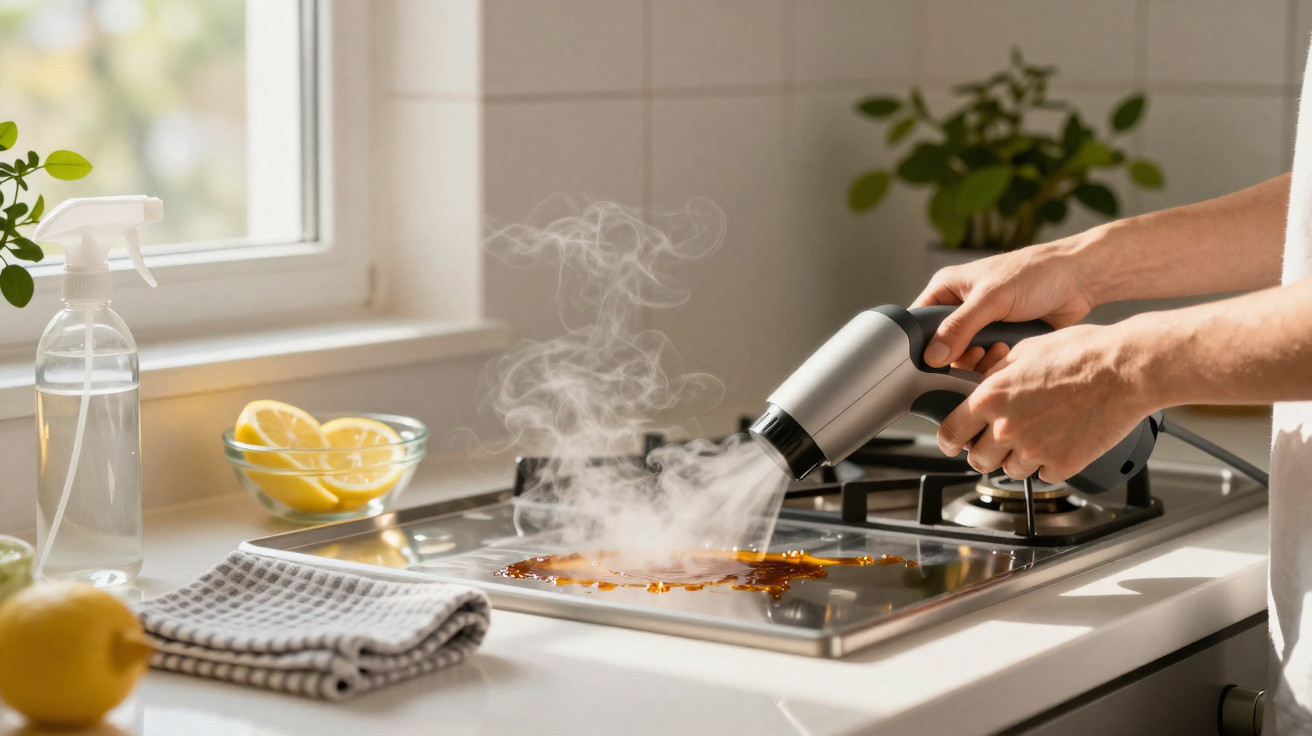
A stubborn greasy layer can form above the hob, seeming to mock every spray and sponge. Cooking vapours settle in the joins, set hard, and make the thought of reaching up with a scourer feel daunting. Cleaning professionals are increasingly recommending a simple, understated solution: hot steam that loosens grime from a cooker hood with very little effort. No scraping. No aggressive odours. Steam takes care of the hard work.
As a kettle begins to bubble, sending clouds of vapour upwards, position it beneath the hood as carefully as a magician placing a prop. Within minutes, the dull, sticky coating on the metal starts to soften, become glossy and gather into small amber-coloured beads. It felt almost like cheating.
The light catches the droplets as they travel towards the filters. Pass a microfibre cloth over the surface once and it returns brown, as though the grease has chosen to surrender. No strenuous scrubbing. No abrasive paste. Only warmth and a little patience. The grease simply releases.
Steam over steel: why vapour melts cooker hood grease
Grease on a cooker hood is more than oil alone: it is a mixture of airborne fat, smoke residue and dust that gradually bakes into a sticky coating. Cleaning experts highlight a straightforward principle: vapour does not merely warm the surface; it clings to it and transfers heat directly to the dirt. Once the metal reaches a warm, workable temperature, stubborn layers loosen and slide away like butter in a frying pan.
There is another useful element at work: airflow. As steam rises, it surrounds the cooker hood canopy before moving into the filters and channels, taking liquefied residue with it. Set the fan to low and the airflow draws softened grease through the mesh, rather than leaving you to tackle it on the surface. The effect is unexpectedly refined, like mist cleaning a window from the inside.
Physics also plays its part. When vapour meets cooler steel, it condenses and releases a concentrated burst of heat at the point of contact, loosening the bond between fat and metal. The fine droplets then collect dirt and pull it downwards with gravity. There is no abrasive product, no scratching and no danger to brushed finishes. It uses the very force that cooks food to reverse the mess cooking leaves behind.
The effortless vapour method, step by step
Prepare the area before you begin. Lay an old towel over the hob to catch drips, then place a broad saucepan or casserole dish containing 5–8 cm of water on a powerful ring. For deodorising, add a splash of white vinegar or a piece of lemon peel; avoid vinegar if the cooker hood is bare aluminium. Bring the water to a rolling boil, then position the pan immediately beneath the middle of the hood canopy.
Allow the steam to rise with the fan switched off for 3–4 minutes, giving it time to surround the metal. Next, run the fan on low for another 3–5 minutes so that vapour is drawn through the filters. You should see droplets appear and run down the surface. Switch off the heat, allow a minute for the densest steam to settle, then wipe gently using a warm, damp microfibre cloth. Do not press hard; contact is enough. For the filters, rinse them under hot water in the sink and watch the liquefied layer wash away. That is no scrubbing in reality.
Everyone knows the feeling of facing a cooker hood that seems too dirty to deal with, so take the easy approach. The main errors are trying to hurry the boil, directing a steam jet at light fittings, or using a cold cloth that makes grease firm up again. Wear oven gloves, keep your hands out of the steam path and allow the metal to warm before touching it. Let’s be honest: nobody actually does that every day. Use this method monthly, or after a frying session, and you will appreciate the difference next time.
“Steam is patient power. Give heat a few quiet minutes and the hood lets go-no drama, no gouging your finish.”
- Quick kit: wide saucepan, kettle (optional), white vinegar or lemon, microfibre cloths, tongs, heatproof gloves and an old towel for drips.
- Fan timing: leave it off first to cover the canopy in steam, then use low speed to draw vapour through the filters.
- Surface notes: stainless steel responds well to this; with aluminium, avoid acids and wipe it promptly.
- Safety: do not direct steam at electrical parts, keep lights off and move slowly around hot vapour.
What changes when grease stops sticking
The kitchen feels different when a cooker hood changes from heavily encrusted to easy to manage. Air clears more quickly after searing, while the room smells of the meal rather than lingering cooking odours. You can cook with confidence again-fish on a weekday or bacon on impulse-because cleaning up no longer feels punitive. The fan operates more quietly when its filters are not clogged, and the lights cast a brighter glow over the pan. Send this to the friend convinced their cooker hood is beyond saving and see their surprise. There is a small pleasure in overcoming a job once fought with force by using something gentle instead. It is also satisfying to know that your kitchen can breathe as freely as you do.
| Key point | Detail | Benefit for the reader |
|---|---|---|
| Heat + humidity do the heavy lifting | Condensing vapour provides focused heat that liquefies grease bonds | Less effort, no abrasives and protection for finishes |
| Two-phase steam flow works more intelligently | Fan off to cover surfaces in steam, fan low to pull it through filters | Quicker results and cleaner internal parts without dismantling |
| Small set-up, big payoff | Pan, water, microfibre cloth and 10–12 minutes of gentle steam | Easy to repeat after messy cooking, with better air and lighting |















Comments
No comments yet. Be the first to comment!
Leave a Comment