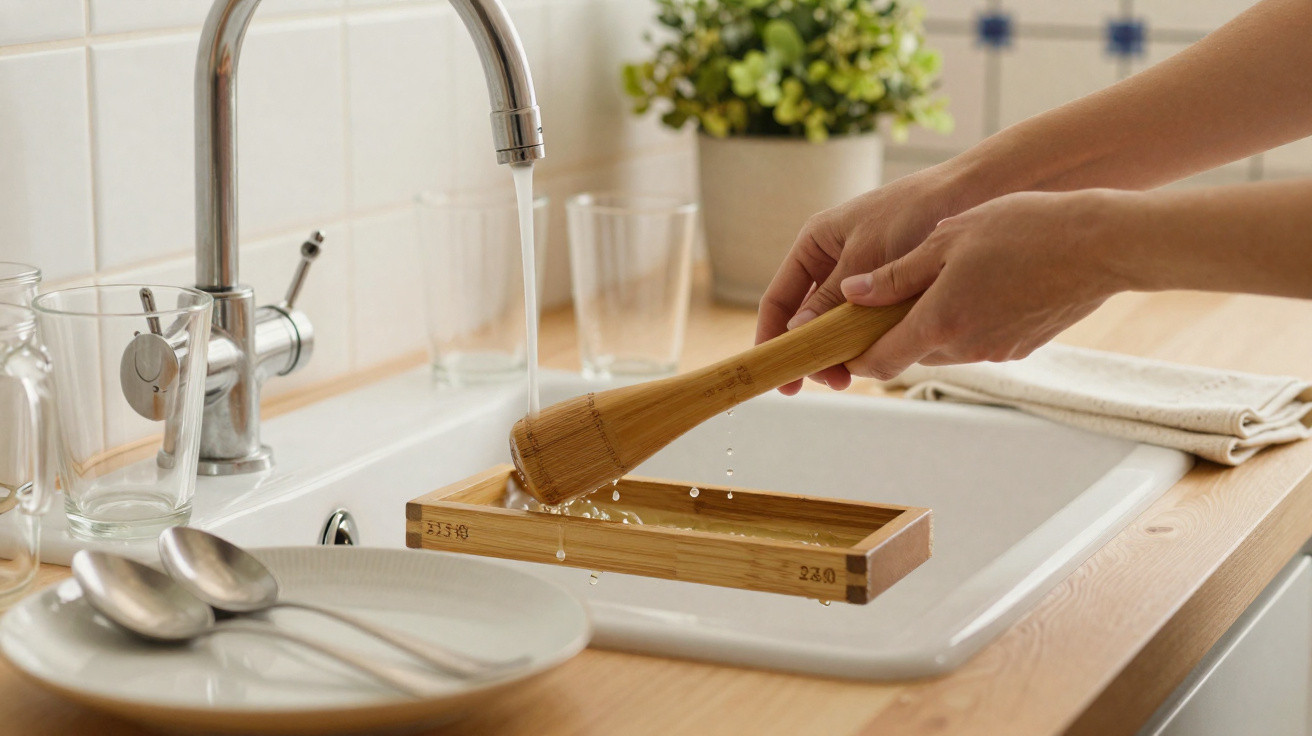
Forks that seem permanently decorated with irritating little spots. A sink that appears “clean-ish”, yet plainly is not. That daily water drama plays out around the dish rack, where droplets, time and gravity battle for hours. On a whim, I replaced my noisy chrome stand with a bamboo rack, and the rhythm of my kitchen subtly shifted. Same washing-up liquid. Same hands. A different rack. Drier cutlery and barely any marks. That is the whole story.
As the kettle clicked and the window misted over, weak winter sunlight fell across the worktop. I washed three mugs, a hazy wine glass and the familiar procession of spoons, then waited with the dull expression reserved for watching water do nothing. On my old wire rack, droplets stayed put like obstinate pearls. On the bamboo rack, they seemed to run off with a gentle push. I made a tea, returned and felt the handles. Dry. Not towel-warm, but genuinely air-dried. The glass had a clear shine, with no chalky ring around it. A modest household miracle was unfolding beneath the tap, as unremarkable as breathing. It was not down to the washing-up liquid.
The small switch that transformed my sink
Changing to bamboo did not feel like a lifestyle decision; it felt as routine as buying teaspoons. Still, the difference was obvious and, in its modest way, rather impressive, as good kitchen equipment can be when it works properly. The sloping slats gave forks a place to rest without holding puddles, while the base no longer rang like a cymbal whenever I put down a plate. It also looked warmer: less clinical and more like home. Most importantly, utensils dried sooner and emerged without those pale water spots that make everything look faintly worn out.
To make sure I had not imagined it, I carried out a small, admittedly nerdy comparison. I used the same washing-up, the same water temperature and the same number of shakes above the sink. On the bamboo rack, forks and spoons were dry in around 12–14 minutes; on the old wire version, they remained tacky at 20. The wine glass dried clear rather than carrying the faint crescent the steel rack usually left behind. We all know the feeling of holding a supposedly clean glass to the light and sighing. This time, I held it up and saw sunlight gleam through it. It felt like reclaiming a little time.
Bamboo is not magical. The difference comes from airflow, contact points and the behaviour of tiny droplets at the edges. A wire rack creates tight pressure points that allow beads of water to gather and cling. Bamboo slats distribute the contact and draw micro-droplets away from the utensil, allowing them to evaporate as the surface warms and breathes. That subtle difference creates less pooling, fewer marks and less need for a second pass with a tea towel. The rack does not dry the dishes; the air does. Bamboo simply lets air work more quickly, with fewer stagnant areas.
How to get the same bamboo rack results at home
Put the rack where air is circulating: beside a window, below an extractor fan or in the path of a mild cross-breeze between a doorway and hall. Before placing anything on it, give each item two firm flicks over the sink. Stand forks upright, and angle bowls and mugs slightly so water runs towards the rim instead of collecting at the base. Place knives blade-down for safety, with handles facing up so they dry quickly. If there is a drip tray, angle it a few millimetres towards the sink rather than letting it become a saucer. That tiny slope is gravity’s cheat code.
Do not create a leaning tower of washing-up. Overfilling the rack stops air from moving and brings the spots back. Avoid keeping cloths beneath it, as they retain moisture and encourage that stale “wet laundry” smell. After a particularly busy day, wipe the bamboo base in the evening and leave it empty for an hour so it can breathe. A light layer of food-safe mineral oil once a month helps prevent swelling and roughness. Realistically, no one does that every day. Apply it when the surface begins to feel dry or coarse, and you will be fine.
Treat the rack as a bridge rather than a storage shelf. Items should pass over it, not settle there indefinitely. As one kitchen designer told me,
“Air is your second sponge. The rack’s only job is to give air a chance.”
A handful of small routines helps preserve the effect:
- Leave space between spoons and forks so their bowls do not nest together.
- Position glasses at 30–45 degrees to prevent halo rings.
- Empty the tray once during drying if you have washed a large load.
- Turn chopping boards so a different edge faces down each time.
- Once a week, place the rack on its side for an hour to air the underside.
A modest change that alters the kitchen’s feel
A sink that returns to order quickly is quietly satisfying. It lifts the atmosphere of the room, reduces friction and makes a late-night wash-up feel less like work. The bamboo rack did not turn me into someone else. It simply moved the kitchen towards greater ease, and ease tends to spread. My glasses appear newer. The cutlery comes out with a bright, clean gleam rather than a dull shrug. The worktop sounds gentler too: less clatter, more quiet. And yes, the no water spots claim is real, not merely a lighting effect. Small domestic victories matter more than we tend to admit. They soften the rough edges of the day, and cooking somehow feels fresher when the drying happens by itself.
| Key point | Detail | Benefit for the reader |
|---|---|---|
| Airflow beats wiping | Angled slats and spacing carry droplets away from surfaces | Faster drying times without additional effort |
| Placement matters | Position the rack by a breeze or extractor, with a slight tray angle | Fewer spots and less standing water |
| Simple care pays back | A quick wipe each evening; refresh with mineral oil monthly | Longer rack life and faster drying over time |





Comments
No comments yet. Be the first to comment!
Leave a Comment