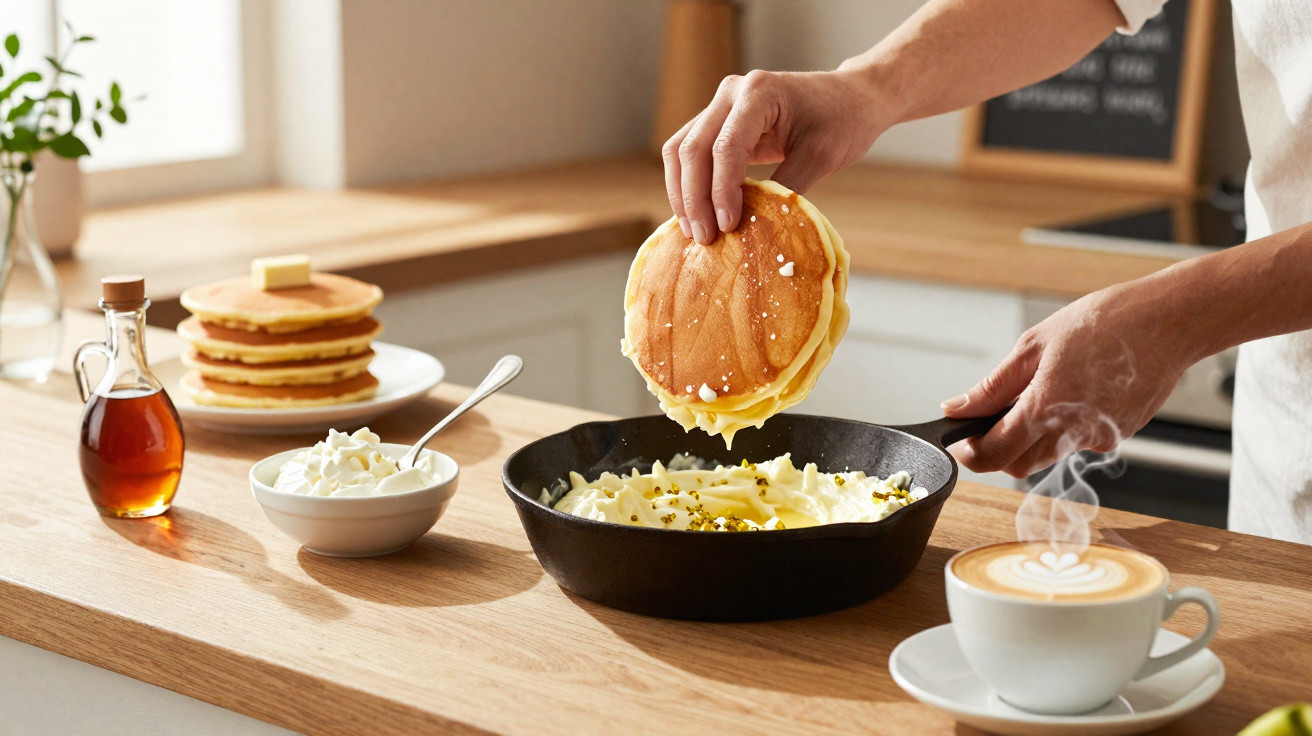
Sunday mornings come with their own soundtrack: the gentle clink of mugs, the subdued whistle of the kettle, and a forgotten favourite playlist drifting in from the next room. You are still in your pyjamas, scrolling through dreamy café photographs where pancakes resemble clouds piled high on a plate.
Then you look around your own kitchen and think, “Mine never look like that.”
The first batch catches, the second comes out flat, and the third somehow tastes of disappointment and baking powder. With a sigh, you pick up your keys and decide that brunch out is simply easier.
Yet one small thought lingers.
What if a café-quality stack really could be made at home?
Why truly fluffy ricotta pancakes taste so special
The first time you try a properly made ricotta pancake, there is a brief pause after the opening bite. Your mind is prepared for the chewiness of a traditional diner pancake, but your fork simply… glides through. The middle is delicate and soft, almost as though a soufflé had chosen to become breakfast.
That is ricotta’s particular magic.
It does not make a fuss. It simply changes everything.
You still have all the comfort of a pancake, but its texture feels a little more refined, a little like a weekend break, even when you are wearing yesterday’s T-shirt.
A friend of mine first discovered them in a cramped café on a rainy Brooklyn street corner. The tables were packed too closely, the coffee was a little overpriced, and the wait for a small plate was thirty minutes.
At first, what arrived was not especially striking: a modest stack, a few berries and a smear of butter melting down one side. Then she cut into it.
She said the pancake almost sighed on the fork.
For the rest of brunch, she quietly analysed the texture, asking the server whether it contained cream, yoghurt or some hidden ingredient. That evening, she was already down a recipe rabbit hole, trying to recreate that gently structured, custardy crumb.
Ricotta is so effective in pancakes because it alters the batter in several ways. It brings moisture without making the mixture wet, and richness without the heavy post-brunch feeling. Its tiny curds nestle among the flour and eggs, trapping air and steam as the pancakes cook.
Rather than ending up with a dense, bread-like round, you get something that rises. It also remains tender when it has cooled on the plate.
That is why café pancakes taste so unlike a boxed mix made at home.
They are not merely sweeter or more attractive.
Their structure is designed for fluffiness.
From fridge to frying pan: making cloud-like ricotta pancakes
The route to café-style fluff starts well before the frying pan. Take the eggs and ricotta from the fridge a little ahead of time so that they are not ice-cold. Bringing them closer to room temperature helps them combine smoothly rather than clumping.
Whisk the egg yolks with the ricotta, a splash of milk and a touch of vanilla until the mixture is smooth. It should resemble a loose, creamy custard.
In a separate bowl, carefully incorporate the dry ingredients: flour, a little sugar, baking powder and a pinch of salt.
Keep the batter a little lumpy and relaxed.
Too much mixing is the enemy of a fluffy result.
Next comes the step many home cooks miss: separating the eggs. Beat the whites with a clean whisk until they form soft peaks. There is no need for a stand mixer; an inexpensive hand whisk and some patience will do the job perfectly well.
Fold the whites into the ricotta batter in two or three light additions. Do not stir forcefully. Scoop upwards from the bottom, fold over, turn the bowl and repeat.
As the whites disappear, the batter will become lighter and puffier.
Let us be honest: hardly anyone does this every day.
But when you do, the difference on the plate is remarkable.
The chef at that Brooklyn café once summed it up perfectly when a regular begged for the recipe: “We’re not doing anything fancy. We’re just not rushing the batter.”
- Choose full-fat ricotta
Lower-fat varieties contain more water and less richness, meaning the pancakes may become gummy or weepy rather than tender. - Do not turn the heat up too high
Medium heat, or just below, is the ideal level. Too much heat burns the outside before the middle has set; too little means the pancakes dry out instead of rising. - Give the batter a short rest
Even 5–10 minutes on the worktop allows the flour to hydrate and the baking powder to begin its quiet work. - Grease the frying pan sparingly
A light coating of butter or oil is sufficient. If the pan is swimming in fat, the edges will fry and become tough rather than softly golden. - Turn them when bubbles appear and the edges look matte rather than glossy.
This small visual signal is the most reliable built-in timer.
The quiet luxury of café brunch at home
There is a particular pleasure in putting down a plate that appears to have come from a menu rather than a packet mix. The pancakes stand a little taller than usual, steam rises from them, and a knob of butter has just begun to slide down the side. The room fills with the scent of vanilla and warm flour.
You are not really trying to impress anybody. You are simply giving a slow morning a little ceremony.
We have all experienced that moment when the first mouthful tells you that you have genuinely got it right this time.
Perhaps you finish them with lemon zest and icing sugar. Perhaps you keep it traditional with maple syrup and a handful of blueberries from the back of the freezer. The toppings are no longer the main event; the base is.
Fluffy ricotta pancakes may seem like a small improvement, but they quietly change the meaning of “home brunch”. They make cooking at home feel less like settling and more like choosing.
All at once, the idea of queuing on the pavement for an overbooked brunch table seems slightly less enchanting.
You begin to see how a handful of small habits-separating eggs, folding gently and monitoring the heat-combine to transform an everyday dish. That way of thinking often extends beyond the kitchen. You realise that you do not always need a reservation or a new spot across town to feel looked after.
Sometimes, all it takes is a bowl of ricotta in the fridge, fifteen peaceful minutes and a frying pan warming on the hob.
It is the sort of small, repeatable ritual that makes home somewhere you truly want to be on a Sunday.
| Key point | Detail | Value for the reader |
|---|---|---|
| Use ricotta for texture, not only flavour | Full-fat ricotta keeps pancakes tender, moist and gently structured | Recreates that café-style “cloud” texture at home |
| Separate and whisk the egg whites | Gently fold the whipped whites into the batter at the end | Increases lift and fluffiness without difficult techniques |
| Manage the frying pan heat and timing | Cook over medium heat, turning when the edges become matte and bubbles set | Avoids burnt exteriors and uncooked centres for reliable results |
FAQ:
- Question 1 Can I use own-brand ricotta, or do I need something fancy?
- Question 2 What happens if I do not have time to separate and whip the egg whites?
- Question 3 Can I prepare the batter in advance for brunch guests?
- Question 4 How can I prevent my pancakes from becoming rubbery or dense?
- Question 5 Which easy toppings work particularly well with ricotta pancakes?

















Comments
No comments yet. Be the first to comment!
Leave a Comment