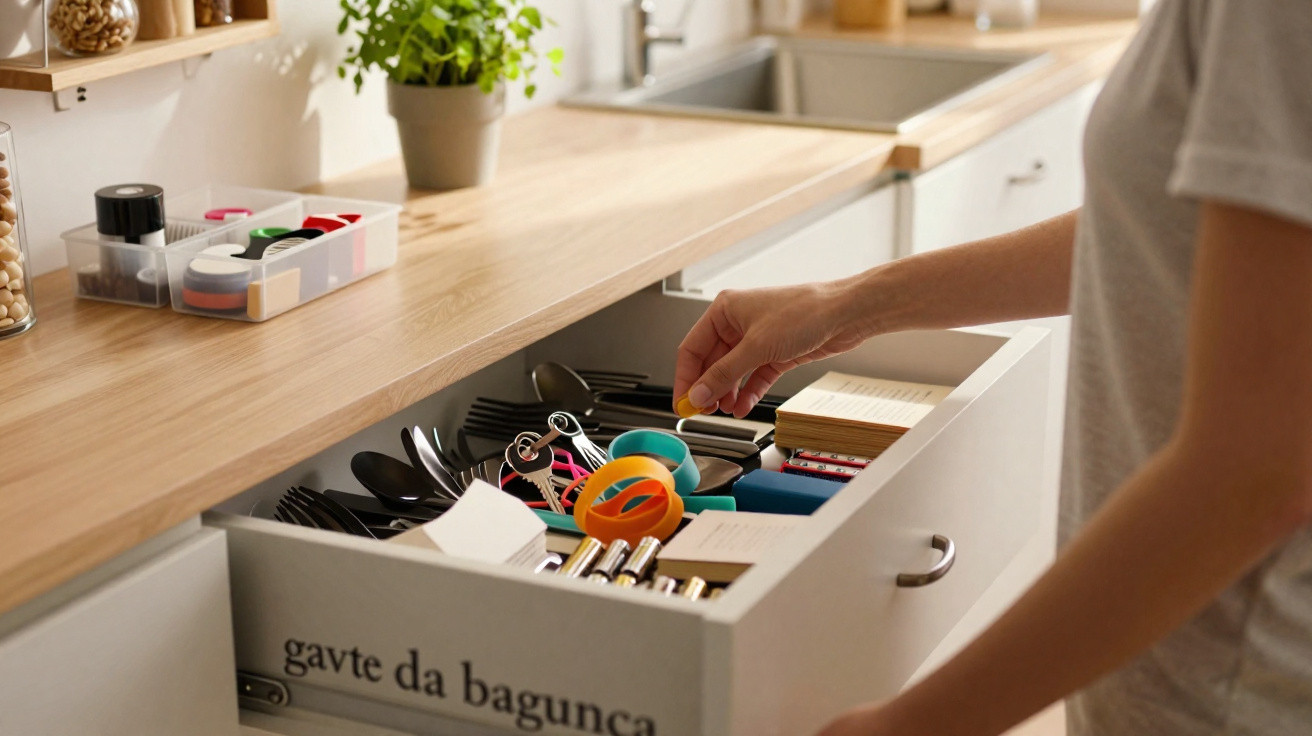
A slim handle, a glossy front, part of the seamless line of cupboards you chose so proudly in the showroom. Yet pull it open and the illusion falls apart. Batteries roll into takeaway menus, dried-out biros knot themselves around string, and soy sauce sachets stick to a partly melted tealight. Somewhere beneath it all is a spare key. Probably.
This drawer was supposed to be “temporary”. Somewhere to put things “just for now”: receipts, elastic bands, that tiny screwdriver you always need when something goes wrong. Years on, it has turned into a miniature museum of domestic chaos.
This neglected drawer is often the untidiest area in the kitchen.
And that is no coincidence.
The quiet chaos inside your kitchen junk drawer
Open the drawer and take a proper look. Rather than seeing a job to tackle, view it as a record of your life. There are loyalty cards for cafés you no longer use, scraps of children’s homework and a stray Allen key that likely belongs to a chair you no longer own.
It is the one kitchen spot where categories disappear. Cutlery lives in its tray, spices sit on their rack, and pans are stacked in orderly piles. This drawer, though, is the hiding place for anything that has no obvious home. There are no rules, labels or boundaries.
That is why it can carry more emotion than your fridge door.
In one London flatshare, four adults used one shared “anything drawer”. It began with spare keys and takeaway menus. Six months later, it held a broken hairdryer, two unidentifiable phone chargers, eight soy sauce sachets, three opened battery packs and the instruction booklet for a washing machine they did not own.
It became so crammed that opening it involved bracing a hip against the cupboard and pulling as though starting a lawnmower. Objects would stand upright and jam the runners. One rusty pair of scissors acted as a gatekeeper, stabbing the underside of the worktop whenever the drawer was moved.
One Sunday morning, somebody went looking for one plaster. The search took 12 minutes, prompted a small argument and uncovered a parking ticket from 2019. The plaster was eventually found, naturally, beneath a bundle of unidentifiable cables.
There are entirely logical reasons this drawer becomes messy. It requires no effort. It is near where you stand to open post, empty pockets or unwrap parcels. Your brain favours shortcuts, choosing “put it in the drawer” instead of “walk to the cupboard and put it away properly”.
There is also the guilt attached to objects: the battery that may still work, the key you will “definitely” need one day, or a plumber’s business card that “might be useful one day”. Discarding them feels like a risk, so the drawer becomes a waiting room for small decisions you are not yet ready to make.
Eventually, it becomes more than clutter. It turns into a faint but constant mental distraction. You know the disorder is there, and you flinch slightly when a guest opens the drawer to help themselves. It is like a background tab in your mind quietly saying: deal with me. Later.
How to reclaim the messiest kitchen junk drawer
Set aside the thought of “decluttering the whole kitchen”. Begin with one small, determined task: spend 15 minutes on this drawer. Not an entire afternoon or weekend, just the time it takes for a kettle to boil and tea to brew.
Start by removing absolutely everything and laying it across the worktop. Empty it completely; do not do it halfway. Let the bare drawer sit there, looking slightly startling. Then take three bags or containers and mentally name them: “Everyday”, “Elsewhere” and “Let it go”.
“Everyday” items return to the drawer. “Elsewhere” items go to their proper place. “Let it go” means bin or recycling, without guilt. Work quickly and do not overthink it. When you hesitate over something for more than three seconds, put it in “Let it go”. Your future self is asking you to follow that rule.
Most people attempt to fix a junk drawer by buying more attractive clutter: polished organisers, bamboo inserts and small acrylic boxes. They arrive looking ready for Instagram, but gradually collect the very same rubbish. The system did not fail because it looked unattractive; it failed because it was unclear.
Focus on categories rather than containers. What genuinely needs to live here? Perhaps working pens, one notepad, one compact toolkit, spare batteries in their original packaging, plasters, a lighter and tape. Nothing more. This restricted list changes the drawer from a black hole into a useful station.
Let us be honest: nobody really does this every day. This is not about turning into someone who alphabetises elastic bands. It is about making one drawer dull enough that it no longer consumes your time or tests your patience.
“The junk drawer is where your delayed decisions go to sleep,” says one professional organiser I spoke to. “If you change that one space, you quietly change how you deal with small choices everywhere else in the house.”
After emptying the drawer, make one modest improvement. A basic cutlery tray or adjustable dividers will do. They are not there for decoration, but to provide a limit. Once each section is full, that is the sign to edit its contents rather than squeeze in more.
- Keep only one of each type of tool: one pair of scissors, one tape measure and one mini screwdriver.
- Contain small objects such as batteries, paperclips and drawing pins in a tin or lidded pot so they cannot scatter.
- Use a visible “expiration rule”: if an item in this drawer goes unused for three months, it gets a one-way trip out.
The goal is not perfection. It is being able to open the drawer while guests are present without feeling your shoulders tighten.
What your kitchen junk drawer quietly reveals about you
When the clutter has gone, something unexpected becomes clear: you can see the stories that had been buried inside. There may be faded leaflets from a gym you never joined, a warranty for an appliance you had forgotten you owned, or spare buttons from clothes that disappeared long ago.
The drawer is a small archive of good intentions: diets you meant to begin, hobbies you planned to try and repairs you intended to handle “one day”. Emptying it is not only about tidying; it means choosing which versions of yourself you still want to carry.
Practically speaking, yes, you will locate your keys more quickly. The bigger change, however, is that small decisions begin to feel like things you can finish, rather than leave unresolved in the dark for months.
There is also a subtle comfort in having one part of the kitchen function exactly as you want it to. No unidentified items and no avalanches when you open it. You reach in for a pen and find… a pen, rather than a dead torch, three dried-up highlighters and a screwdriver from 2011.
On a grey Tuesday night, when dinner is late and the bin bag has just split, that small success matters more than it seems. You are no longer battling the house as well as the day. One little area is working with you.
At a deeper level, sorting the messiest drawer changes your relationship with the entire kitchen. Clearing the worktop suddenly no longer seems futile. Wiping up crumbs no longer feels like trying to mop against the tide. With the “junk vortex” gone, the room feels lighter, calmer and more your own.
On a human level, there is something strangely intimate about this drawer. If someone you do not know well opens it accidentally, you may feel exposed. It is not necessarily because of the individual items inside, but because the lack of control is so obvious.
Once you have reclaimed it, that uncomfortable moment changes. The drawer opens, everything stays where it belongs, and the story it tells about you shifts. It does not say “perfect person with a label maker”. It simply says that you have decided one small element of daily life need not be a struggle.
Everyone knows the scene: you are searching for one thing, late for school or work, half dressed, and you yank open the drawer as though it owes you money. Coins scatter, a rogue candle rolls to the back and the batteries bought last week have disappeared. It is a tiny incident, but it can throw an entire morning off balance.
Alter that moment and you alter the tone of the day. You gain a few extra breaths where there once were swear words and scrabbling fingers. The lingering shame of “I really need to sort this one day” is replaced by the quiet satisfaction of “I already did”.
Perhaps that is why this small, concealed kitchen corner feels so personal once you have dealt with it. It is not because anybody else will notice, but because every time you slide it open and it simply works, you have proof that disorder at home is not unavoidable.
The rest of the kitchen may still be unfinished: the overflowing mug cupboard, spices multiplying behind the hob and mysterious Tupperware lids. All of it can wait. You began with the place that once swallowed everything you did not know how to deal with, and gave it a purpose.
Perhaps tonight you will casually mention it to a friend: “I finally did the junk drawer.” They will roll their eyes, laugh and confess that theirs is worse. Just like that, this small hidden spot stops being a private embarrassment and becomes what it truly is: a very ordinary part of modern life, quietly ready for a reset.
| Key point | Detail | Benefit for the reader |
|---|---|---|
| Identify the “junk” drawer | Recognise this drawer as an unstructured space where postponed decisions accumulate | Understand why it becomes the most chaotic point in the kitchen |
| Put a quick sorting method in place | Empty everything, then sort into three categories: “Everyday”, “Elsewhere”, “Let it go” | Take action without feeling overwhelmed or spending an entire weekend on it |
| Create a simple system | Restrict the contents to a few clear categories, using basic dividers | Keep the drawer useful long term and reduce everyday stress |









Comments
No comments yet. Be the first to comment!
Leave a Comment