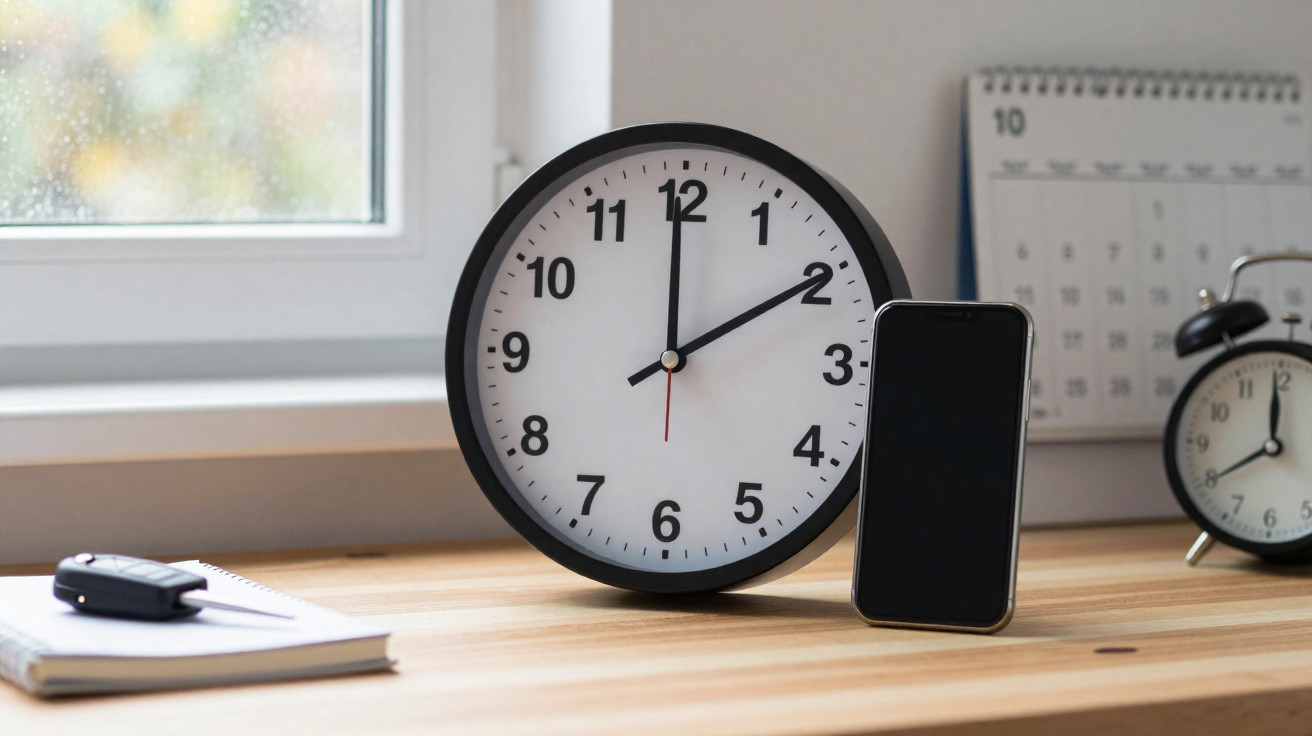
For anyone who wakes early, works shifts or relies on a carefully timed Sunday routine, the autumn clock change can be surprisingly disruptive. The main point is simple: in the UK, clocks go back one hour at 2am on Sunday 25 October 2026, returning to Greenwich Mean Time (GMT).
At 2am British Summer Time (BST), the time becomes 1am GMT. Most people gain an extra hour in bed, but evenings become dark earlier. Phones and other connected devices will usually update themselves, while kitchen clocks, cars and wall clocks may need changing manually.
When do the clocks go back in 2026?
British Summer Time ends in the early hours of Sunday 25 October 2026. At 2am BST, clocks go back to 1am GMT.
The switch takes place on the last Sunday in October each year in the UK. It marks the end of BST and the return to GMT. Although people sometimes call this “winter time” or “standard time”, GMT is the clearest term when timing matters.
Put simply: the UK gains an hour overnight, but loses an hour of evening daylight.
The change happens on the same date in many European countries, though the local clock time is different. In the UK, 2am becomes 1am. In countries on Central European Time, it is generally 3am becoming 2am.
Do clocks go forward or back?
In October, clocks go back by one hour.
A simple UK-friendly reminder is: clocks go forward in spring and back in autumn. The spring change, which happens in March, is usually the more difficult one because an hour is lost.
The autumn change creates its own complication. The period from 1am to 2am happens twice: first in BST, then again in GMT. This can matter for overnight travel, shift work, alarms and appointments.
If you are setting an alarm for the early hours, check whether the device labels the time zone or has updated correctly. For an important journey or shift, use the time supplied by the organiser or operator rather than relying only on a household clock.
What happens to phones, alarms and appliances?
Most modern connected devices should update automatically if they have the correct time zone selected and a mobile or internet connection. This often includes:
- smartphones and tablets;
- computers and smart watches;
- digital television boxes;
- smart speakers;
- internet-connected heating controls; and
- radio-controlled clocks.
It is still wise to check any vital alarm before bed on Saturday 24 October. Older phones, manually configured devices and equipment set to the wrong region may not make the adjustment.
Clocks to check manually
Make a quick round of the house on Sunday morning and check:
- Analogue watches and clocks, including bedside, kitchen and wall clocks.
- Car clocks, as many vehicles need to be changed manually or require an automatic setting to be enabled.
- Ovens, microwaves and coffee machines, especially models without online connections.
- Boiler and heating timers, if they run programmes at particular times.
- Security systems and cameras, as the repeated hour can affect recordings and time stamps.
Avoid changing settings you are unsure about on boilers, alarms or security systems. Check the manufacturer’s instructions, or contact an installer if a setting controls heating, security or access to your home.
Why does the UK change the clocks?
Daylight saving moves more usable daylight into the evening during the lighter months. When clocks go forward in spring, sunset occurs later according to the clock, which can make evenings feel longer.
The UK uses GMT in winter and BST, which is GMT+1, in summer. The present arrangement has developed over many decades, shaped by changing patterns of work, transport, business and everyday life.
Energy use is often part of the debate. Less need for electric lighting on summer evenings does not automatically mean lower overall energy use, however. Heating, lighting, weather, insulation and household routines can all affect the outcome.
Some people favour lighter evenings, while others prefer more morning daylight in winter and would rather avoid the twice-yearly disruption.
Will daylight saving time be abolished in 2026?
No. The UK clock changes remain scheduled for 2026.
There have been discussions in Europe about ending the seasonal switch, but there is no EU-wide change in force. The UK is no longer a member of the European Union and sets its own time arrangements.
The key UK dates for 2026 are:
- Sunday 29 March 2026: clocks go forward one hour, from 1am GMT to 2am BST.
- Sunday 25 October 2026: clocks go back one hour, from 2am BST to 1am GMT.
Do not assume that discussion of future reforms means a scheduled clock change has been cancelled. Check official information nearer the date if you are arranging time-sensitive travel, events or work.
How the October change can affect sleep and routine
The autumn switch can feel easier than the spring one because it provides an additional hour. Even so, a clock changes instantly while your usual sleep and waking routine may take a little longer to settle.
People with young children, regular care commitments, night shifts or tightly timed routines may notice the change more. Earlier darkness can also affect when you feel ready to exercise, eat or wind down for bed.
A gentle way to prepare
A few practical habits can make the weekend less disruptive:
- Keep bedtimes and waking times broadly consistent in the days beforehand.
- Spend some time outdoors in daylight, particularly in the morning where practical.
- Avoid using the extra hour as a reason to make a major change to your sleep routine.
- Check recurring alarms, care arrangements and work rotas.
- Keep children’s bedtime routines calm and familiar.
If you take medicine at set times, do not make significant changes to the timing without checking the instructions or asking a pharmacist, GP or other relevant healthcare professional.
Travel, work and the repeated hour
The clock change can be awkward for overnight travel. Between 1am and 2am, local clock times occur twice: once in BST and once in GMT. Booking systems generally account for this, but check the time-zone information on confirmations carefully.
For rail, coach and air travel, look at the operator’s latest timetable before leaving. Flights are normally shown in local time, so journeys involving more than one country can be especially confusing around the clock change.
Workers on overnight shifts should follow their employer’s rota and payroll guidance. A shift crossing the change may run for an extra hour in real time, even if the local clock display makes this less obvious. Employers should provide clear arrangements for breaks, handovers and recording hours.
For any time-critical plan, check the date, the local time zone and whether the time is shown in BST or GMT.
Common mistakes to avoid
A few errors return every autumn:
- Changing clocks on the wrong weekend. In 2026, the change is on Sunday 25 October.
- Moving clocks forward instead of back. October is the backward change.
- Assuming every device updates automatically. Older gadgets, cars and appliances often do not.
- Forgetting calendar time zones. International meetings can appear to move by an hour.
- Ignoring alarms after changing a clock manually. Make sure the alarm remains set for the intended local time.
- Using vague wording for travel arrangements. Write GMT or BST where precision matters.
A practical checklist for Saturday night
Before bed on Saturday 24 October, take two minutes to make Sunday simpler:
- Confirm that your phone is set to the UK time zone.
- Set any essential alarm on a reliable device.
- Check travel tickets, shift times and online meetings.
- See whether heating, lighting or security timers need attention.
- Change manual clocks on Sunday morning, once the switch has happened.
On 25 October 2026, the UK returns from BST to GMT: at 2am, the time goes back to 1am. Remember “back in autumn”, check the few devices that need manual adjustment, and the seasonal switch should be little more than an extra hour overnight and a darker evening.

















Comments
No comments yet. Be the first to comment!
Leave a Comment