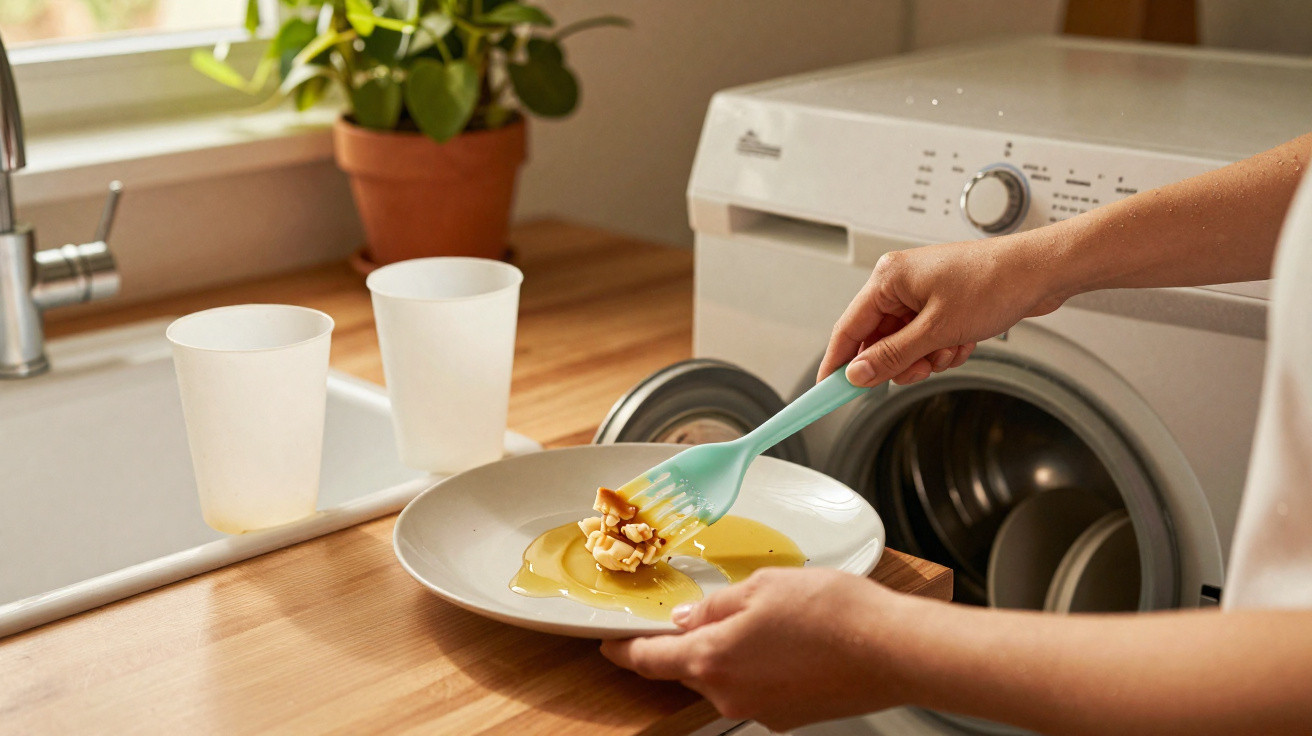
The tap is already running at full blast.
In your right hand, you have a sponge; in your left, a pasta plate you “just want to help the dishwasher with”. There is greasy sauce, a handful of peas and a line of cheese. You scrub until the plate is nearly clean, then place it in the machine with a modest sense of achievement. You have done the “pre-work”. That is efficient, isn’t it?
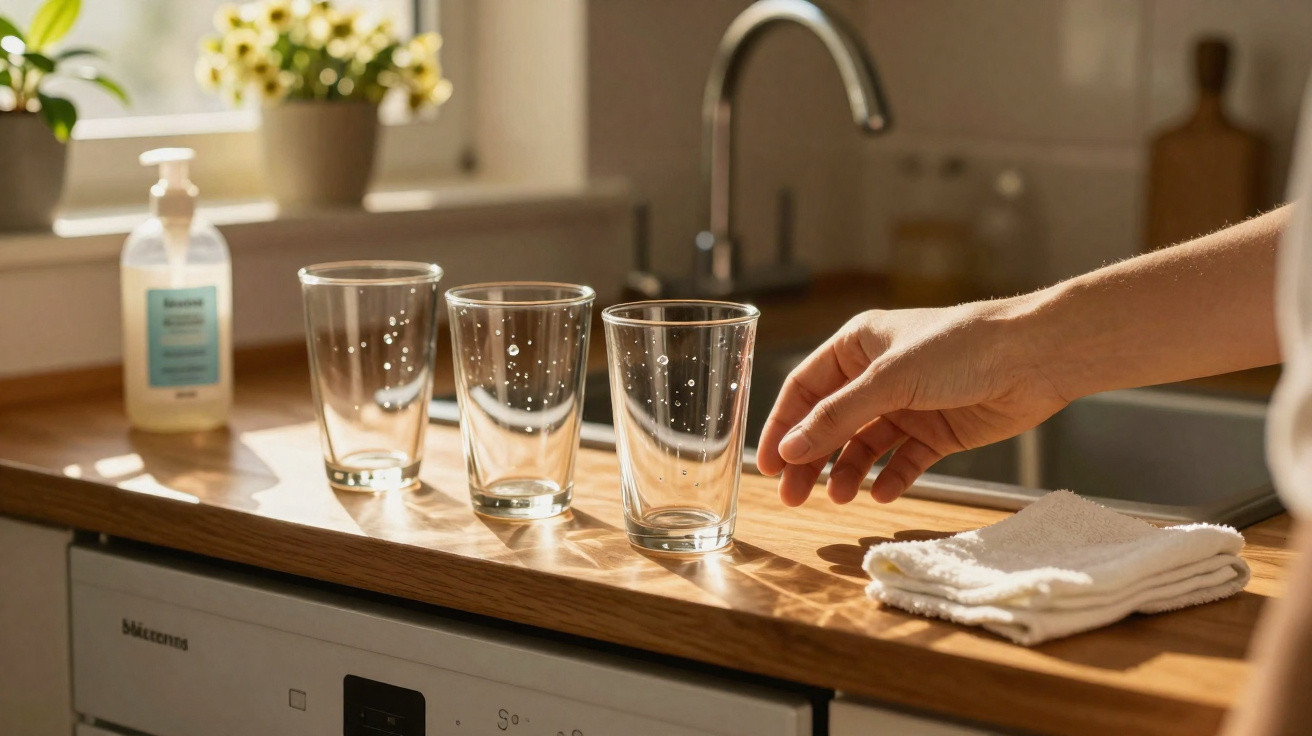
Two hours later, the programme finishes… and the same plate emerges with an odd cloudy coating. The glasses on the upper rack are marked with spots. The cutlery basket is nowhere near as shiny as the advert suggested. You stare at the open door, partly blaming the detergent and partly the machine that cost a month’s wages. Then a nagging question begins to form.
What if all that pre-rinsing is not merely unnecessary, but is actually making the results worse?
Why your “help” can sabotage the machine
Look into a family kitchen after dinner and the same routine plays out again and again. One person opens the dishwasher, another switches on the tap, and plates queue up for a brief rinse before being loaded. The sink gradually fills with lukewarm, faintly greasy water. At the tap, the person is certain they are doing things “the proper way”. It has become an almost automatic habit, handed down like a piece of kitchen folklore.
Without giving it much thought, we have learned to believe that appliances need us to prepare the ground for them. As though a dishwasher is a timid guest that must never encounter genuine mess. We offer it plates that are already half-washed, almost as an apology. But the intelligent machines beneath our worktops are designed for far tougher work than we allow them to tackle. They are more like small, precisely calibrated laboratories than the old steel tubs our parents used.
A few years ago, the US appliance manufacturer Cascade commissioned a consumer survey which found that nearly 75% of people typically pre-rinse their dishes. Meanwhile, major manufacturers including Bosch and Whirlpool were quietly revising their manuals to advise the opposite. An engineer told a trade magazine that modern sensors “look for dirty water as a starting point”. Put simply, clean plates can genuinely confuse the appliance. It assumes the programme can be cooler, shorter and less powerful.
The disagreement is visible in real time on social media. One person writes: “My dishes are STILL dirty after the dishwasher.” Below it come dozens of replies: “You need to pre-rinse.” “You’re doing it wrong.” Hardly anyone asks about the model, the selected programme or how full the machine was. Instead, we revert immediately to the familiar ritual: turn the tap up, scrub a little harder and expect a different outcome from the same routine.
The reason this can backfire is surprisingly straightforward. Most modern dishwashers use turbidity sensors to assess how cloudy the water is. That cloudiness indicates the level of soiling, the temperature needed and how long the wash should continue. If you pre-rinse every item, the water from the first rinse remains almost clear. The sensor concludes: “Not much to do here.” The appliance then shortens the main wash and reduces its intensity.
There is another factor too: the enzymes in dishwasher detergents are formulated to attach themselves to food particles and break them down. They actually need a little sauce, starch and grease in the water to work properly. If you strip the plates clean beneath the tap, those enzymes have nothing to “grab”. They are like cleaners sent into an empty room and asked to earn their pay. The consequence can be that persistent film on glasses and a slightly greasy feel on plastic containers, despite the fact that you have put in more effort than ever.
The right kind of “lazy”: scraping, not rinsing
The small but important change is this: stop pre-rinsing and start pre-scraping. Rather than turning on the tap, use a spatula, a used sheet of kitchen roll or even the back of a knife. Sweep food remnants directly into the bin or food-waste caddy, including the partly fused cheese in a lasagne dish. The aim is to remove solid pieces, not every trace. Leave the sauce smear behind, but not the ball of spaghetti.
Quickly run your fingers over plates and bowls. If you can feel something thick or sticky that might block the filter, scrape it away. If all that remains is a colourful reminder of dinner, leave it alone. This straightforward approach works with the way the appliance was designed to operate. It is not laziness; it is calibration. It also immediately reduces the time you spend at the sink.
On a rainy Tuesday evening in a small Leeds flat, Olivia, 32, decided to try a “lazy month”. For four weeks, she stopped herself from pre-rinsing entirely. She simply scraped plates into the food caddy and put them straight into the dishwasher. “The first three days I was panicking,” she laughs. “I was almost embarrassed for my machine.” By the second week, she observed something quietly remarkable: her glasses were clearer and the powdery residue on bowls had vanished.
Out of curiosity, she looked at the water meter and found that her household had used roughly 30% less water that month. This was not only down to shorter rinses at the sink, but also because the dishwasher no longer repeated programmes for loads that were “not quite clean”. The additional benefit was unexpected: her evening routine changed. Rather than being stuck at the sink, she was on the sofa while the appliance genuinely took care of the dirty work.
Engineers explain this in characteristically dry terms, referring to soil loads, enzyme activation curves and spray-arm hydraulics. Remove the technical language and their point is remarkably clear: dishwashers are made to deal with actual dirt. Their hottest jets, most persistent sprays and smartest sensors engage fully only when there is sufficient grime to warrant them. Deprive them of that grime and you reduce a powerful wash programme to something more like a lukewarm rinse.
There is a less obvious water issue as well. Pre-rinsing a full dishwasher load by hand under a running tap can consume up to 20–30 litres of water, and occasionally more. A complete dishwasher cycle, particularly on an eco programme, often uses less than this. We hold on to the feeling of control that comes from watching food disappear down the plughole. Yet, paradoxically, the most effective control is to step back, scrape once and shut the door.
How to load dishes so the machine actually shines
Treat loading a dishwasher as if you were arranging dozens of miniature rain showers. Water needs to reach every surface, rebound and drain away, taking debris into the filter with it. Space is therefore essential. Leave roughly a finger’s width between plates in each slot. Do not nest bowls inside one another, however tempting that may be when there is a large pile. Position them so the dirtiest areas face the spray arms in the centre.
On the upper rack, handle glasses like delicate microphones aimed downwards. Angle them enough for water to drain away rather than collect in their bases. Plastic containers are better on the top rack, further from the hottest heating elements. As for a pan with baked-on residue, a short soak in cold water followed by a firm scrape is more useful than any vigorous pre-rinse. The dishwasher needs to detect that baked-on ring in order to recognise that it has a proper task to perform.
This is where many of us go wrong. On hectic evenings, we overload the dishwasher, forcing in one final plate sideways and laying a wooden spoon across the top. That blocks the water’s route, leaving some items completely outside the spray. We then blame the tablet, the manufacturer or “modern machines”. Let’s be honest: nobody really creates that perfectly organised basket display every single day.
Another common habit is to place everything facing in the same direction, usually away from the spray arm. Turn every second plate around to vary its exposure. Keep taller items clear of the detergent dispenser door so that it can open properly. Try not to wash large non-stick pans in the machine every day either: they wear out more quickly and take up space and water that the rest of the load needs. Your dishwasher is not overly fussy, but it has its own logic.
“Once we reminded customers to stop pre-rinsing and just scrape, call-backs about ‘bad washing’ dropped sharply,” confided a UK repair technician who’s been opening dishwasher doors for 18 years.
This is not about becoming the ideal eco-warrior or the most disciplined household organiser. It is about allowing the machine you already own to do the job it was engineered to do. It also means removing those unnoticed, mildly draining tasks that no one consciously chose; they were simply inherited. On a tiring evening, that matters more than a glossy advert.
- Scrape away substantial leftovers, but do not scrub plates spotless.
- Leave space between items when loading so water can circulate.
- Select the appropriate programme: eco for everyday use and intensive for genuinely messy loads.
- Clean the filter and spray arms monthly, rather than annually.
Living with a dishwasher that actually does the dirty work
We have all reopened a dishwasher, sighed and started washing by hand “the ones it missed”. It feels like a minor defeat, as though the appliance misrepresented itself on its CV. Stopping pre-rinsing will not magically turn an average dishwasher into a professional-grade model, but it does bring your use of it closer to its intended purpose. The difference between frustration and quiet satisfaction often lies in the few minutes before you press Start.
When you scrape rather than rinse, and give plates room instead of cramming them together, something changes over time. You begin to trust the programme button again. Concerns about cloudy glasses gradually recede. You are no longer doing half the work for the dishwasher, then resenting it for failing to complete the task. Instead, you let it handle the entire shift.
A broader point is concealed within that small everyday habit. Water wasted from the tap never has the opportunity to work where it is most effective. Energy used for an unnecessarily long programme is energy you will quietly pay for, month after month. Altering the script in your kitchen does not look heroic from the outside. It looks like putting a plate in the machine with last night’s tomato streak still showing.
Perhaps that is why these changes travel by word of mouth rather than through major campaigns. Someone stops pre-rinsing, sees clearer glasses, a lower bill and less time standing at the sink, then mentions it to a friend over coffee. The next time you instinctively reach to turn on the tap before loading the dishwasher, you may hear that voice in your mind: the engineer, the technician or the friend who tried a “lazy month”. You will pause, scrape once over the bin and close the door on a slightly messier plate.
The machine will take care of the rest, quietly challenging years of habit whenever you press Start.
| Key point | Details | Why it matters to readers |
|---|---|---|
| Skip pre-rinsing, just scrape | Use a spatula or cutlery to remove food pieces into the bin or compost, but allow sauce marks and light residue to go into the dishwasher. | Reduces water use by dozens of litres per load and enables sensors to detect genuine dirt, improving cleaning performance. |
| Load with space for water | Keep a finger’s width between plates, do not stack bowls, and avoid obstructing spray arms or the detergent flap. | Minimises inexplicably dirty items after a cycle and means the dishwasher runs less often, saving time and money. |
| Use programmes strategically | Choose eco or auto for everyday dishes with light to normal soiling, reserving intensive programmes for heavily soiled pans with baked-on food. | Balances clean dishes with lower bills, as the hottest and longest programmes are used only when they genuinely make a difference. |









Comments
No comments yet. Be the first to comment!
Leave a Comment