The jar seems harmless enough.
Its faded label still reads “cumin”, the lid carries a light coating of orange powder, and it promises warmth and depth. You unscrew it over a simmering pan, add a generous spoonful… and very little changes. The kitchen never fills with that roasted, earthy fragrance. The food is acceptable, but somehow lacking. You add another spoonful. It is still lacking. Soon, you blame the recipe or doubt your own cooking, before returning the jar to the cupboard as another small disappointment.
Later that week, you visit a friend. They open a little tin of smoked paprika and the whole room comes alive. It catches your nose in the most wonderful way. It is the same type of ingredient, with the same purpose, but the effect is entirely different. You glance at their spice shelf – compact, orderly and clearly used often – then think of your own disorderly collection of neglected jars. It is not a matter of skill. The explanation is much less exciting, but far more influential.
The answer lies in how you preserve flavour before it reaches the pan.
Why spices lose their flavour well before their expiry date
For most people, the first surprise is this: spices do not usually “go off”. Instead, they become muted. They gradually fade. The lively essential oils that make cinnamon evoke Christmas, or cardamom smell like a bakery at daybreak, slowly escape into the air. A spice may still be safe to eat, but it has lost the reason you bought it: the character of its flavour.
Whenever you open a jar over a steaming saucepan, minute aromatic compounds leave it for good. Heat, light and oxygen act like a thief working in slow motion. They are not dramatic; they take tiny amounts, day after day. That is why turmeric bought five years ago can remain yellow while tasting almost dusty. Its colour lasts, but its aroma does not.
A small study frequently mentioned in culinary schools found that ground spices may lose a substantial portion of their volatile compounds within a year when stored poorly. Whole spices retain their strength for longer because their oils remain sealed inside. Grinding releases those aromas – and begins the countdown. This is not superstition; it is simply chemistry at work in your cupboard.
Imagine two kitchens. In one, an attractive metal rack hangs above the hob, filled with neat glass jars. The cook likes how “organised” it appears on Instagram. At every meal, rising steam warms the glass and surrounds the spices with moisture and heat. Within a few months, the chilli flakes taste like red cardboard, while the oregano has the faint smell of old hay.
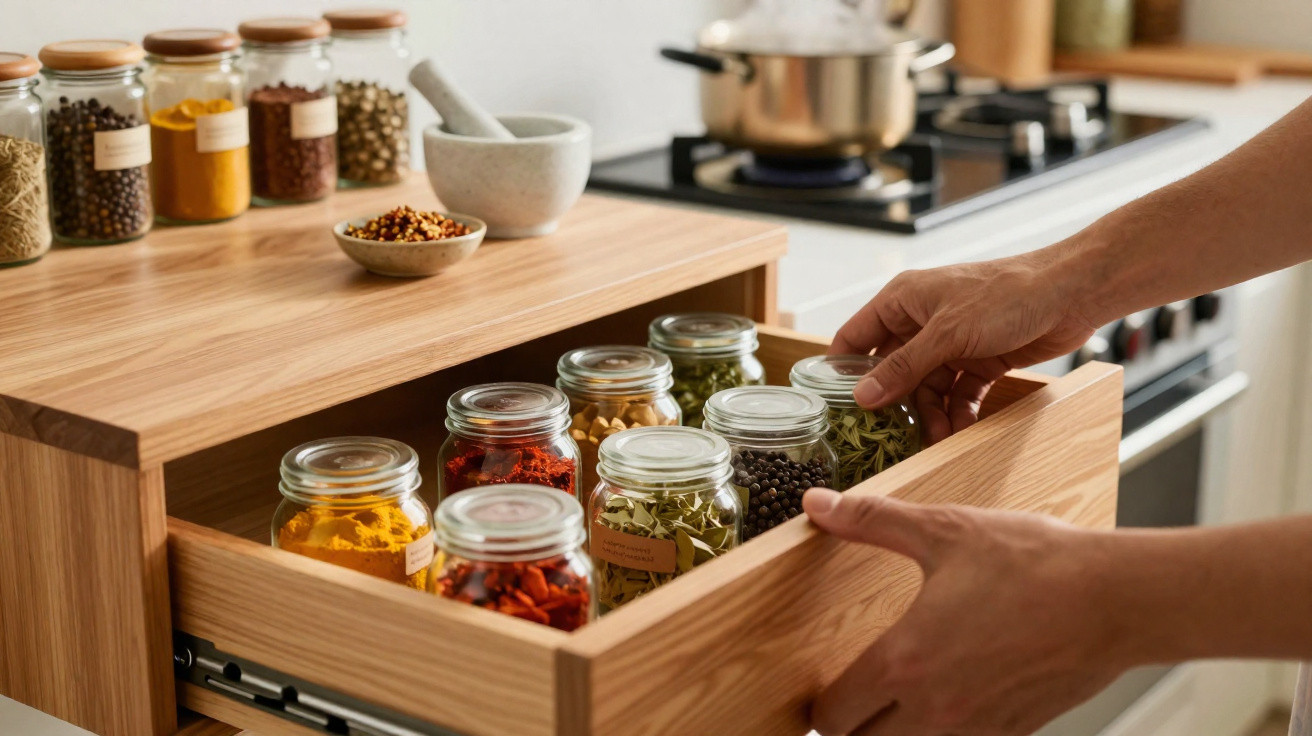
In the other kitchen, spices are kept in a drawer away from the oven. There is no direct sun and no cloud of steam. The containers are smaller, topped up more regularly and hand-labelled. When this cook takes out cumin, its aroma feels like a warm hug. They are not paying more; they are simply treating small spice jars as fresh ingredients rather than decorative objects. That is the important change: thinking of spices as living aromas with a limited life, rather than dusty wallpaper for the pantry.
We tend to think flavour is created only in the pan: through technique, heat and timing. Naturally, those things matter. But even the most accurate sear cannot bring a lifeless spice back to life. Flavour starts sooner, in the quiet daily protection of delicate oils. Light degrades pigments and aromatic compounds. Heat accelerates oxidation. Air weakens intensity whenever a lid is removed. Spices do not suddenly “die” on one particular day; first they whisper, then they mumble, then they hardly say anything at all.
Best-before dates can also offer false reassurance. A jar may remain “in date” for years while becoming a shadow of what it once was. Chefs do not wait for a formal expiry date. They rely on aroma and colour, then replace a spice without sentiment. That straightforward, almost ruthless approach is one reason restaurant food often tastes more vibrant than food made at home.
The spice storage rule chefs follow religiously
Ask a professional chef about spice storage and you will usually hear the same advice, delivered with real certainty: “Cool, dark, dry. Always.” It may sound like a phrase printed on a tea towel, but it guides their habits. They do not keep spice racks above the hob, leave jars open during service or store huge tubs that slowly deteriorate at the back of a warm kitchen.
Spices are stored in sealed containers, out of sunlight and away from heat, often in deep drawers or on lower shelves. Many chefs buy whole cumin, coriander and fennel seeds, grinding only small quantities. Some mark each container with its opening date and rotate stock as they would fresh ingredients. It is not needless fussiness; it is routine. They understand that a teaspoon of bright, carefully stored spice will outperform a tablespoon of tired powder every time. That is why they guard those teaspoons like gold.
At home, this rule can be put into practice with a few easy changes. Move spices away from the oven and window. Choose small, airtight jars or tins with secure lids. Store them somewhere convenient, so they do not disappear from view. When you open a fresh jar, smell it properly and silently begin the clock. You are doing more than organising a cupboard: you are creating a small flavour bank that delivers results.
Many home cooks do not realise that they are undermining their own seasoning. They leave containers open while preparing food, dip in damp teaspoons and keep every jar directly above the cooker, where conditions are cosy and warm. It seems harmless as a routine. Over time, though, it creates slow flavour bankruptcy.
On a hectic weekday evening, nobody wants a lesson in flawless storage systems. Let’s be honest: nobody actually does all of this every day. You hurry, stir, reach for the nearest jar and carry on. That is why a chef’s rule must be simple enough for ordinary life. “Cool, dark, dry” is remarkably brief. Use it to assess any location in your kitchen. Above the hob? Hot and steamy – no. Beside a sunny window? Bright and warm – no. A cupboard away from appliances? That is where the magic can quietly endure.
There is a human side to those forlorn jars, too. They carry the guilt of money spent on unusual blends that now sit unused, or flavours brought back from holidays that have dulled beneath halogen lights. We all have one tin to which we are oddly attached. The aim is not to make you feel guilty. It is to regard every new jar as a short-term visitor, rather than a permanent fixture. Use it while it is still singing, then let it go.
Spice expert and chef Maria Hussain told me something memorable:
“If you wouldn’t leave fresh herbs on a hot windowsill for six months, don’t do it to your spices either. They’re just herbs and seeds in another form.”
That change in perspective – seeing spices as dried plants instead of magical dust – makes the storage rule feel more practical and more like ordinary care.
Here is a quick, no-nonsense look at what professional chefs actually do, without the romance or television polish:
- Keep spices in opaque or dark-glass containers, with lids tightly closed at all times.
- Store them away from ovens, dishwashers and sunny areas – lower drawers or cupboards are best.
- Buy smaller quantities more frequently, particularly when choosing ground spices.
- Choose whole spices where possible, and grind small portions just before cooking.
- Smell and taste spices regularly; once the aroma has faded, replace them without fuss.
From dusty jars to bold flavours: a quiet kitchen revolution
Once you recognise how tired many household spices have become, it is difficult to ignore. You begin opening jars and breathing in properly. Some make an immediate impact, while others barely register. This simple habit – smelling with attention – is how many chefs make decisions each day. There is no ceremony or app involved, just a nose and a memory.
Perhaps the starting point is a small, honest review of your spice collection. It need not be a punishment; think of it as checking in on old friends. Which jars still bring pleasure when opened? Which smell of cardboard? You do not need to throw everything away at once. Simply relocate the lively spices somewhere better, then plan to replace the weakest ones in smaller quantities next time. Small changes can bring a significant reward over time.
This sort of care has a quiet satisfaction of its own. Looking after flavour becomes a private ritual rather than an Instagram project. You may start decanting fresh spices into clean containers and writing the month and year on a strip of tape. Without even thinking, you close lids securely or move a jar away from a shaft of sunlight. It takes little effort, but changes the way you cook. Meals become slightly brighter, and familiar recipes gain more character. You did not suddenly become a better cook; your spices simply came back to life.
We live in a culture that encourages us to buy more: more blends, more rubs and more glossy packets of “world flavours”. Yet the understated reality is that flavour often comes from having less: fewer jars, stored well and used more deliberately. That is the storage rule chefs follow religiously, even when no one is watching. It is not dogma, but the result of tasting the difference that cool, dark, dry storage makes during a Tuesday lunch service.
Once you have experienced that difference at home – a curry that finally smells like the one you remember from a small takeaway, or roast potatoes dusted with paprika that genuinely sing – it is hard to return to the old way. You may look at that attractive rack above the hob and think: it looks good, but smells of nothing. Then, one day, you take it down, and your kitchen quietly shifts from display to flavour.
| Key point | Detail | Why it matters to the reader |
|---|---|---|
| Spices fade rather than “go off” | Aroma and essential oils gradually disappear when exposed to heat, light and air | Explains why food can taste flat even when you follow recipes correctly |
| Chef rule: cool, dark, dry | Spices are stored away from sunlight and heat sources in airtight containers | Provides a clear, memorable rule used in professional kitchens |
| Buy less, protect more | Smaller quantities, more regular rotation and a preference for whole spices | Maximises flavour, cuts waste and saves money over the long term |




Comments
No comments yet. Be the first to comment!
Leave a Comment