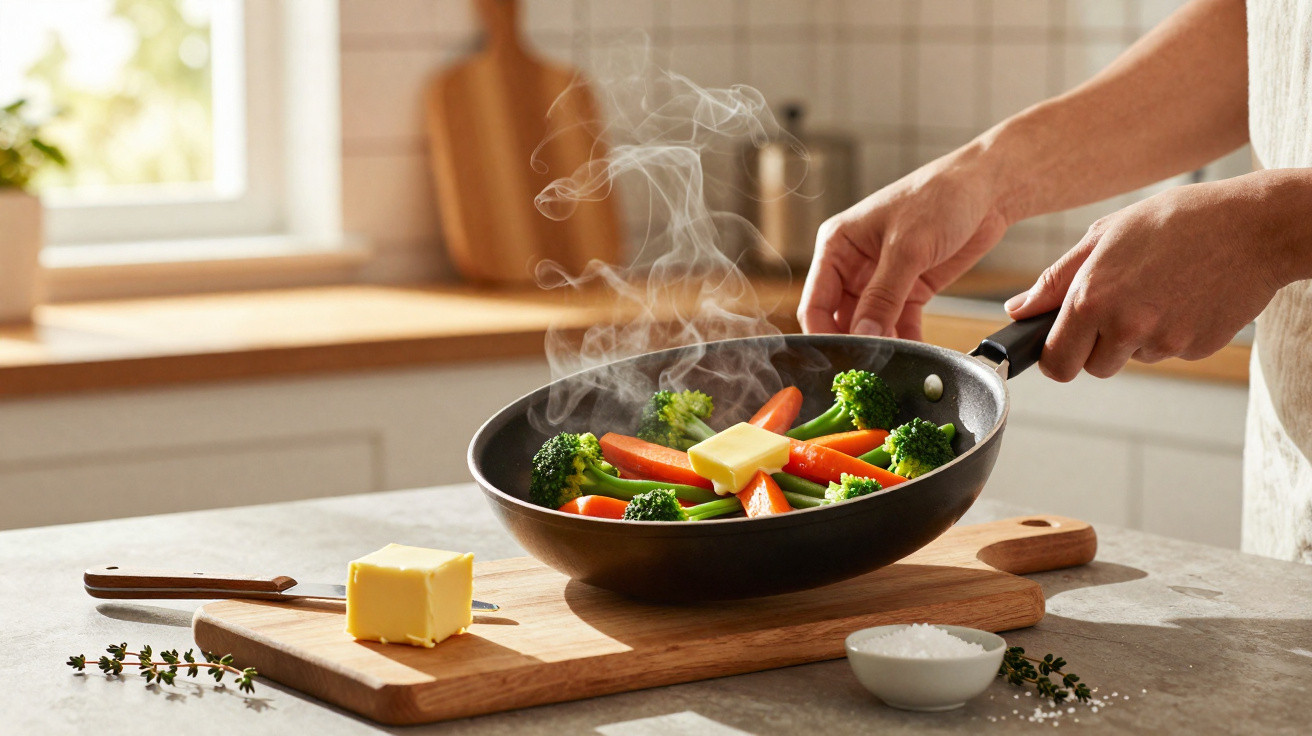
The bowl of steaming carrots sat in the centre of the table as though it had been ordered purely as decoration. Nobody reached for it. The children picked at their rice, while the adults behaved as if they had simply failed to notice the vegetables. Then, without saying a word, my friend took a small knob of butter, let it melt in the still-hot pan, briefly tossed the carrots through it and sprinkled over a little salt. Suddenly, the whole kitchen smelled different: warmer, richer, a little like Sunday lunch at Grandma’s. Forks immediately started moving towards the vegetables, as if someone had secretly hidden a steak underneath them. That tiny piece of butter had changed the mood around the table. Something about it makes vegetables seem more intense. Perhaps butter has more power than we give it credit for.
When a knob of butter “switches on” vegetables
We all know the moment: freshly cooked vegetables are in front of us, and they taste vaguely “healthy” rather than like something we genuinely want. They look good and smell fine, yet remain bland in the mouth. Then somebody suggests stirring in a knob of butter. Suddenly, the same beans have more depth, peas taste sweeter and broccoli seems less harsh. It is as if somebody has turned up the flavour saturation. No longer “vegetables because we should”, but something people willingly go back for.
A nutrition doctor once told me that family meals teach him more about eating habits than his practice does. At a cookery class, he watched a family with two trays of roasted vegetables made from identical ingredients. At the end, only one tray received a knob of butter, which melted in the residual heat. Guess which tray was cleared. The buttered tray held nothing but a few roasted traces, while the other was left with a forlorn layer of dried-out courgette. Nobody objected to vegetables; they simply objected to boring flavour. The evening’s statistic was this: 90% of the butter-seasoned vegetables disappeared, while well over half of the other tray remained.
The straightforward truth is that fat enhances flavour, and butter is among the most appealing options. It contains milk-derived aroma compounds that combine with the flavours in vegetables. Fat carries scent molecules, and smell makes up a huge part of taste. Without a little fat, many of these molecules never really get going. A knob of butter works like a volume control for vegetables: the sweetness of carrots, the nuttiness of Brussels sprouts and the gentle sharpness of leeks all become clearer when they have some fat to “cling” to. We suddenly taste what was always present in the vegetables but had never properly come into the light.
How to “switch on” your vegetables without any fuss
A small butter ritual is often all it takes. Remove cooked or steamed vegetables from the heat when they are just done. Add a small piece of butter - genuinely only a little, around half a teaspoon per serving - then toss everything in the remaining heat. Do not fry or brown it; simply coat the vegetables. Add a little salt, perhaps a squeeze of lemon, and that is it. As it melts, the butter forms a thin layer around every piece and carries the seasoning with it, like a taxi delivering flavour directly to your palate. Rather than immediately mixing the vegetables into a sauce, let them shine on their own for a moment. The difference is surprisingly noticeable.
People often either overdo it or avoid it altogether. Either the beans drown in fat until they cling heavily to the plate, or they arrive completely “naked” and taste exactly as you would expect. Let us be honest: in everyday life, nobody painstakingly weighs every flake of butter. It is more about instinct. A small amount is enough to intensify vegetables without turning them into a calorie trap. Anyone who has avoided butter because “low-fat” kept flashing in their mind may be surprised by how little is needed to make vegetables enjoyable rather than an obligation.
A chef I met in a canteen put it rather bluntly:
“People say they do not like vegetables. Most of the time, they just do not like the sad, dry vegetables they are served.”
- Add butter only at the end: This preserves its delicate flavours and stops the vegetables from seeming greasy.
- Minimum amount, maximum effect: Half a teaspoon per serving is enough to change both flavour and mouthfeel.
- Use salt and acidity: A touch of salt plus a little lemon juice or vinegar noticeably strengthens butter’s effect.
- Vary the vegetables: Carrots, peas, broccoli, cauliflower and fennel respond particularly well to a knob of butter.
- Taste consciously: Try one mouthful without butter, then one with it, to notice how dramatically the aroma really changes.
What really creates a “better” vegetable moment
Perhaps it is not only about flavour, but also about feeling that the food has been valued. A knob of butter says: this is not an obligation; this is proper food. Many of us grew up with that slight shine on vegetables. It brings back kitchens where time did not matter and plates did not have to look “clean”, only satisfying. Adding a dollop of butter to asparagus or beans today can bring back some of that relaxed normality. The vegetables are no longer the moral part of the plate, but the sensual one.
There is also a very practical benefit: some vitamins in vegetables are fat-soluble. They need fat to be properly absorbed by the body. Without a little of it, some simply pass through without ever really entering the system. Butter acts like a door opener here. Not as an excuse to bathe everything in fat, but as a small reminder that enjoyment and nutrient absorption can sometimes go hand in hand. It takes the pressure off: you do not have to choose between “healthy” and “tasty”. Both can go on the same plate.
It may be worth trying a small experiment at your next meal. Prepare two plates: one with plain vegetables and the other with the same serving, briefly tossed in butter. Alternate between them without overthinking it. Notice how the mouthfeel, aroma and desire for the next bite change. Share the result if you like - at the family table, in a shared-house kitchen or in the group chat alongside a photo of your glossy pan of beans. Sometimes a new ritual begins with a tiny knob of butter quietly melting into hot vegetables, and suddenly everything seems a little more intense than before.
| Key point | Detail | Benefit for the reader |
|---|---|---|
| Butter intensifies vegetable flavours | Fat carries and brings together aroma and flavour compounds | Understands why a small knob of butter makes food noticeably tastier |
| Timing and quantity matter | Add butter at the end in the residual heat and use a small amount | Learns a simple method without overloading the dish |
| Enjoyment and nutrients complement each other | Fat-soluble vitamins are absorbed better with a little fat | Takes pressure out of the “healthy versus tasty” debate and makes cooking feel more relaxed |
FAQ:
- Question 1: Does olive oil work as well as butter with vegetables?
- Question 2: Does a knob of butter automatically make my vegetables unhealthy?
- Question 3: When does a vegetable plate contain “too much” butter?
- Question 4: Which vegetables benefit most from a knob of butter?
- Question 5: Does this work when cooking vegan food?













Comments
No comments yet. Be the first to comment!
Leave a Comment