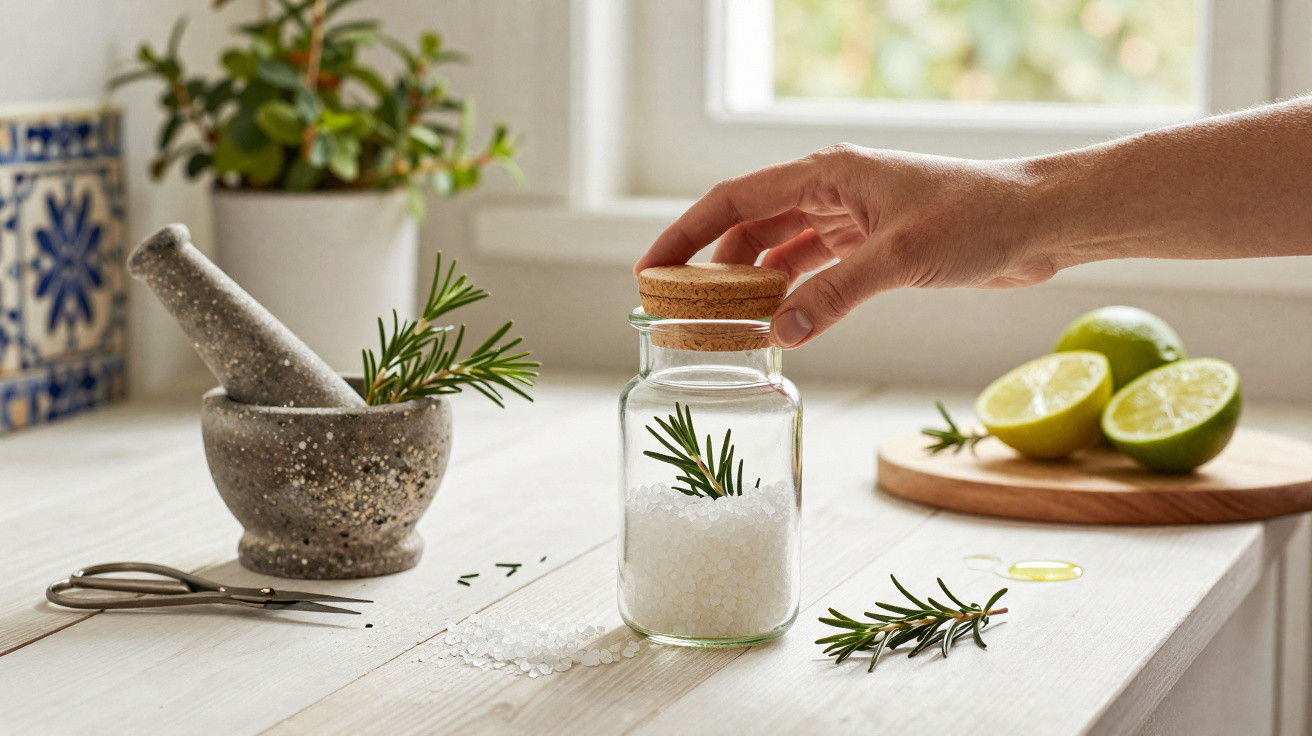
The jar itself is nothing remarkable.
Inside are a few handfuls of coarse salt and several dried rosemary sprigs, left at the back of a kitchen cupboard. You could pass it a hundred times and never give it a second glance. In certain homes, though, this modest glass jar is regarded almost as a small domestic talisman.
First comes the fragrance: fresh, pungent and faintly woody. Then there is the feel of it when you unscrew the lid and rub the grains between your fingertips. It has an old-fashioned quality, like something your grandmother might have done quietly while everything else hurried on around her.
One little jar. Countless understated uses. And an unusual ability to make a home feel more lived-in.
Why this unassuming salt and rosemary jar has real power
Take a closer look in the kitchens of people who truly enjoy caring for their homes and you may well find one: an uncomplicated jar, filled half with salt and half with rosemary, beside the hob or the sink. It has not been placed there for Instagram. It stays there because it is used constantly.
They use it almost automatically: to season a frying pan, scour a greasy dish or remove the scent of garlic from their hands after cooking. The mixture becomes woven into everyday kitchen routines, something your hands remember before you have consciously thought about it.
It is not flashy. It is practical magic of the quietest kind.
In a survey of home cooks posted across several food forums, people named “coarse salt” as the cupboard staple they most worry about running out of. Not olive oil or pepper, but salt. Add rosemary and the subject goes beyond flavour alone, reaching into atmosphere and memory.
Picture a Sunday roast whose aroma meets you halfway up the stairs. Rosemary is often working quietly behind that effect, bringing the whole moment together. Sealing that scent in a jar with coarse salt gives you a shortcut to instant cosy-home feeling, whatever day of the week it is.
One woman I interviewed called it her “reset button” after work. She comes home, opens the jar, breathes in, and only then begins to cook. A small ritual can create a considerable change.
There is a straightforward practical explanation as well, with nothing mystical about it. Coarse salt is dry, stable and abrasive. Rosemary is fragrant, antimicrobial and rich in oils. Combined, they make a mixture that can season, scent and clean.
Salt crystals work as miniature scourers. On a cast-iron pan or wooden board, they loosen residue without relying on harsh chemicals. Meanwhile, rosemary gradually releases its oils into the salt, adding fragrance along with gentle antibacterial qualities.
The jar is effectively a multi-purpose tool: a natural scrub, spare seasoning, a hand freshener and a pantry deodoriser. That is impressive for something costing less than a coffee.
How to use a salt and rosemary jar every day
Begin with the basics. Choose a clean glass jar with a secure lid and fill it to around three-quarters full with coarse sea salt or kosher salt. Add a generous handful of dried rosemary leaves or sprigs. Seal it, shake it well and leave it for at least 24 hours, allowing the aromas to combine.
Store the jar wherever you naturally pause during your kitchen routine: beside the hob, near the sink or alongside your chopping board. It should not be a decorative prop; it should be something you can grab with wet hands, without any fuss.
Add a pinch to food, use a spoonful to scrub, or rub a small amount into your palms to freshen your fingers. Over time, let it become an instinctive part of your routine.
Cleaning chopping boards is among the simplest ways to use it. Scatter a tablespoon of the blend over a damp wooden board, rub it with half a lemon or a clean cloth, and rinse. The salt provides the scrubbing action, rosemary helps tackle odours, and the board is left looking and smelling fresher.
Cast-iron skillets can be treated in much the same way. There is no need for soap or concern about “ruining the seasoning”. Use warm water, a spoonful of the blend and a firm scrub, then dry the pan quickly and apply a little oil.
Let’s be honest: nobody really does this every day. Even so, using the jar twice a week can alter the feel of your kitchen. It becomes less greasy and less filled with chemical scents, while feeling more grounded.
The main mistake is to treat the jar as a precious decorative item rather than a hard-working tool. Some people pack it with fresh rosemary, introducing moisture that can encourage mould. Others choose fine table salt, which tends to clump and offers little scrubbing power.
Use coarse salt with predominantly dried rosemary. For a stronger fragrance, you can include fresh sprigs, but let them air-dry first. Every few months, discard any remaining mixture, wash the jar quickly and make a fresh batch. No guilt and no drama.
On a more personal level, this small practice often leads to other changes. Once you start scouring a pan with something you have mixed yourself, you may become more interested in other ways to simplify your home. It is less about “doing it right” and more about feeling comfortable in your own space.
“I thought the jar was just a cute idea from a magazine,” a reader told me. “Then I realised it was the only thing I reached for both when I’d burned dinner and when friends came over. It turned into this little anchor in my kitchen.”
That’s the quiet power of objects that do several jobs at once. For a practical view, consider your jar a compact toolkit:
- Kitchen: scrub boards, clean pans and season food quickly
- Hands: remove garlic or onion odours and provide gentle exfoliation
- Home: place a small open dish in the fridge or a cupboard to deodorise it
- Table: use it as a rustic pinch bowl beside a roast or focaccia
- Mind: take one deep breath over the jar when the day feels overwhelming
The deeper comfort of a salt and rosemary jar on the shelf
Most of us know the feeling when a house seems slightly wrong: there is a little mess, lingering cooking smells, and your mind is still humming from the day. You could light a candle or use a synthetic spray, but that does not always feel quite right. The salt-and-rosemary jar offers something different.
It is tactile and tangible, engaging your hands as much as your sense of smell. You turn the lid, take up a pinch of grains, smell the rosemary and perhaps scrub something for 30 seconds. That small action signals to your mind: “I’m taking back control here.”
This is not about becoming a perfect homemaker. It is about having one uncomplicated, dependable thing that makes your surroundings feel more like your own.
There is also something surprisingly current about returning to such an old-fashioned method. We are surrounded by products promising extraordinary results: five-in-one sprays, super foams and fragranced capsules. Yet many people are quietly returning to coarse salt in a jar with herbs their grandparents knew instinctively.
It is not nostalgia simply for nostalgia’s sake. It is about confidence. You recognise the ingredients, know where to purchase them and can pronounce their names. If a child licks their fingers after helping scrub a pan, you are not rushing to find the poisons information service number.
That sense of confidence can change how you feel in your own kitchen, easing a little of the constant background pressure.
Naturally, there is no requirement for the jar to contain rosemary. Some people use lemon zest, thyme or a small amount of dried sage instead. Rosemary, however, has a distinctive balance: it is strong enough to notice, familiar enough not to overwhelm, and comforting without being sweet.
For many people, its scent suggests Sunday, someone taking the time to cook, and a house waiting for you to return. In a world that moves quickly and often feels disposable, that has value, even if it goes unspoken.
When you spot a jar of coarse salt and rosemary on someone else’s shelf, then, you are seeing more than a seasoning blend. You are glimpsing the quiet rituals that help hold their days together. Perhaps, without fully noticing, you may want some of that for yourself.
| Key point | Detail | Benefit for the reader |
|---|---|---|
| Simple mixture | Coarse salt + dried rosemary in a sealed glass jar | Easy to make, inexpensive and requires no specialist equipment |
| Multiple uses | Gentle cleaning, deodorising, seasoning and a small ritual | Saves space and time while reducing chemical products |
| Emotional dimension | Reassuring fragrance, repeated action and a feeling of control | Makes the home feel warmer and routines more calming |











Comments
No comments yet. Be the first to comment!
Leave a Comment