The chips are done: golden, crunchy and exactly how you want them. The chicken, meanwhile, is still raw in the centre of the other oven tray, sulking away. The clock is moving, the children are hungry, and your partner is at the doorway asking the unavoidable question: “So… how long do I have to wait?” You dish up the food that is ready, reheat the rest, and the notion of a “quick dinner” quietly expires on the worktop.
That is the familiar trade-off with cooking on a single tray: one thing is spot-on while another is disappointing. When you are trying to manage salmon with broccoli, tofu with potatoes, or burgers with wedges, the compromises become even more obvious. Cooking times, temperatures and textures all compete. What was meant to be a speedy, healthy meal becomes a small negotiation with the oven. The Cosori TwinFry arrives in precisely this situation with one straightforward idea: what if you did not have to make that choice at all?
Two baskets, one dinner, zero arguments
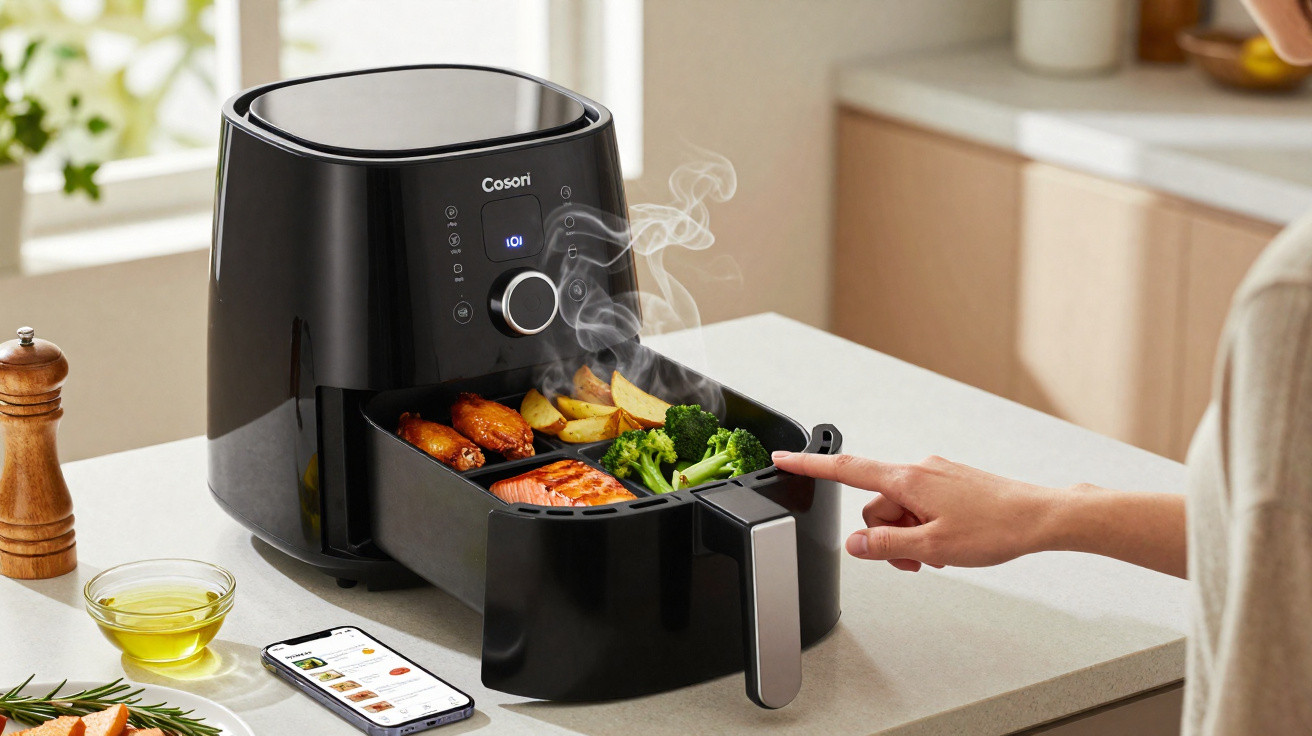
Before you notice the Cosori TwinFry’s styling or controls, you notice its two baskets. They face you like matching empty plates, ready for entirely different meals. One can hold chicken wings while the other cooks chips; one can take salmon while the other handles broccoli. It feels as though someone has finally accepted that households do not eat just one thing at once.
Pull out one drawer and tip in frozen chips. Fill the other with fresh chicken thighs, paprika and a punch of garlic. The air fryer begins with its quiet, reassuring hum. The right-hand basket can cook hotter while the left stays a little gentler, without you having to analyse every setting. You just press a couple of buttons and walk away.
Its real appeal is not simply its speed, although it is quick. For once, the appliance adjusts around your routine rather than demanding that you adjust around it. The entire dinner reaches the table together instead of arriving in stages. Arguments over what “gets cooked first” simply fall away.
Anyone who has owned a single-basket air fryer for longer than a month will often admit the same thing. They began enthusiastically, but gradually returned to their old routines because the constant juggling became tiresome. First the chips, kept warm. Then the nuggets. Then the vegetables, if there is any energy remaining. By the end, the appliance is still working, but the person cooking is worn out.
A recent UK home-cooking survey found that more than 60% of families serve dinner in “rounds” at least three times a week. It is not by choice; foods simply need different temperatures and cooking times. If you have watched perfect chips become like cardboard while you “just finish off the chicken”, you will understand the problem. Dinner becomes a logistical exercise.
The TwinFry quietly reverses that pattern. Its two independent baskets allow one to run hotter for proteins while the other remains a little cooler for vegetables or carbohydrates. A simple function lets you synchronise the finishing time, bringing everything into line. Version A of the evening - cold sides, rushed serving and passive-aggressive jokes - is suddenly replaced by version B: everything arrives hot, together, with much less fuss.
Cosori has not reinvented cooking; it has simply stopped assuming that we all eat one food at a time. The principle is remarkably simple: different foods have different requirements but share one deadline. The TwinFry retains independence where it counts - temperatures, timings and textures - while synchronising only the finish. It is rather like having two compact ovens that agree to sound the bell together.
From an engineering standpoint, there is nothing especially radical here. Dual zones, individual controls and balanced airflow are all problems that can be solved. The more interesting element is psychological. When both baskets finish together, your mind registers a completed “meal” rather than an “ongoing task”. The kitchen no longer feels like a queueing system and returns to being, simply, dinner.
At a more fundamental level, this design can encourage better routines without preaching at you. When salmon and broccoli can finish at the same time, you are more likely to eat the broccoli too. If sweet potato chips can cook alongside your chicken rather than trailing behind it, you may decide against a takeaway. Let’s be honest: nobody runs three oven cycles on a Tuesday night merely to “eat more vegetables”.
How to actually win at weeknight dinners with the TwinFry
The approach that makes the difference is to think in pairs. Think beyond recipes or courses, and focus on pairings. Put proteins in one basket and sides in the other: chicken and chips, salmon and green beans, falafel and roasted peppers. Give the protein slightly more heat, keep the vegetables or carbohydrates a touch lower, and then use “Sync Finish” to ensure both baskets are ready together.
Begin with uncomplicated combinations. Try frozen chips with pre-marinated chicken strips, or shop-bought veggie burgers alongside sliced courgettes coated with a little oil and salt. In time, you will find that chicken thighs need a little longer, broccoli benefits from shorter bursts, and salmon responds well to gentler heat. The TwinFry allows you to make adjustments as you go, rather than forcing every ingredient into one programme.
A useful way to view the two baskets is as two moods on your plate. Put comfort in one and virtue in the other. Choose one side that keeps everyone at the table happy, plus another your future self will appreciate. Fried-style potatoes can go here, crisp carrots or asparagus there. The machine is indifferent; it simply follows the plan.
On a hectic weekday, routine matters more than inspiration. You are not aiming to cook like a television chef; you just want something respectable on plates before everyone runs out of steam. This is where air-fryer users often go wrong: they picture elaborate recipes, then resort to reheating the same frozen burgers. The TwinFry works best when expectations stay realistic and routines are easy to repeat.
The main pitfall is filling both baskets to the brim because “it all fits”. Food packed too tightly will steam instead of crisp. You then blame the appliance when the real issue is physics. Also remember that marinated ingredients may burn on the outside before cooking through if the heat is set too high. The TwinFry offers control, but it cannot override the basic rules of cooking.
There is also a subtle emotional benefit to owning an appliance that reflects the way your household genuinely eats. There is less standing over the food, less second-guessing, and less guilt about throwing together whatever you can at the last minute. You stop saying sorry for dinner and start feeling in charge of it again.
“It was realising I could give my kids chicken and veg at the same time without turning the kitchen into Mission Control.”
That is the quiet change this air fryer can bring. You spend less time thinking about “what’s burning” and more about “what goes well together”. It is a small mental shift that can alter the atmosphere of the entire evening.
- Match foods with similar cooking times: thin vegetables with fish, denser root vegetables with chicken.
- Leave some room in each basket to improve airflow and crispness.
- Use the dual zones to combine fresh food (left) with frozen shortcuts (right).
- Keep a “go-to pair” for difficult days: one combination you can make almost automatically.
The subtle lifestyle shift hiding in a countertop gadget
Something changes when dinner is no longer a frantic collection of partly finished dishes. Conversations around the table last longer. People are less distracted, less constantly getting up and down, and less likely to say “I’ll eat later”. Serving hot food all at once quietly encourages everyone to be present at the same time. This is not only a story about an appliance; it is also one about family life.
The Cosori TwinFry will not solve your timetable, stress levels or endless WhatsApp notifications. Nor will it somehow make your teenager love broccoli. What it can do is remove one source of everyday friction: the choice between juicy chicken and crisp chips, or perfectly cooked salmon and lukewarm vegetables. Once that decision disappears, something simpler remains: eating together.
Some kitchen gadgets demand attention from their place on the worktop. Once you have worked out your favourite pairings, this one is more likely to blend into the background. That is where it quietly succeeds. It becomes the appliance you reach for when you are tired, short of time, or when the thought of using three pans on the hob makes ordering pizza seem tempting. On those evenings, two baskets with one shared finishing point can feel surprisingly like a small act of self-respect.
The longer people use it, the less they tend to speak about “air frying” and the more they mention “not having to think so hard”. That may be the true direction of kitchen technology: less noise and a closer fit with the untidiness of real life. Not cleverer recipes, but tools that recognise you never want to choose between chicken and chips, or salmon and broccoli, again.
| Key point | Detail | Benefit for the reader |
|---|---|---|
| Independent dual baskets | Two zones with separate time and temperature settings that can be synchronised at the end of the cooking cycle | Cook chicken and chips or salmon and broccoli simultaneously, without compromise |
| “Sync Finish” mode | A function that aligns the end of both cooking cycles despite different settings | Everything reaches the table hot at the same time, with less stress and logistics |
| Everyday use | Designed for simple, repeatable combinations rather than complex recipes | Genuine time savings on weeknights, more consistency and fewer failed meals |






Comments
No comments yet. Be the first to comment!
Leave a Comment