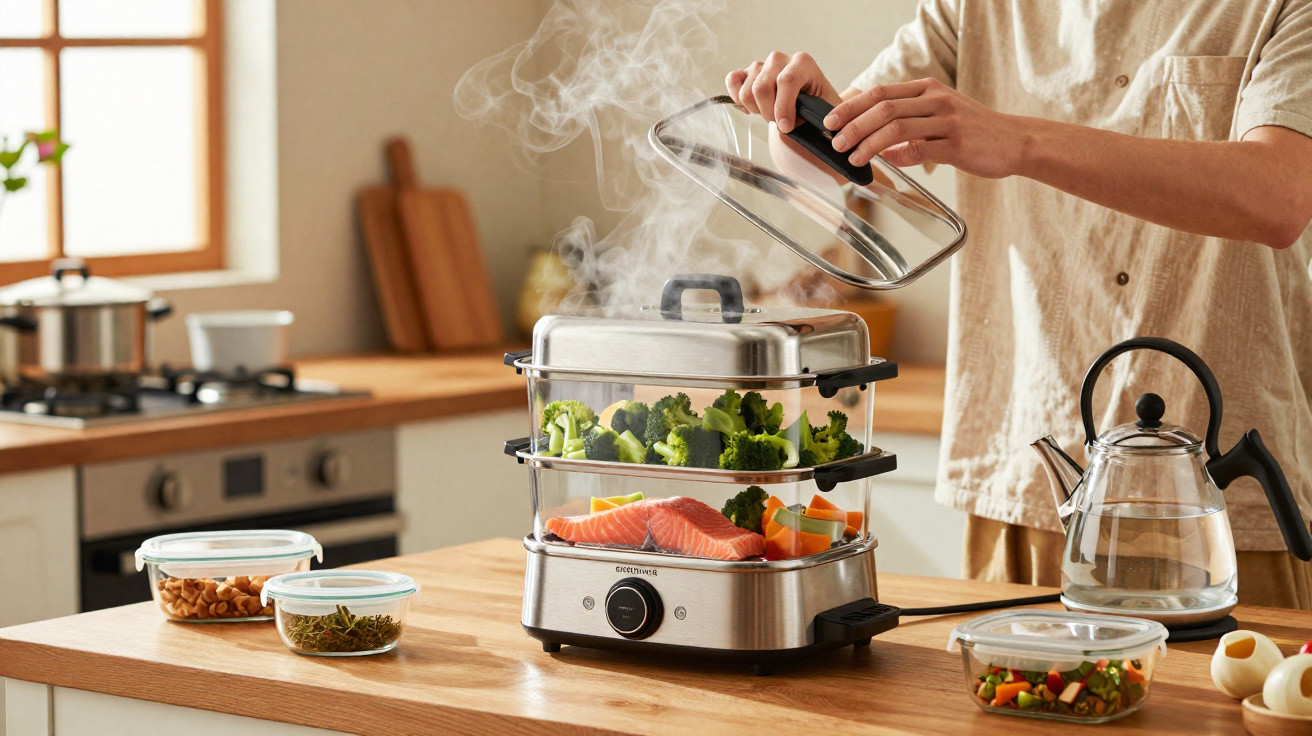
In the home kitchen, the stainless-steel steamer has quietly become a useful ally for anyone who wants to eat better without making the hob more complicated.
As more people look for quick, light meals that can be organised for the week ahead, stainless-steel steamers are moving beyond their niche status and becoming an almost permanent fixture on the worktop. In 2026, the market ranges from straightforward hob models to large electric appliances with digital functions designed for convenience.
Why stainless steel has become the standard for steamers
Stainless steel did not become a kitchen staple by chance. It withstands knocks, repeated heat and temperature changes, while also making cleaning easier without taking on the colour of carrots or the smell of fish. In steamers, those qualities make a tangible difference every day.
A stainless-steel steamer brings together three qualities that matter in real-world use: durability, hygiene and straightforward maintenance.
Unlike many models with plastic baskets, stainless steel does not stain from turmeric, tomato sauce or beetroot, and it can last for years provided the user follows basic care steps, such as drying it thoroughly and descaling the heating element of electric models from time to time.
Seb VC145100: quick steaming for busy everyday use
Among compact electric models, the Seb VC145100 is a typical kitchen workhorse. It offers 900 W of power and around 6 litres of capacity across two stackable stainless-steel baskets.
In performance tests, it proves well suited to a hectic routine: frozen vegetables and fish reach a pleasant finish in roughly six minutes. Potatoes take about 15 minutes, while meats such as chicken need a little longer, although with no unexpected results.
Its strengths are particularly clear:
- 100% stainless-steel baskets that are durable and dishwasher-safe
- enough capacity for two people or a small household
- even cooking in most recipes
On the less convenient side, the water tank is small, the mechanical timer is not especially accurate, and the system for topping up water during use can cause splashes. Even so, it is a well-balanced package for anyone wanting to move away from the frying pan and start steaming regularly.
Kitchen Craft Clearview: traditional hob steaming with stainless steel and glass
The Kitchen Craft Clearview follows the classic format: there is no plug, as it works as a three-tier stainless-steel pan used directly on the hob, including induction. Water goes into the base, while the two upper levels serve as steaming baskets.
The set holds more than 4 litres, enough to cook vegetables, fish and some rice or eggs at the same time. Its standout detail is the tempered-glass lid, which lets you see inside without lifting it and losing heat.
As a hob model, it needs a preheating period while the water comes to the boil. Once there, its performance is consistent: fish is ready in around five minutes, frozen vegetables in approximately six, chicken in just over ten, while firmer root vegetables require a little more time.
For anyone who already has a good hob and wants an item that will last for years, a stainless-steel hob steamer remains a straightforward and robust choice.
The Clearview is well suited to people who prefer kitchenware without electronic components and want a coordinated stainless-steel and glass look in the kitchen.
Tower T80836: versatile use on the hob and in the oven
The Tower T80836 takes versatility a stage further. It is also a hob steamer, but its encapsulated stainless-steel base is intended to spread heat more effectively over every type of heat source, including induction.
Its polished stainless-steel finish pairs neatly with other metal cookware, while the glass lid with a steam vent prevents excessive pressure from building up. The stainless-steel handles provide a secure grip, though using an oven glove or cloth is sensible because they become hot.
One uncommon benefit is its oven compatibility, up to around 200 °C. This gives the utensil a second role: it can become a dish for baking small meals, gratinating vegetables that have been pre-cooked by steam, or finishing fish with a crisp topping.
| Tower T80836 | Type | Compatibility | Key strength |
|---|---|---|---|
| Stainless-steel steamer | Hob / oven | All hob types | Dual use: steaming and oven cooking |
Cecotec Vapovita 3000: large capacity for cooking for more people
Among entry-level electric options, the Cecotec Vapovita 3000 stands out by offering 9 litres of capacity in three stackable baskets, powered by 800 W.
In practical terms, that means it can prepare an almost complete lunch in one go: vegetables on one level, fish or chicken on another, and rice or eggs on the third. The appliance includes a dedicated egg rack and a container for rice, both of which are especially useful in day-to-day cooking.
Its generous capacity and stackable baskets make the Vapovita 3000 a natural fit for larger families or anyone preparing meals for the week.
Among its safety features, the appliance switches itself off when the water runs out or when the cycle ends, reducing the risk of the heating element burning out. Its keep-warm function holds food at serving temperature for a while, avoiding a rush when it is time to plate up.
After use, the baskets can be stored nested together, taking up less cupboard space, which is often important in smaller kitchens.
Cuisinart STM1000E CookFresh: digital display and rapid heating
At the more sophisticated end of the list, the Cuisinart STM1000E CookFresh is aimed at people who appreciate technology but do not want to commit to a full food processor. It heats up in around 30 seconds and shows the remaining time on a digital panel with a clear countdown.
Its 5-litre glass dish works both as the cooking vessel and a serving dish, reducing the amount of washing up and making it easier to serve at the table.
One technical detail becomes apparent in use: the glass dish has no perforations, so too much moisture can collect in certain recipes. For more effective steaming, the internal stainless-steel basket is therefore the better option, particularly for vegetables that can easily become watery.
Potatoes and carrots, for instance, generally need more than 20 minutes to reach a pleasant texture, which is worth considering for anyone always seeking the fastest possible cooking. In return, the precise time control and rapid initial heating offer comfortable operation for more organised routines.
Electric or hob steamer: which makes more sense?
Anyone choosing their first stainless-steel steamer often faces the same question: should they invest in an electric model or choose a hob-based solution such as a three-tier pan?
- Electric: greater autonomy, a timer, automatic switch-off and, in some cases, a keep-warm function. It takes up worktop space and needs a plug socket.
- Hob: no electronics, a long service life and easy storage. You need to control the heat and timing manually.
For people who prepare meals in advance or cook on several days of the week, a model such as the Cecotec Vapovita 3000 is likely to be a better fit. Those who steam only occasionally and prefer fewer appliances on the worktop may find better balance in options such as the Kitchen Craft Clearview or Tower T80836.
Criteria that genuinely matter when choosing a steamer
Capacity and number of tiers
A capacity below 4 litres works well for single people or couples who do not cook much. Between 6 and 9 litres, a steamer can handle complete family meals, with leftovers included. The number of tiers also changes the possibilities: more levels mean more combinations can be cooked in the same cycle.
Power and heating time
For electric models, the 800 to 1000 W range generally provides a reasonable heating time. Less than that can make operation slower; above it, the response tends to be quicker, as seen with the CookFresh.
Ease of cleaning and storage
Stackable baskets, smooth surfaces and dishwasher compatibility make life easier for anyone who dislikes scrubbing pans. Models with fewer loose parts usually cope better with everyday use.
Before buying, it is worth literally measuring the cupboard: some steamers are tall and may not fit on lower shelves.
Steaming in practice: from healthy dishes to weekly meal preparation
In theory, steaming is about preserving nutrients. In practice, its most noticeable benefit is consistency. Vegetables develop a predictable texture without burning, and the risk of overcooking is greatly reduced once you understand the timing needed for each food.
A common 2026 use case is the “Sunday kitchen”: the user separates potatoes, broccoli, carrots and chicken breast across different tiers, cooks everything in a single cycle in a large model such as the Vapovita 3000, then prepares meals for the week with small variations in seasoning and cold sauces added afterwards.
A steamer can also be used as a supporting tool: pre-cook potatoes with steam before finishing them in an air fryer; briefly steam broccoli before finishing it in a frying pan with garlic and olive oil; or use the Tower T80836 to steam fish before placing it in the oven to gratinate with herbs and breadcrumbs.
Terms worth a quick explanation
An encapsulated base is a thicker disc at the bottom of a pan, made from layers of metal. It helps distribute heat and prevents hot spots, which is crucial for avoiding a burnt base while the food at the top is still undercooked.
A keep-warm function is not the same as cooking: it keeps food within a safe temperature range for a few minutes, but leaving it there for extended periods can dry out meat or make vegetables overly soft. With larger appliances, using this feature sparingly usually gives better results.
As for risks, the most common issue is not technical but practical: overfilling the basket by packing vegetables too tightly prevents steam from circulating. The result is uneven cooking. Arranging food in thinner layers and, if necessary, running two shorter cycles replaces effort with efficiency and a more even flavour.








Comments
No comments yet. Be the first to comment!
Leave a Comment