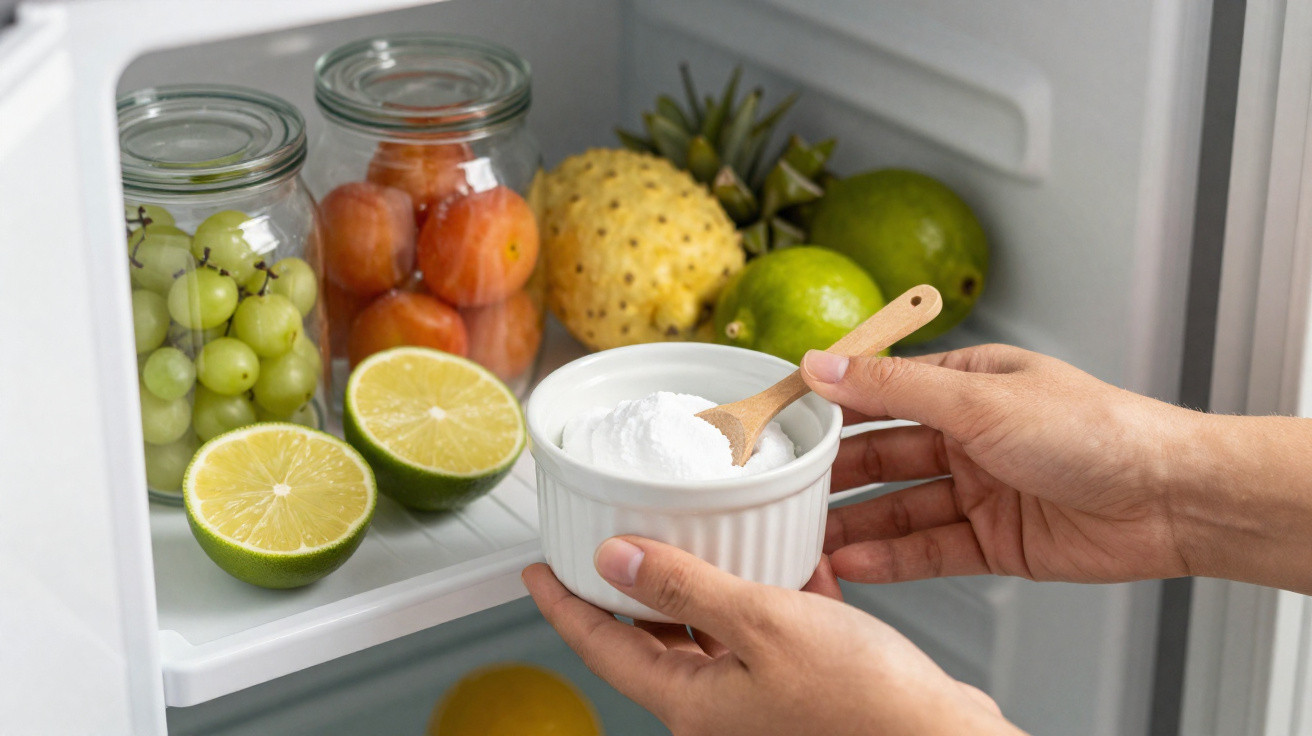
The odour arrived before the door had even shut.
It was not rotten, just… strange. There was a muddled combination of Sunday’s garlic roast, half an onion wrapped in cling film, and a slice of chocolate cake doing its best to last. The chef showed no reaction. He opened the walk-in fridge in his small bistro, spoke to the waiter about service, then nonchalantly moved a little white bowl towards the back of a shelf. It took two seconds. Nothing theatrical.
“That’s why our fridge never stinks,” he shrugged, as if it was the most obvious thing in the world.
A week later, I returned and opened the same fridge, half expecting to prove him wrong. It was cold, clean and neutral. There was no trace at all of the previous evening’s fish special.
That same small bowl remained among the trays and containers.
It was carrying out a quiet, unseen task that you would probably like your own fridge to handle as well.
The hidden secret behind restaurant-fresh fridges
Most people assume restaurant fridges stay neutral because of industrial-strength cleaners or exceptionally rigid routines. Both play a part. Yet in many professional kitchens, the understated star is a basic bowl placed out of sight and nearly overlooked. It does not beep, gleam or look impressive on Instagram.
Still, it keeps working around the clock while everyone is asleep.
Usually, that bowl contains one simple ingredient: ordinary baking soda. In some kitchens, it is coffee grounds. In others, white vinegar. Every chef has their own preference, but the principle stays the same: allow the bowl to quietly capture the smells you do not want to encounter at 7 a.m. while reaching for milk.
In a compact Paris kitchen, a line cook showed me their approach: a chipped ceramic ramekin half-filled with bicarbonate of soda. “We change it every two weeks, roughly,” he said, already turning back to his station. There was no timer, app or chart pinned to the wall.
The restaurant serves fish, cheese, sauces heavy with garlic, and cured meats. It is exactly the sort of combination that ought to create a cold, damp nightmare behind a metal door. Yet after staff open that fridge 200 times in an evening, they find a mild chill rather than an overpowering smell.
At another venue, a hectic brunch spot, the owner relies on used coffee grounds in a shallow bowl. “We go through kilos a day,” she laughed, “might as well recycle some of it.” She dries the grounds, puts the bowl inside, and lets the coffee quietly treat the air between piles of prepared vegetables and trays of marinated chicken.
The science behind it is almost unexcitingly straightforward. Powerful food odours come from volatile compounds moving through the cold, enclosed air inside your fridge. Garlic, onion, fish, cheese and even leftovers that have not quite gone off can all contribute. A bowl of baking soda, coffee or vinegar does not magically clean the appliance; it simply absorbs or neutralises those airborne molecules.
Baking soda, for instance, is mildly alkaline, while many unpleasant-smelling compounds are slightly acidic. When these molecules meet the soda’s surface, they react and become less pungent. Coffee grounds act more like a sponge, catching odours in their porous texture while disguising others with their roasted scent.
Surface area is the key. A bowl leaves more of the powder or liquid exposed to the air than a sealed box or sachet. Greater contact with the air means more smells are captured before they develop into the heavy “fridge funk” that makes yoghurt taste faintly of last week’s curry.
The simple bowl trick you can copy at home
The restaurant habit you can borrow could hardly be easier: leave an open bowl containing an odour-absorbing ingredient in your fridge. That is all. There is no gadget or specialist brand involved, only a small everyday bowl you would be happy to place on the table.
For most households, plain baking soda is the most effective choice. Add 45–60 ml to the bowl, spread it out rather than leaving it in a high mound, and place it on a middle or upper shelf where air can circulate. There is no need to conceal it in a corner; it can sit beside the jam and hummus.
If you prefer more natural scents, use fully dried coffee grounds rather than soda. Alternatively, place a small amount of white vinegar in a bowl on the bottom shelf, particularly if vinegar is already part of your cleaning routine. Restaurants make use of whatever they have available, and you can do the same.
This is where many people go wrong: they put the bowl in place once, then leave it untouched for months. Once it stops working, they say, “It’s useless.” Restaurant fridges do not remain fresh by chance. At some point, someone replaces the contents of that bowl. For a standard home fridge, replacing baking soda roughly once a month is a sensible routine.
Of course, some weeks life gets in the way: the fridge is crammed full, a Tupperware container leaks, and good intentions lose out. Let’s be honest: nobody truly manages this every day. That is perfectly fine. The bowl trick is not about getting everything right; it is about shifting things in your favour, so odours do not get the opportunity to become permanent residents.
Steer clear of miniature lidded containers, deep jars, or anything that is “cute but closed”. Air has to reach the surface. Equally, do not expect one bowl to rescue a fridge containing something genuinely rotten. Throw away the spoiled food and clean the fridge first. The bowl is a maintenance tool, not a miracle cure.
“In a professional kitchen, you don’t wait for the fridge to smell bad,” a head chef in London told me. “You set things up so it never gets the chance.”
That way of thinking transfers surprisingly well to home life. A single small, repeated action can alter the feel of your entire fridge. Rather than concealing a problem, you gradually reduce it before it has the chance to grow.
To make it manageable, treat the bowl as one part of a simple, low-pressure routine that genuinely fits into everyday life.
- Replace the baking soda bowl on the same date you pay your rent or main monthly bill.
- Choose a sturdy, unattractive bowl, so nobody worries about moving it.
- Pair replacing the bowl with a 60-second shelf wipe using warm water and vinegar.
- If using coffee grounds, dry them completely to prevent mould.
- Keep one spare box of baking soda exclusively for the fridge, rather than baking.
Why this tiny habit feels bigger than it looks
That small bowl does more than spare your nose. It subtly changes how you feel about everything stored in the fridge. Food that smells like itself rather than a blend of “everything at once” feels easier to eat, easier to trust and less likely to be thrown away on suspicion.
When you open the door, you are greeted by chilled air and distinct aromas rather than a vague, faintly sour cloud that leaves you questioning whether leftovers from two nights ago are safe. There is less uncertainty, less guessing and less standing there sniffing a container for far too long.
One modest action can provide that.
At a time when we are encouraged to deep-clean, organise by colour, label every item and disinfect every surface, the bowl trick seems almost suspiciously gentle. It does not demand that you become a different person. Instead, it fits into your usual rhythm and quietly absorbs the effects of real life: the half-eaten stir-fry, forgotten lemon, or cheese you promised yourself you would finish.
We have all opened the fridge before visitors arrive and been met with an odour we desperately hope they will not notice. Restaurants work hard to prevent that moment, not through frantic cleaning but through small, dependable routines.
Once the smell disappears, you may find you can see your food more clearly. There is less guilt and more curiosity; less “I should clean this” and more “What can I cook with what’s here?”
The simple bowl trick is almost too modest to boast about. Nevertheless, it quietly links home kitchens with the calm, controlled space behind a restaurant’s swinging door. It is not a trade secret protected by professionals; it is simply a habit they have kept using.
You can begin tonight with a bowl from the cupboard and a handful of baking soda or dried coffee grounds.
Put it in place, close the door and leave it alone for a while. A few days later, when you open the fridge and the familiar background funk has faded or disappeared, you will remember it.
You may even tell someone about “that weird little bowl trick” that made your fridge feel new again, without buying anything shiny or spending Sunday scrubbing shelves.
| Key point | Detail | Benefit for the reader |
|---|---|---|
| The open bowl | A simple bowl filled with baking soda, coffee grounds or vinegar and placed in the fridge | An exceptionally easy solution requiring no specialist equipment |
| Regular replacement | Renew the contents every 2–4 weeks according to how the fridge is used | Maintains maximum effectiveness and prevents unpleasant odours from returning |
| A realistic routine | Link replacing the bowl to an existing monthly task | Makes the habit sustainable without pressure or an exhausting “big clean” |












Comments
No comments yet. Be the first to comment!
Leave a Comment