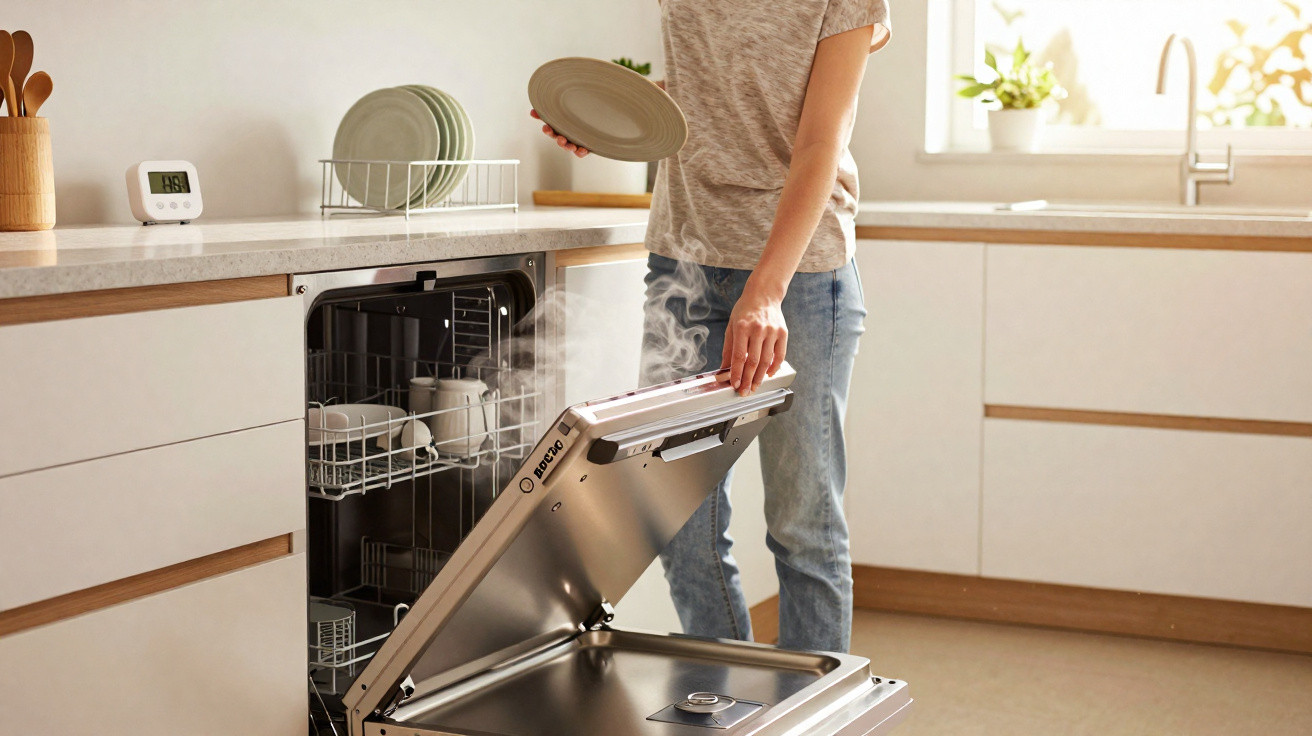
The dishwasher beeps, the cycle has finished – what next? Do you fling the door wide open to make everything dry faster? This is precisely where everyday habits diverge from expert advice. Bosch and other manufacturers have set out clear guidance, which affects not only your dishes but also your kitchen and energy bills.
Why you should not open the door straight away
It may seem obvious: opening the door immediately after the programme ends lets hot steam escape, removes moisture and dries the dishes more quickly. That is partly true. However, the moisture does not simply disappear; it enters your kitchen and settles on cabinet fronts, worktops and walls.
Many kitchens contain substantial amounts of wood or wood-effect materials, including fitted units, worktops, shelving and sometimes even parquet flooring. This makes steam a concern. Over months and years, constant exposure to moisture can cause damage: veneers may warp, edges can split and cabinet fronts may swell.
Bosch advises allowing the dishwasher to cool down slightly after the programme has ended – considerably less hot steam will then escape.
The reason is that temperatures inside the appliance are often still well above 50 degrees immediately after the final wash or drying stage. If you open it then, a concentrated blast of steam hits the underside of the worktop and the kitchen fronts. These are often particularly vulnerable areas in the construction of fitted kitchens.
Risks for fitted kitchens and furniture
Siemens also highlights this issue in its instructions. The manufacturer puts it quite plainly: escaping water vapour can damage fitted furniture if the appliance is opened too early. Customers are advised to let the machine cool for a short time after the programme ends before opening its door.
This does not mean waiting for hours, but allowing a brief interval for the internal temperature to fall noticeably. During this time, some moisture condenses inside the appliance or is released through dedicated ventilation routes. The burst of steam when the door is opened is therefore much smaller.
- Hot steam immediately after the programme ends: maximum strain on furniture
- A brief cooling period: less steam and lower risk to wood
- Long-term effects of continual steam: swelling, warping and unsightly edges
How Bosch and other brands solve the issue automatically
Many modern dishwashers balance effective drying with furniture protection through an intelligent additional feature. After a set period, it opens the door automatically, usually only by a small gap. This allows residual moisture to escape without a blast of hot steam striking the kitchen front.
Bosch calls this feature “Eco Dry”. The system follows a straightforward principle: the machine opens the door only once the temperature inside has dropped to around 42 degrees. According to Bosch, roughly half of its models now have this automatic door-opening function.
Automatic door opening at a moderate temperature: the machine ventilates itself – with less steam and no extra effort.
Siemens offers a similar approach called “autoOpen Dry”. The process is much the same: at the end of the programme, the appliance waits until the interior has cooled, then opens itself by a small gap. The dishes can continue drying while steam disperses gradually instead of escaping all at once.
What does automatic door opening actually offer?
These functions are intended to deliver several benefits at once:
- Improved drying performance: Glasses and plastic items dry more thoroughly without you having to ventilate the appliance manually.
- Kitchen protection: Less moisture reaches the worktop and sensitive edges directly.
- Energy considerations: Optimised drying phases allow manufacturers to design more economical programmes.
- Convenience: Anyone who would otherwise forget to open the door benefits from an automatically “ventilated” interior.
How long should you wait after a programme ends?
Neither manufacturer publicly gives a fixed number of minutes as a universal guideline, because programmes and appliances vary considerably. Their advice does, however, suggest a practical rule of thumb.
A typical sequence is as follows:
- Wait for the programme to end; the signal sounds or the display shows “End”.
- Leave the dishwasher closed for around 15–30 minutes so that the steam and temperature can fall.
- Initially open the door only a small gap, allowing the remaining moisture to escape gently.
- Open it fully only later, once no hot cloud of steam emerges.
If your kitchen has particularly delicate or expensive elements, it is better to opt for the longer waiting period. In open-plan kitchens with a larger volume of air, the moisture is somewhat less concentrated, but it can still damage furniture directly beside the appliance over time.
What this means for everyday dishwasher use
Many households have followed the same routine for years: start the programme, wait, open the door wide, remove the cutlery basket, done. Bosch and Siemens recommend adjusting that order slightly. First allow a brief “cool-down”, then open the door gradually.
Anyone who wants to keep their kitchen in good condition for the long term should treat the dishwasher like a mini steam oven: let it cool first, then open the door.
In practical terms, if the dishwasher runs overnight, simply open the door when you first enter the kitchen in the morning. If you run it during the day, time the programme to finish shortly before another activity, such as going shopping or switching to working from home. By the time you return to the kitchen, the interior will already be noticeably cooler.
Humid air, mould and energy: the underlying issue
Steam from a dishwasher is essentially strongly heated air saturated with water. When it meets cold surfaces, such as window frames, external walls or poorly insulated corners, it condenses. Over time, this can contribute to moisture damage and mould growth. The effect is especially significant in airtight new-build homes with little natural air circulation.
Anyone already dealing with high humidity at home should therefore take extra care before letting the dishwasher “steam out” every time. A short cooling period followed by delayed, controlled opening helps keep the additional moisture load low.
When opening immediately can make sense
Despite the warnings, there are circumstances in which opening the door early is less of a problem. This may apply to kitchens without sensitive fitted furniture, such as basic student kitchens with a freestanding appliance and little wood nearby. Being able to create cross-ventilation, with windows and perhaps a balcony door open, also reduces the risk.
Even so, the manufacturers’ central message remains unchanged: the safest approach for both furniture and kitchen is to wait briefly once the programme has finished. Those few minutes make little difference in daily life, but can prevent many common kitchen blemishes that may become costly later.
A few practical tips
- Check your appliance manual: does your dishwasher have an automatic door-opening feature or a dedicated Eco Dry programme?
- Get into the habit of not pulling the dishwasher open as soon as it beeps while passing by.
- When opening it, first leave the door only slightly ajar and allow the steam to escape slowly.
- Pay attention to sensitive kitchen areas, especially the underside of the worktop and cabinet fronts beside the appliance.
- If you notice visible moisture damage or swollen edges, reconsider your routine – the dishwasher is often the cause.
Ultimately, this is not about perfection but about habits that have an impact over many years. Treating your dishwasher as a small steam appliance and giving it a few minutes to cool protects not only the dishes but also the surrounding kitchen – exactly what Bosch and Siemens recommend.











Comments
No comments yet. Be the first to comment!
Leave a Comment