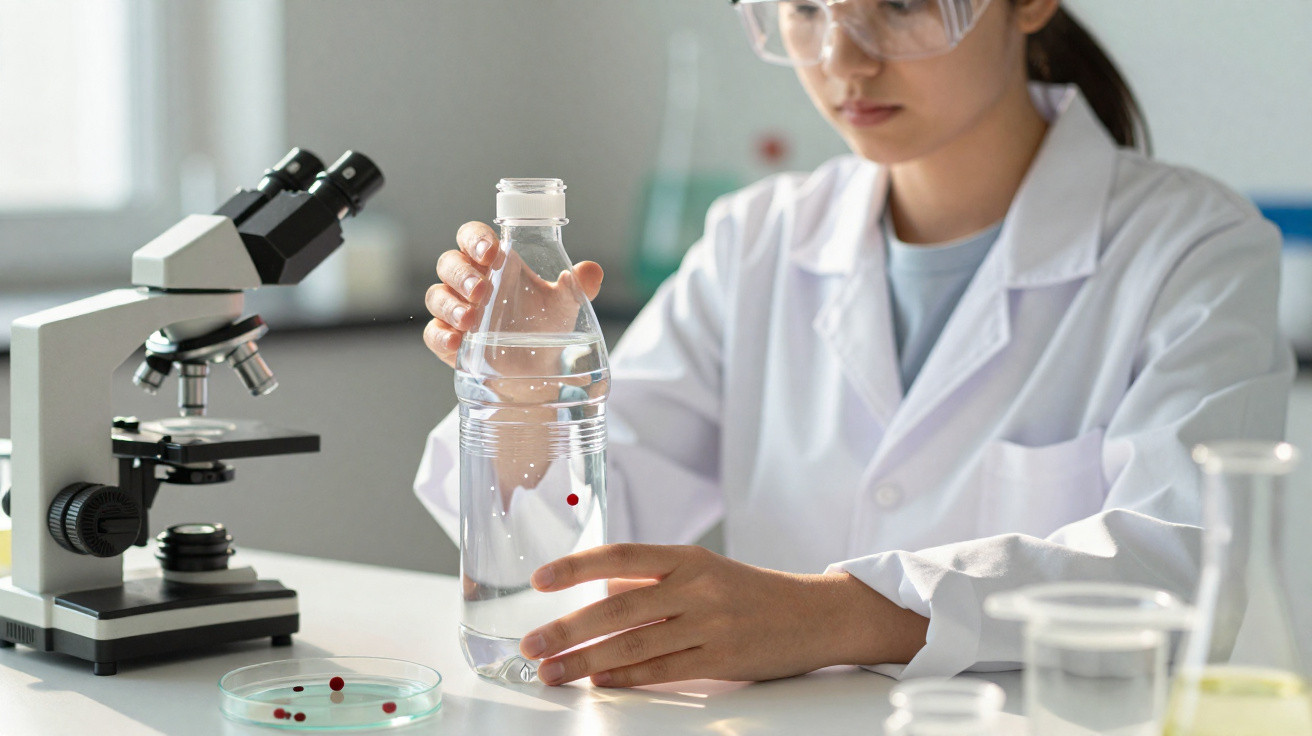
Do you drink bottled water? You should not. A meta-analysis published in the Journal of Hazardous Materials warns consumers that people who drink bottled water every day consume up to 90,000 more microplastics a year than those who drink tap water. The potential health consequences could be dramatic.
Sarah Sajedi, a researcher at Concordia University in Montreal, launched the investigation following a personal experience. During a day on Phi Phi Island in Thailand, she found herself on a beach strewn with plastic waste, mostly bottles. On her return, she brought together a team of researchers to assess how dangerous this plastic pollution may be to human health.
Her team reviewed more than 140 scientific studies to produce a comprehensive assessment of plastic contamination linked to single-use bottles. Their findings show that the average person consumes between 39,000 and 52,000 microplastic particles each year through food and drink. However, for people who rely solely on bottled water for hydration, the figure rises sharply. They swallow almost 90,000 additional particles, bringing their annual total to roughly 140,000 pieces of plastic.
Bottled water and microplastic exposure
Invisible particles with devastating effects
Measuring between one micrometre and five millimetres, these microplastics are completely imperceptible to us. Nanoplastics are even smaller and are literally invisible to the naked eye. Yet their invisibility does not make them harmless; quite the opposite.
According to the scientists, contamination can occur throughout a bottle’s life cycle: during manufacture, storage and transport, and particularly as plastic gradually breaks down when exposed to temperature changes and ultraviolet radiation. Unlike microplastics already present in the food chain, those in bottled water are consumed directly, with no filter or intermediary.
Once inside the body, these particles can cross biological barriers, enter the bloodstream and build up in vital organs. The researchers identified several chronic health risks: systemic inflammation, cellular oxidative stress, hormonal disruption, reproductive disorders, neurotoxicity and even certain cancers. Some studies have even suggested that the human brain contains the equivalent of a teaspoon of microplastics.
A 2018 study by the State University of New York had already examined bottled-water samples from 16 countries. Nestlé Pure Life and the Indian brand Bisleri recorded the highest concentrations, at 826 to 2,277 particles per litre. These figures cast supposedly “pure” water in a very different light.
“Drinking water from a plastic bottle is acceptable in an emergency, but it is not something that should be used every day,” Sarah Sajedi insists. “People need to understand that the issue is not acute toxicity, it is chronic toxicity.” In other words, the effects do not appear immediately but accumulate over the years.
A complicit state
Detection limits and calls for regulation
The researchers are calling for collective awareness and the introduction of strict regulations. Although current detection tools can identify these particles, they have significant limitations. Some methods detect the smallest fragments but cannot establish their chemical composition. Others assess that composition but fail to detect nanoplastics. The most effective equipment remains expensive and difficult to access, hampering the development of standardised measurement protocols worldwide.
Some countries are beginning to respond to this health threat. Elsewhere, the mineral-water industry’s lobbying power remains strong. In France, bacterial contamination was recently detected in bottles of Perrier sparkling water. Other mineral waters were found to be non-compliant because of high levels of microplastics, yet their sale was allowed to continue with the complicity of the authorities. Gulp!















Comments
No comments yet. Be the first to comment!
Leave a Comment