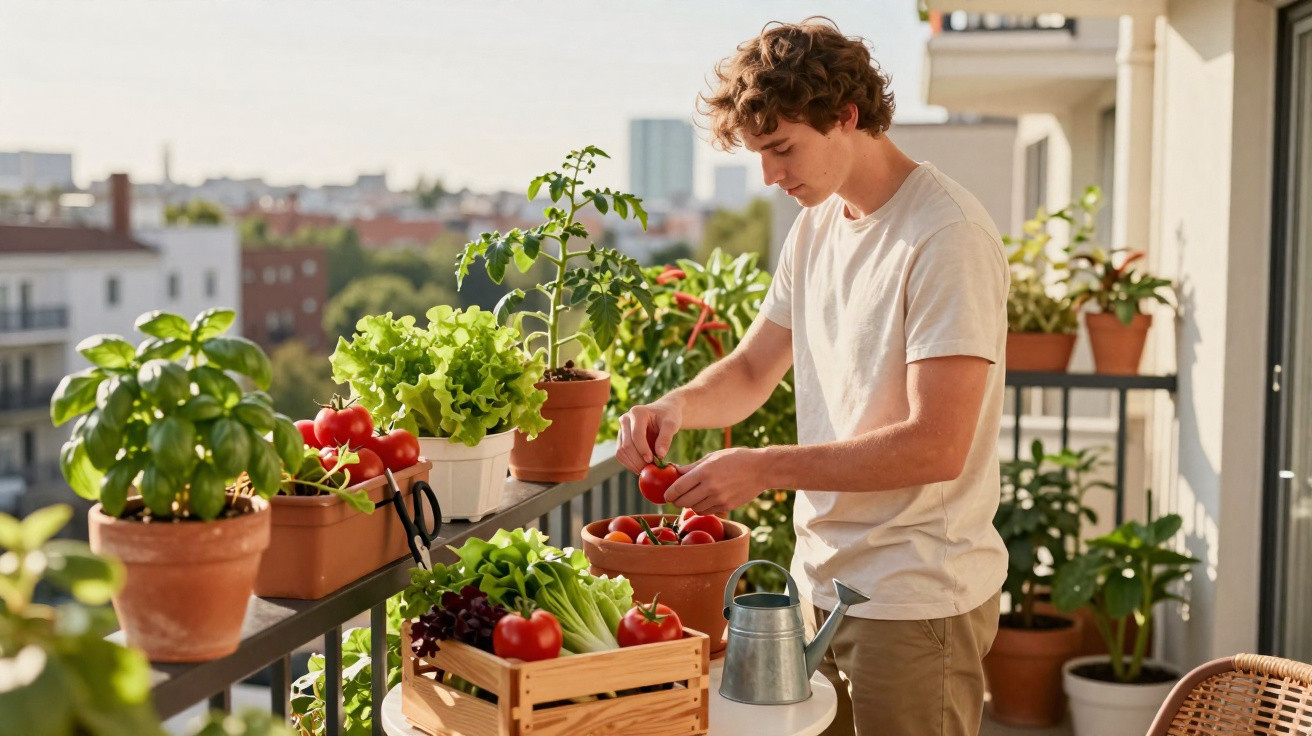
The neighbour on the third floor waters her tomatoes as other people water their houseplants. Red bucket, watering can, a quick assessing glance into the pots – followed every time by that proud, almost conspiratorial look down into the courtyard. On one of those first warm evenings in April, the air suddenly smells of wet soil and basil, even though there is not a garden in sight. Just concrete, balcony railings and a few bicycles. Yet something is growing here, directly above the street, between washing lines and window boxes.
Anyone who has tasted a still-warm balcony-grown courgette or held their first home-grown radish harvest understands why people plan half a vegetable garden in three square metres. More can thrive on a balcony than many imagine. You simply need to know which varieties genuinely like it there.
The overlooked stars: tomatoes, lettuce and more in high-rise homes
When spring reaches the city, balconies quietly turn into small experimental spaces. Wobbly IKEA shelves fill with young plants, makeshift greenhouses appear from old plastic storage boxes, and pots of every shape gather together. Amid the apparent chaos, several vegetables work almost every time: cherry tomatoes, cut-and-come-again lettuce, radishes, herbs and snack cucumbers. They are more forgiving of missed watering sessions than many others, and need no allotment – only a few litres of good compost and some sunshine.
Tomatoes, for instance, love a spot by the balcony edge, provided the wind does not blast through relentlessly. Lettuce will grow even where sunlight arrives for only half the day. Radishes are for impatient growers: sow them, wait a few weeks, then harvest. Once you realise how quickly a small balcony becomes alive, pot by pot, you begin to see those few square metres of concrete differently. Then you start wondering: what else could grow here?
For Anna, 28, who lives in a two-room flat in Cologne, it began with one supermarket pot of basil. “Of course it died on me,” she says, “so I bought seeds out of spite.” That defiance turned into three containers: one planted with cut-and-come-again lettuce, one with radishes and one with baby spinach. There was no elaborate plan, only the quiet hope that at least something would come up. Three months later, she was sending voice notes to friends in which they could hear her picking lettuce leaves.
Her balcony is narrow and not even five paces long, with neighbouring buildings close by. Even so, she has two pots of bush tomatoes, a box of herbs and a long balcony planter filled with mixed leaf lettuces. “I hardly buy any lettuce in summer any more,” she says, laughing. The figures support this small personal revolution: urban gardening is booming, and balcony vegetables in particular are among the beginner projects that rarely fail – if you choose suitable varieties.
The explanation is straightforward: many traditional “garden plants” have long been bred for containers. Bush tomatoes remain compact, snack peppers fruit reliably in limited space, and miniature cucumber varieties prefer climbing upwards rather than spreading out. The best choices for a balcony are mainly plants with shallow roots or those that do not become too bulky. Lettuce, radishes, herbs and cherry tomatoes are rather like a band that sounds good on every stage.
Let us be honest: nobody tests the soil pH every morning or fertilises to a strict timetable. Balcony plants need to cope with a fairly chaotic everyday life – shifts, weekends away and sudden rain. This is precisely where hardy varieties show their appeal. They are not divas. They will still grow when the compost is a little dry, and forgive you for missing the ideal sowing date. Accepting that means creating not an Instagram garden, but a living balcony garden that works with everyday life.
Which balcony vegetables really suit pots – and how to care for them
Start with the easy all-rounders: cut-and-come-again lettuce, rocket, Asian salad leaves, radishes, spring onions and baby spinach. These varieties can cope with partial shade and do not need deep containers. A balcony planter 15–20 cm deep is often entirely sufficient. If you have sunshine, plant cherry tomatoes, bush tomatoes, snack peppers, mini cucumbers and courgettes in larger pots – ideally with at least 10 litres of compost. The more compost there is, the more stable the small ecosystem becomes.
A practical beginning is one large pot with a tomato, a balcony planter of mixed lettuces, a pot containing a mini cucumber trained up a trellis or string, plus a shallow tray of radishes. It is manageable, yet already surprisingly productive. If you like, add a herb box with parsley, chives, basil, thyme and oregano. Herbs are like a film's soundtrack – you only notice how much they contribute once they are absent.
The most common mistakes do not happen at sowing time, but when watering, repotting and choosing a position. Many people squeeze too many plants into one pot because the balcony is small anyway. The result is thin, weakened stems that produce very little. Another classic mistake is leaving saucers permanently full of water. The roots effectively drown. Then there is overconfidence about sunlight. A north-facing balcony receiving only ten minutes of morning light is harsh for warmth-loving plants such as tomatoes or peppers.
At the same time, there is a quiet sense of calm once you realise that plants communicate. Limp leaves? They are thirsty. Yellowing leaves? Perhaps they are too wet or short of nutrients. Instead of trying to make everything “perfect”, it helps to look at the basics: how does the compost feel? Where is the plant at midday, and where is it in the evening? These small observations can sometimes be more useful than any gardening guide. And yes, on some days you simply water quickly in the half-light – that is real life.
“Vegetables on the balcony are not a decorating project, but a quiet pact: I look after you a little, and you give me flavour and a sense of control in a rather uncontrollable world.”
If you prefer to follow specific vegetable lists, this is a useful general guide:
- Sunny balconies (south/west): cherry tomatoes, bush tomatoes, peppers, chillies, mini cucumbers, courgettes, aubergines (mini varieties), basil
- Partial shade (east, bright north-facing balcony): cut-and-come-again lettuce, rocket, radishes, spinach, chard, spring onions, parsley, chives
- Narrow balconies: climbing mini cucumbers on strings, tomatoes on trellises, vertical herb shelves, hanging strawberries
- For complete beginners: radishes, cut-and-come-again lettuce, chives, mini cucumber, one hardy bush tomato
- For keen experimenters: Asian salad leaves, pak choi in autumn, colourful chard varieties, mini snack peppers, microgreens on the windowsill
Why balcony vegetables can create a sense of freedom
At some point, there is a moment when you step onto the balcony in the evening, reach out and pick a basil leaf without thinking. No “I still need to go shopping”, no “Damn, we have run out of lettuce”. Just a small, quiet abundance immediately outside the door. There is something childlike about it, almost defiant: while the world becomes more difficult and expensive, something here simply keeps growing, entirely unmoved by news, appointments or subscriptions.
Anyone walking past their tomatoes each morning also notices their perspective changing. Suddenly, a rainy day is not merely annoying but a free watering session. A heatwave is no longer just exhausting; it is also “tomato weather”. You begin to think in seasons rather than only in deadlines. Some say that, on their balcony, they feel the passing of time properly for the first time – from the first seed leaves to the wilting stems in autumn.
Of course, a balcony garden does not solve crises, nor does it replace agriculture. But it does put a tiny piece of power back into your own hands. Anyone who knows how a tomato plant feels when it is close to bursting walks through the supermarket differently. A soft pepper on the shelf is no longer merely “reduced”; it becomes a small tragedy. Many people share photographs of their first harvest with family and friends, almost as though they have acquired a new pet. That pride is not embarrassing. It shows how rarely we now experience food being produced directly.
Perhaps that is the hidden appeal of balcony vegetables: not the perfect Instagram photograph and not the saving, but the quiet thought in the back of your mind: I can do this. On three square metres, on the fourth floor, between city noise and concrete. And once you have started, you will catch yourself automatically looking for new varieties the following spring – simply to find out what else is possible.
| Key point | Detail | Benefit for the reader |
|---|---|---|
| Suitable vegetable varieties | Tomatoes (bush/cherry), cut-and-come-again lettuce, radishes, mini cucumbers, herbs | A quick overview of what can reliably green and produce a harvest on the balcony |
| Position and containers | Sunny versus partially shaded balconies, sufficiently large pots and planters | Helps avoid unsuitable purchases and place plants appropriately from the start |
| Avoiding typical mistakes | Planting too densely, waterlogging, unrealistic expectations for north-facing balconies | Saves frustration, money and time, while increasing the likelihood of a successful first harvest |











Comments
No comments yet. Be the first to comment!
Leave a Comment