A narrow rectangle beneath the worktop, a brushed-steel handle, nothing especially remarkable. You open it for a spoon, a peeler or the lighter for the gas hob. It catches slightly. Something is trapped. A whisk? The pizza cutter? The drawer jolts before finally opening with a crash loud enough to disturb the neighbour’s dog.
You search by touch, brushing against crumbs, a loose battery and a rubber band wrapped around a meat thermometer you had forgotten you owned. Meanwhile, your coffee cools on the worktop as you hunt for the one small item you need immediately. Your shoulders tighten, your breathing becomes shallower, and you mutter something you would not say in front of children.
All that daily drama can come from a single neglected kitchen drawer.
The small drawer quietly draining your energy
Watch somebody prepare breakfast in an unfamiliar kitchen and the moment is obvious. Their hand reaches confidently towards a drawer… then pauses. This one? No. That one? Cutlery. The next? Total disorder. Utensils are heaped together, a corkscrew is hidden beneath spatulas, and scissors lie under a jumble of wooden spoons.
That brief interruption, repeated every morning and evening, gradually wears down your patience. You only wanted to fry an egg. Instead, you are half-crouching with your head practically in a drawer that squeals on its runners, asking yourself why a potato masher is wedged diagonally as though it belongs there. It is the sort of tiny resistance most people never challenge. They simply put up with it.
And without realising it, you carry that irritation through the rest of the day.
Picture an ordinary Tuesday night. You get home late and hungry, while mentally flicking through emails you have not answered. You put pasta on to boil, take out a pan for the sauce, then reach for the garlic press. The drawer will not open fully because something inside is stopping it. Again.
You rearrange a few things, hear stainless steel scrape against wood and feel a sharp burst of annoyance that seems disproportionate. At last, the drawer opens - only for you to discover that the garlic press is in the dishwasher anyway. Two minutes have disappeared. The room has gained a little more tension. Your sauce catches slightly because your attention was elsewhere.
Multiply that small frustration by four or five times each day. After a year, that flimsy drawer has swallowed hours of your time and a share of your patience. There is no big catastrophe, only persistent low-level friction in a room that ought to feel like your home base.
There is a simple reason this drawer often seems cursed. It is generally the easiest storage space to reach, so it becomes the drop zone for everything “we use often, but don’t know where to put”. Garlic presses, pizza cutters, vegetable peelers, bottle openers, lighters, kitchen scissors, rubber bands, random keys, spare batteries and soy sauce sachets from a takeaway three months ago.
The human brain looks for patterns, yet this drawer offers none. Each time you pull it open, your eyes have to scan a newly arranged landscape of objects that has shifted since yesterday. That tiny search uses decision-making energy. Ten seconds here, eight seconds there. This is cognitive load, not clumsiness: your mind is working unpaid overtime in front of a heap of metal.
Over time, the drawer quietly teaches you to anticipate resistance in your own kitchen. That is the real issue.
Turning the ‘junk’ drawer into an easy daily shortcut
The solution is not a full weekend kitchen makeover that you abandon halfway through. Begin with one intentional action: choose the drawer that frustrates you most and tip everything onto the worktop. Every item. The crumbs, unexplained screws and soy sauce sachets. It may look a little horrifying. Good.
Then select only five to seven things you genuinely reach for every day. Not items you “might need”, or tools used occasionally for Christmas baking. Daily-use items only: a peeler, chef’s knife sheath, favourite spatula, scissors or lighter. These are the VIPs. Give them the front positions in the drawer, with nothing piled over them. Everything else should move to another area, go into a container at the back or leave the house. If you have not used it in twelve months, your kitchen is unlikely to miss it.
The aim is not perfection. It is calm and speed.
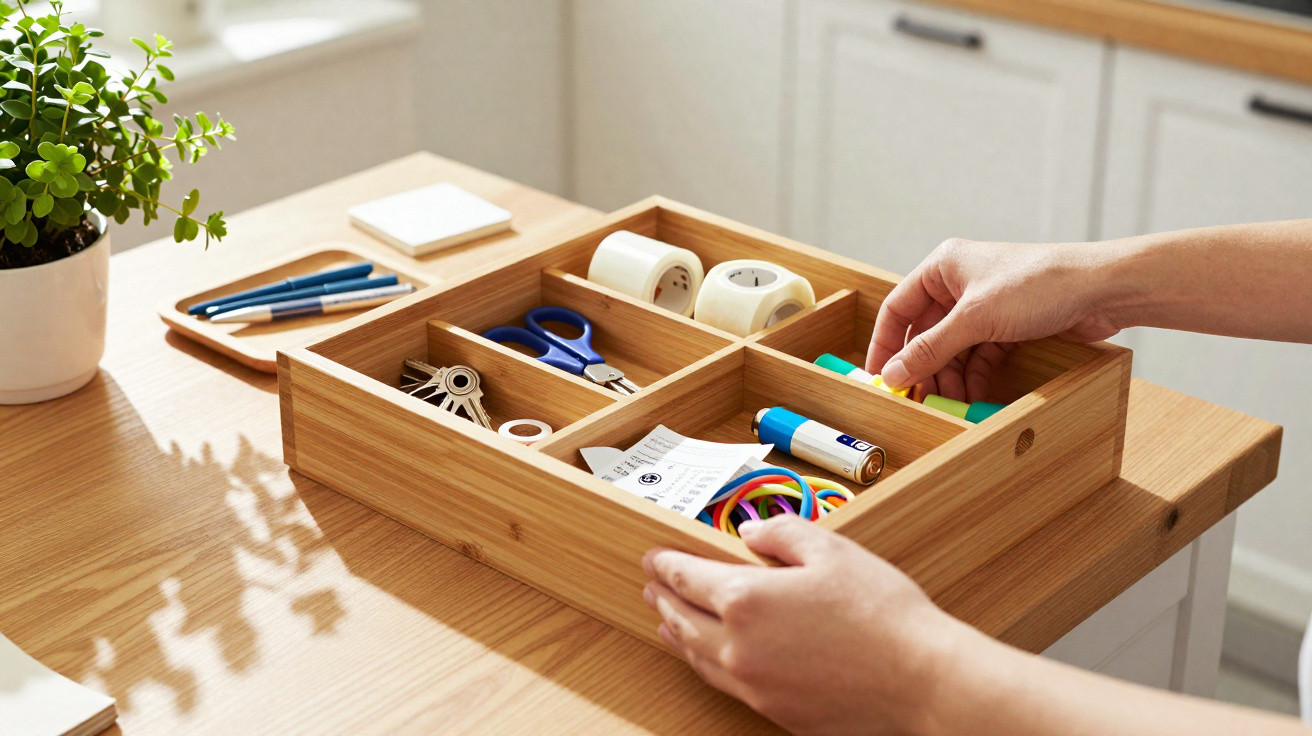
After choosing the essentials, assign every type of item a “home” within the drawer. You do not need costly organisers from an influencer’s Amazon storefront. A trimmed shoebox, ramekin or old takeaway container will do - anything that forms a clear boundary. Scissors go here. Openers go there. Rubber bands and twist ties need their own enclosure rather than wandering about like wild horses.
Most people make the same error: they mistake closeness for usefulness. They pack everything near the hob “because we cook here”, then battle the resulting mess every evening. Walking three extra steps twice a week is much better than wrestling with an overflowing drawer twice a day. Consider friction rather than square metres.
Labels can help too. A quick note in pen on masking tape is sufficient. You are not arranging things for Instagram; you are arranging them for the half-awake version of yourself at 7:06 a.m.
Here is the understated truth professional organisers mention once the cameras are off:
“A drawer isn’t cluttered because you own too much stuff. It’s cluttered because nothing has a clear job and a clear place to live.”
One further habit can transform the system: a very short weekly reset. Spend 90 seconds, not an entire tidying session. Open the drawer, remove anything that has wandered into the “VIP zone”, and return it to its category container or another cupboard. That is all. No pressure, no pursuit of perfection - simply putting items back where they belong.
- Keep the front of the drawer for 5–7 tools used every day.
- Use any small containers to divide categories inside the drawer.
- Store genuine “junk” in a separate box away from the main cooking area.
- Do a 90-second reset each week rather than a three-hour clear-out every year.
- Follow one rule: one purpose per item, one place per item.
From an annoying drawer to a quiet ally in your day
Once you have used a drawer that works smoothly and predictably, a subtle change happens. During cooking, you reach out and your hand finds what it needs; the moment passes without resistance. There is no slamming, searching or burst of irritation distracting you from the recipe or a conversation. It feels unexpectedly luxurious, rather like a hotel kitchen that happens to be your own.
The drawer is no longer a black hole; it becomes muscle memory. That is when its wider effects become apparent. You may be less short-tempered when your partner lingers in the kitchen. More attention remains for tasting, chatting or letting a child stir the sauce without fearing they will pull the whole arrangement off the worktop. It sounds minor, but it is not.
We often discuss self-care in terms of candles and bubble baths. Another form exists in these small household systems, which either support you or obstruct you every day. One drawer can quietly affect how your mornings begin, how your evenings unwind and how much dignity you feel in your own home. Let’s be honest: nobody really does this every day, but a 90-second reset once a week? That is achievable.
Sharing this sort of adjustment can be oddly satisfying. You show someone a “before” photograph of your chaotic drawer, then open the redesigned version with absurd pride. They laugh, then return home, open their own drawer and suddenly see it differently. They spot the places where their day gets caught. They recognise the small frictions that were invisible the day before.
That is the real invitation. Not to become somebody with colour-coded spice jars and a label maker, but somebody who notices where energy drains from ordinary days - and gently fixes one of the simplest leaks. The next time you hear that familiar clatter beneath the worktop, you may realise it is no longer part of your life.
| Key point | Detail | Benefit for the reader |
|---|---|---|
| Identify the “friction drawer” | Notice the drawer used most often that regularly sticks or overflows | Recognise a frequently overlooked source of everyday stress |
| Reduce it to the genuine essentials | Limit the immediately accessible area to 5–7 tools used every day | Save time and reduce mental load every time you use it |
| Establish a mini-routine | Do a 90-second reset once a week to restore order | Maintain comfort without major effort or time-consuming organising |








Comments
No comments yet. Be the first to comment!
Leave a Comment