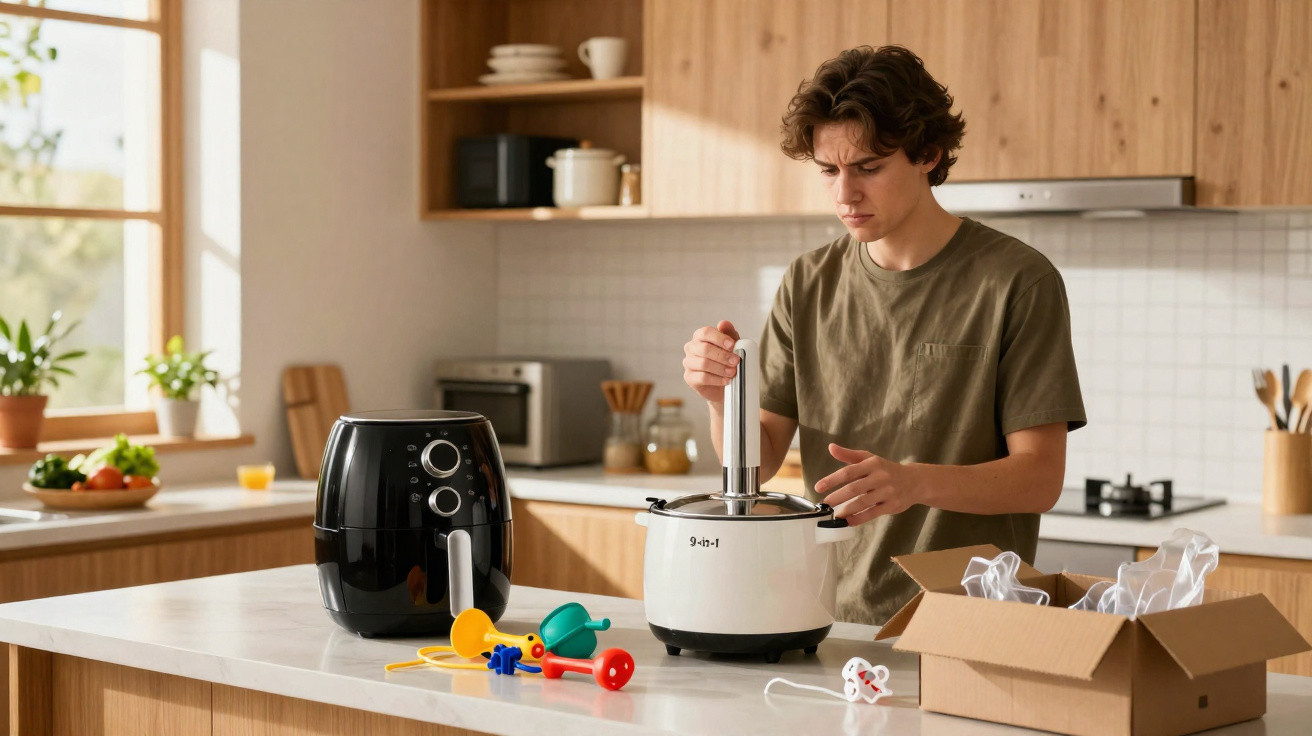
The parcel turned up on a Tuesday: large, gleaming and printed with an image of a family laughing around an immaculate white worktop. Its packaging shouted “Nine-in-one miracle”, claiming it could toast, bake, roast, air fry, grill, dehydrate, reheat, slow cook and steam - all from one squat plastic cube. My friend Emma tore it open as though it were Christmas morning, moving her entirely functional air fryer aside so the new arrival could take pride of place. The old appliance, not quite two years old, was nudged awkwardly towards the end of the worktop.
Then into a cupboard.
Then, predictably, closer to the bin.
We watched another “must-have” appliance claim its territory, complete with gleaming buttons and smart settings that nobody would remember six months later. The air fryer that had once seemed so groundbreaking suddenly appeared bulky and dated.
Behind us, a modest but unsightly heap of cardboard, polystyrene and plastic wrapping was building on the floor.
There was something unsettling about it.
The nine-in-one kitchen gadget promise taking over our kitchens
Visit any large retailer today and the message is impossible to miss: a whole aisle lit up by claims and guarantees. “All-in-one.” “No oil.” “Healthier cooking.” The nine-in-one kitchen gadget has become the home-appliance industry’s latest favourite, presented as the polished next step after the air fryer boom. It is tall and glossy, usually black or silver, and may even include a viewing window so you can watch chips brown as they cook.
The proposition is tempting. Why keep a toaster, air fryer, compact oven and steamer when one robot-like cube says it can take over every job?
You are not merely purchasing convenience; you are buying into the prospect of a tidier, more minimalist home.
Spend five minutes on TikTok or Instagram and you are likely to find a “kitchen reset” video treating a nine-in-one gadget as though it were part of the household. A creator carefully wipes it down, taps its digital display, then produces crisp broccoli or salmon. “We got rid of three appliances,” the creator says, while putting an old toaster, air fryer and rice cooker into a box.
What that shot does not reveal is what follows.
A recent EU report estimated that small household appliances are now among the fastest-growing forms of electronic waste. The U.S. Environmental Protection Agency has discreetly highlighted a comparable pattern: increasing numbers of plastic-bodied appliances with shorter working lives are reaching landfill more quickly than ever.
Those “declutter” videos often simply show clutter being moved to somewhere off-camera.
At first glance, the argument for these multi-function gadgets appears airtight. A single appliance performing nine jobs ought to mean fewer possessions, less waste and less disorder. Trouble begins when each “new generation” offers marginally improved presets, marginally quicker preheating and marginally cleverer apps. Last year’s nine-in-one can soon feel as antiquated as a flip phone.
Manufacturers understand that urge to upgrade extremely well.
They package it in smooth styling and “smart kitchens” buzzwords, although the underlying formula is straightforward: sell a large plastic box, then encourage you to regard it as outdated within two years. This creates an odd contradiction. We assume one all-purpose appliance is simplifying life, but we may instead be accelerating a cycle of buying, throwing away and filling drawers, cupboards and landfill with yesterday’s “game changer”.
Avoiding the plastic junkyard trap without becoming a minimalist
There is a low-key, practical route out, and it does not require cooking over a fire or owning only one wooden spoon. Begin with something distinctly unglamorous: list what you genuinely make during a typical week. Not the meals you aspire to prepare, but the ones you actually cook.
Next, compare that list with the functions advertised by the nine-in-one.
If you rarely dehydrate fruit or slow-cook stews, those features are simply marketing sparkle. If your regular cooking involves roasting vegetables, toasting bread and reheating leftovers, dependable high heat and a good tray probably matter more than a dozen pre-set programmes.
One particularly useful approach is to wait 30 days from the point at which you first want to press “buy”. If you still want the appliance afterwards, and can identify at least three uses for it every week, it may deserve room on your worktop.
There is also another straightforward step that many people overlook: ask what will become of the appliance being replaced. The old air fryer, with its scratched basket and worn buttons, turns into “invisible clutter” as soon as a newer, shinier cube appears on the worktop. We have all experienced it: the new box is opened, and the old machine quietly begins fading away in the background.
Before you upgrade, settle on its destination. Will you donate it, sell it locally, give it to a student or neighbour, or at minimum take it to an e-waste collection point? Or will it gradually travel from cupboard to garage to rubbish bag?
Let us be realistic: nobody manages this perfectly every time. Even so, forming this small habit before every purchase can achieve more than any fashionable “no-buy year” challenge.
“I visit recycling centers every week,” says Marta, a waste management technician in a mid-sized European city. “What shocks me most isn’t big fridges or ovens. It’s the mountains of barely used small appliances. Air fryers, multi-cookers, these new nine-in-one machines. Some still in their original plastic. People buy them like fashion.”
- Inspect the materials
Choose models with metal casings, replaceable baskets and clearly available spare parts rather than completely sealed plastic cubes. - Assess how you really use it
Borrow one from a friend or purchase second-hand first. If it is barely used over a month, you will have saved both money and space. - Arrange the exit plan
Before making a purchase, decide precisely where the old appliance will go: donation, resale or e-waste. - Look past the hype
Read reviews from owners after 6–12 months rather than relying only on first-week enthusiasm. - Repair rather than replace for novelty
If a basket coating starts peeling or a button sticks, contact the manufacturer about spare parts before deciding it is “dead”.
What our fixation on “smart” kitchen gadgets reveals
A broader question runs beneath every nine-in-one launch, and it is less about fan temperatures than it is about us. Why do we repeatedly hope the next box will improve our cooking, our schedules and even our bodies? Many adverts quietly deliver the same suggestion: you are too busy, too exhausted and too overloaded, so this gadget should rescue you.
What we are really purchasing is not a machine, but a fantasy of a simpler life.
Critics speaking of “plastic junkyards” are not only referring to landfill. They are also pointing towards a growing feeling that our homes are filling with possessions that promise far more than they provide.
Perhaps the real change is not about boycotting nine-in-one appliances or feeling guilty about your air fryer. Perhaps it means pausing for long enough to ask one disarmingly simple question: who is really in control of your kitchen - you, or the next launch?
| Key point | Detail | Value for the reader |
|---|---|---|
| Challenge the nine-in-one hype | Compare the gadget’s functions with what you genuinely cook each week | Avoid paying for features you will never use |
| Plan what happens to old appliances | Choose donation, resale or e-waste before upgrading | Cut household clutter and reduce environmental impact |
| Put durability before novelty | Look for repairable metal-bodied models with spare parts | Keep fewer gadgets for longer that genuinely earn their place |










Comments
No comments yet. Be the first to comment!
Leave a Comment