No furious spit of oil, no smoke alarm teetering on the brink, no frying pan fused to a scorched onion. Instead, there is only a gentle whisper, like rain pattering on canvas, and the easy assurance of a chef in a white jacket who has plainly done this countless times.
We are in a compact London kitchen that resembles a technology lab more than a restaurant. There are no gas flames or weighty cast-iron pans on the worktop: only a narrow metal tray gliding into what looks like an extravagantly designed giant toaster. The celebrity chef beside me smiles, folds his arms and says, with complete calm: “This will change the way you cook forever.”
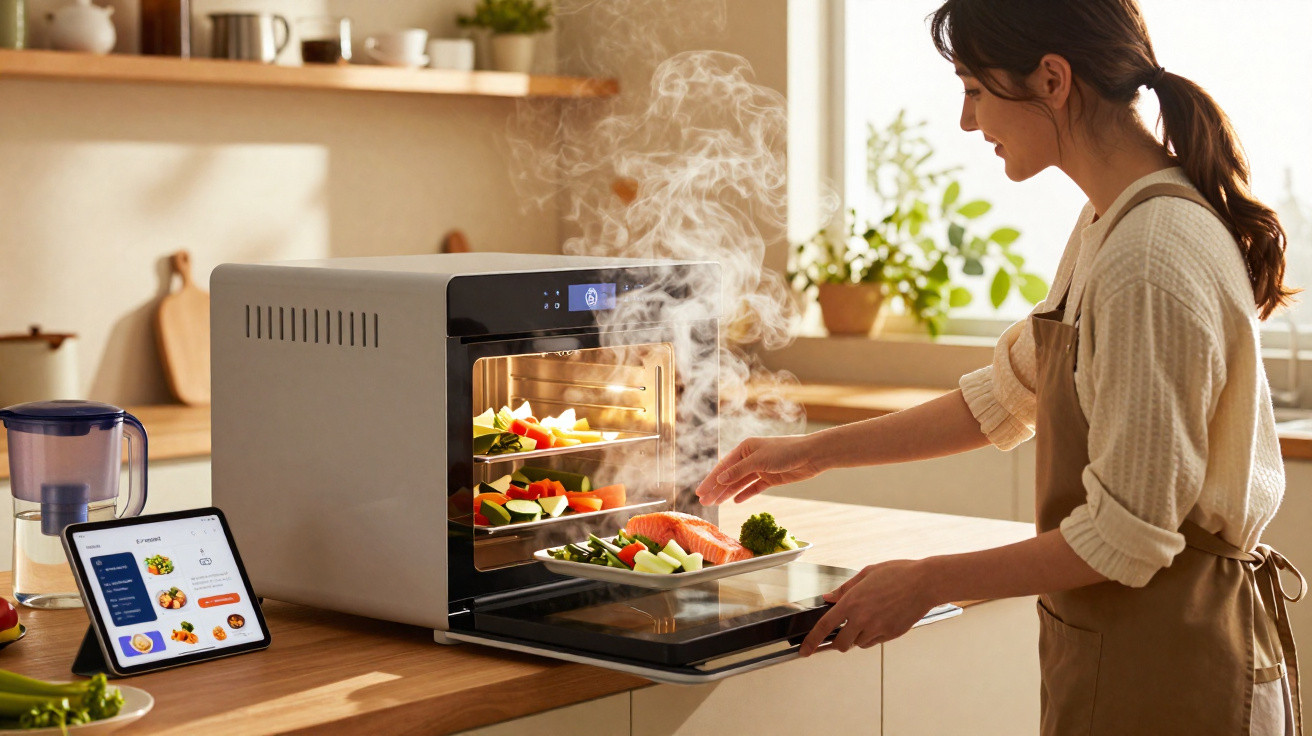
Within the appliance, carrots, salmon and a small bunch of grapes cook simultaneously. There are no lids, no stirring and no need to time three separate pans. It almost seems unnatural.
Yet, when the tray emerges, the kitchen carries the aroma of a Sunday lunch your grandmother might have cooked. It is something deeply familiar, driven by something entirely new.
A quiet revolution in your kitchen
The innovation he means is not an elaborate knife or an internet-famous gadget. It is a new breed of smart steam ovens, using accurately controlled low-temperature steam and sensors to cook food with an almost unnerving level of precision.
Picture a blend of a conventional oven, a sous-vide bath and the most organised person you know. Put the tray inside, select a programme, and the appliance determines the temperature, duration and humidity. Your role is simply to wait.
For busy cooks at home, the point is not earning a Michelin star. It is achieving relaxed, restaurant-standard food on an ordinary Tuesday evening, when you are exhausted and have no patience left.
A chef I met in Paris demonstrated his preferred method: a whole chicken, potatoes and broccoli, all cooked together in a smart steam oven in 40 minutes without any complication. He seasoned everything on a single tray, chose a preset named “Family Roast”, then left it to deal with emails.
When the oven sounded, the chicken skin was deeply golden and crisp, the potatoes were fluffy at the centre, and the broccoli remained vivid green rather than becoming its usual khaki-coloured disappointment. He had not opened the door once while it cooked. There was no basting, prodding or “just checking”.
Manufacturers say these ovens can reduce cooking mishaps by almost half for beginners. Commercial kitchens rely on the same technology to send out identical dishes hundreds of times each evening. At home, though, the first thing you notice is not the precision. It is the freedom.
What happens inside is not really magic, but mathematics. The oven relies on probes, humidity sensors and pre-programmed “profiles” that track the way food genuinely changes while cooking.
Rather than firing everything at 200°C and hoping it works out, it alters temperatures in phases, introduces or removes steam, and gauges how quickly heat reaches the middle of a salmon fillet or a dish of lasagne. It acts like an unflappable chef who never loses focus because of WhatsApp.
From a scientific perspective, steam carries heat more quickly and gently than dry air. That enables food to cook evenly without losing moisture. Consequently, you can be less exact with timing and still produce tender vegetables, succulent meat and golden surfaces. It is this room for error that transforms daily cooking, rather than any far-off notion of “perfection”.
How to actually use this innovation at home
The first meaningful change is not the appliance itself, but your way of thinking. Rather than approaching dinner pan by pan, you begin to plan tray by tray: one tray, one meal, one button.
Consider a weekday meal of salmon, green beans and baby potatoes. On a typical evening, you would be managing a saucepan of boiling water, an oven tray, a frying pan, a timer on your phone and an increasing feeling of low-level panic. A smart steam oven changes that arrangement.
Arrange everything across one tray in a single layer. Add a little olive oil, salt and pepper, then place lemon slices over the salmon. Next, choose “Fish & Veg”, or enter the ingredients on the display or app. The oven takes care of the remainder, balancing steam and dry heat so the potatoes become tender, the beans retain their bite, and the salmon stays pink and silky rather than turning dry and chalky.
The mistake people make is assuming that a smart steam oven is simply an ordinary oven with a different badge. They put food in haphazardly and anticipate miracles. In reality, it is more subtle than that.
These ovens respond well to order. They work best when you give them useful signals: vegetables cut to similar sizes, some space between items, and no stacking food four layers deep “just this once”. Let’s be honest: hardly anyone manages that every day, but the nearer you come, the better your results will be.
One chef told me that the most common error home cooks make is disabling the steam because they “want it crispy”. He laughed and said, “You want both. First steam, then dry heat. Let the oven do that dance for you.” That is not laziness; it is strategy.
“People think innovation in the kitchen means more work or more rules,” the chef in London told me, leaning on the counter while the machine hummed in the background. “For me, the real luxury is walking away. Let the technology watch the food so you can watch your life.”
There is a very practical point behind those words. This is not about pursuing Instagram perfection. It is about easing the emotional burden of making dinner. On days when your mind is overloaded, the children are shouting or an email refuses to send, an appliance that quietly guides your meal from raw ingredients to ready food matters a great deal.
- Start small: Begin with one-tray meals before taking on a complete Sunday roast.
- Trust presets: Modes such as “Fish”, “Veg” and “Reheat” come from laboratory testing rather than guesswork.
- Use steam for leftovers: Rice and pizza from the day before can be revived to something close to freshly made.
- Keep pieces a similar size, allowing the sensors to “read” the tray properly.
- Clean the steam system every week, so its performance does not gradually decline.
The deeper shift: what changes when cooking stops being a battle
The real subject is not a desire for new gadgets. It is what happens to your evenings when cooking no longer feels like an exam you may fail. On a tired Thursday, while scrolling on your phone, you may genuinely decide to cook rather than order a takeaway simply because the effort required is lower.
Imagine arriving home, filling a tray with vegetables and chicken thighs, selecting a programme and going for a shower. You do not need to stand watch over a frying pan. There is no “just five more minutes” that becomes twenty. The oven alerts you when the internal temperature is correct, rather than when an arbitrary timer reaches zero.
For a family, that could mean eating together slightly more often. It could also mean that the person who “can’t cook” suddenly can, because the most difficult elements are handed over to discreet sensors and pre-written recipes. For someone living alone, it could mean no longer accepting beige, lukewarm dinners as the unavoidable norm.
Everyone has experienced ruining dinner in the final five minutes. Pasta turns soft as you drain it. Fish overcooks while you answer the doorbell. A tray of vegetables goes from caramelised to burnt while you wrestle with the recycling.
What these ovens truly provide is protection from that final misstep. Once food is ready, they keep it at a gentle temperature. They can pause programmes. Rather than penalising you with a spoiled meal, they prompt you with a notification.
Some chefs are concerned that this makes cooking “too easy”, and that skills will disappear. Standing in that London kitchen, I did not sense a loss. I sensed a change. The craft remains, but shifts position. You still select flavours, ingredients and combinations. You still taste and make adjustments. However, the repetitive and error-prone task of chasing precise temperatures and timings becomes less of a precipice.
Perhaps the change will extend beyond how we cook to how we define being “good” at cooking. It may become less of a measure of timing and multitasking, and more about curiosity and flavour. Less pressure, more enjoyment. Less fear of getting it wrong, more “let’s see what happens if…”
| Key point | Detail | Benefit for the reader |
|---|---|---|
| Sensor-assisted cooking | The oven adjusts temperature and steam in real time | Reduces failures, even when you are distracted |
| Steam + dry-heat cooking | Combines gentle steam with dry heat for browning | Food is juicy inside and crisp outside |
| “One-tray” mode | One tray, several foods, one programme | Less washing-up, less stress and more home-cooked meals |









Comments
No comments yet. Be the first to comment!
Leave a Comment