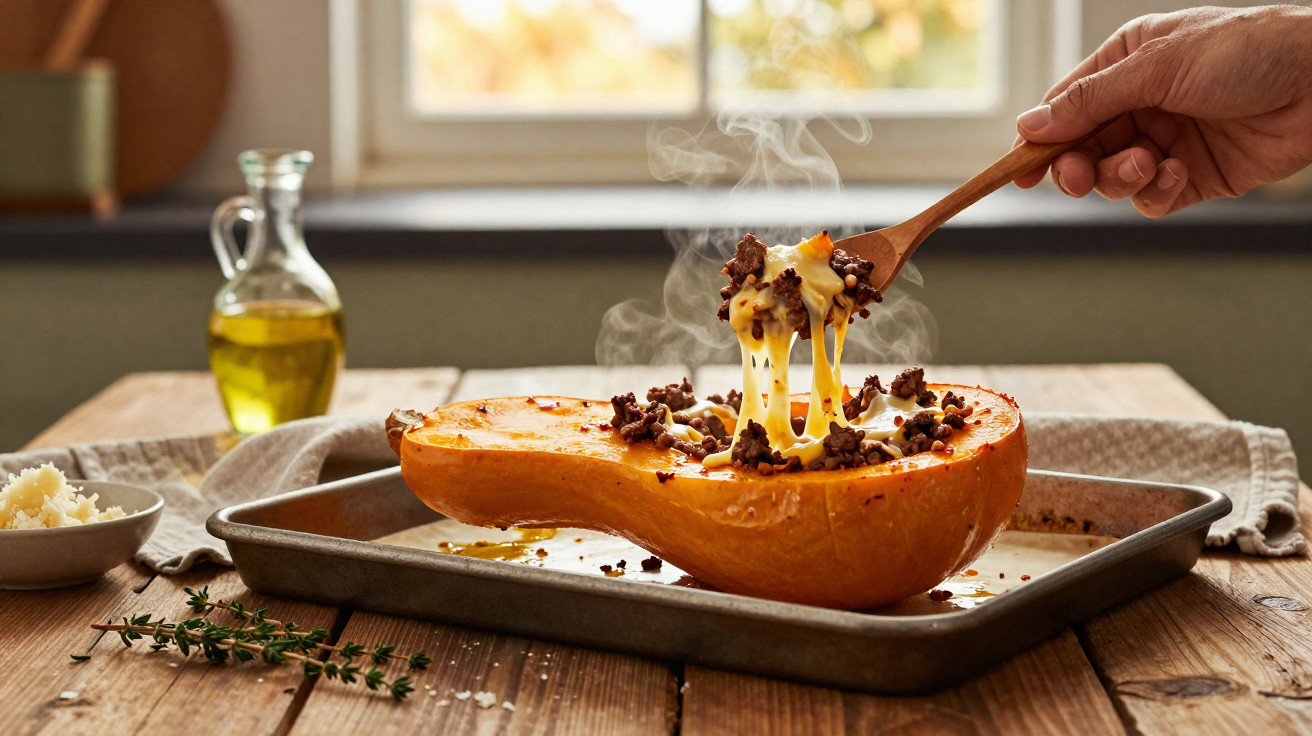
Butternut squash often ends up stacked in baskets and across worktops, headed for yet another familiar soup. It deserves a more exciting future: a bubbling, aromatic filling of seasoned mince and cheese that makes this modest squash into a satisfying meal for two.
The evening I became convinced, the kitchen windows had steamed up, the radio played softly, and two butternut squashes rested on the chopping board like stubby lanterns. As I split them, the blade slid quietly through the orange flesh. The pan sizzled as mince joined onion, filling the room with the scent of November: sweet, savoury and faintly smoky.
I scooped a trench through each roasted half, then settled the sauce inside as though tucking it in. Cheese fell over the top. It blistered, the edges turned caramelised, and the table fell into that unusual, approving silence that says you got it right. After that, the kitchen was silent too.
Why stuffed butternut squash belongs in November
This meal makes particular sense at this time of year. Butternut squash has a natural sweetness and velvety texture that need contrast, while mince supplies salt, richness and the savoury depth created by proper browning.
Cheese brings the components together: melting comfort alongside a sharp note of brightness. Everything sits inside a roasted shell that works as an edible casserole dish. This is the November hug you can eat.
Everyone knows the feeling of a long day, when hunger seems bigger than the pan. A friend messaged me after cooking this on a Tuesday: “It tasted like the weekend, but I cooked like it was Tuesday.” That is exactly the appeal: a generous-tasting recipe that does not consume the whole evening.
There is a useful practical side as well. One butternut squash naturally separates into two portions at the seed cavity. While the squash roasts, you can prepare the filling, so the timing works in your favour. Because the squash doubles as the baking dish, there is less to wash afterwards.
The principle is straightforward. Sweet squash needs seasoning, acidity and browned flavours to remain interesting until the final mouthful. Mince provides those elements, especially when you give it enough time to colour and leave a little fond in the pan. Cheese contributes fat and umami that move through the squash fibres, making each spoonful feel complete.
Texture plays its part too. The edges become sticky and crisp, the filling remains saucy, and the topping stretches as you cut through it. It is spoonable drama.
How to make stuffed butternut squash unforgettable
Always roast the squash before filling it. Cut it in half lengthways, remove the seeds and score shallow diamond shapes into the flesh. Rub with oil, salt and pepper, then place cut-side down on a hot tray. Roast at 200°C/400°F until the neck gives easily to a fork, around 30 to 40 minutes depending on its size.
Meanwhile, fry the mince in a wide pan until deeply browned, with onion, garlic and a pinch of chilli if that suits you. Add fennel or sage for a warmer winter flavour, if desired. Loosen the pan with a splash of stock or wine, then reduce until glossy before mixing in a spoonful of tomato purée or miso for depth. Finish with a dash of lemon or vinegar. The sauce should cling to a spoon rather than flow from it.
Brown the mince more deeply than seems necessary. That is where its flavour comes from. If it stays too pale, the filling will seem bland against the sweet squash. Take out the roasted halves, turn them cut-side up and use a spoon to form a channel through the middle, pressing the removed squash into the sides. Fill with the mince, heap it slightly, then cover with cheese. Return it to the oven for 10 minutes, followed by a brief spell under the grill until the surface turns golden.
What can go wrong? First, insufficient seasoning. Squash absorbs salt readily, so season in stages: the squash itself, the mince and finally the topping. A watery filling is another common issue. In an overcrowded or insufficiently hot pan, mince steams instead of browning. Give it room, then reduce the sauce until it clings.
Your cheese selection is important. Pair a good melter with something sharper. Mozzarella offers stretch, cheddar adds character and Parmesan delivers concentrated intensity. To avoid greasy splitting, stir some cheese into the mince and reserve the remainder for the top.
Realistically, this is not something anyone makes every day, and that is perfectly fine. It feels occasion-worthy without becoming a major undertaking. It is suitable for batch cooking, reheats effectively and can wait calmly while you deal with a delayed train or homework chaos.
Use two cheeses rather than one. A combination keeps the texture gooey and the flavour bright. For a lighter result, choose a younger cheese with a scattering of hard cheese for impact. Add fresh herbs at the end, so their aroma feels freshly picked.
“The trick is cooking the mince until it tastes like it’s already finished, then tucking it into the squash so the oven just marries everything,” said a home cook I met at a market stall, holding a wedge of cheddar like a good-luck charm.
- Roast cut-side down for stronger caramelisation and a shorter cooking time.
- Reduce the filling until it is glossy and easy to spoon, rather than soupy.
- Combine cheeses: one for stretch and another for tang.
- Finish with something fresh, such as lemon zest, parsley or a spoonful of yoghurt.
A dish that travels well
What I enjoy most is the way this recipe changes character while keeping its essential appeal. Lamb mince with cumin and feta makes it cosy and Mediterranean. Turkey mince, rosemary and a little cranberry shift it towards a festive mood. For a plant-based version, lentils and mushrooms create the same savoury centre, especially when you toast the spices and finish with miso.
Leftovers are equally obliging. Have cold wedges with a crisp salad and pickled onion for a quick lunch, or press a spoonful onto toast and top it with a fried egg at breakfast. The squash skin becomes tender enough to eat, adding a roasted, lightly sweet note to every bite.
You do not need strict instructions to make this brilliantly. All it takes is a hot tray, an unhurried pan, a handful of cheese and a minute of quiet once it reaches the table. Serve it to the person who always claims the crisp edge, or save it for yourself on an evening when the weather comes knocking and you want dinner to answer.
| Key point | Detail | Benefit for the reader |
|---|---|---|
| Roast-first method | Part-cook the squash cut-side down at 200°C/400°F | More developed flavour, a quicker schedule and less uncertainty |
| Saucy, reduced filling | Brown the mince thoroughly; deglaze and reduce until glossy | Stops sogginess and maintains flavour through the final bite |
| Two-cheese strategy | One melting cheese (mozzarella), one bold cheese (cheddar/Parmesan) | Balanced stretch and tang, without greasy splitting |















Comments
No comments yet. Be the first to comment!
Leave a Comment